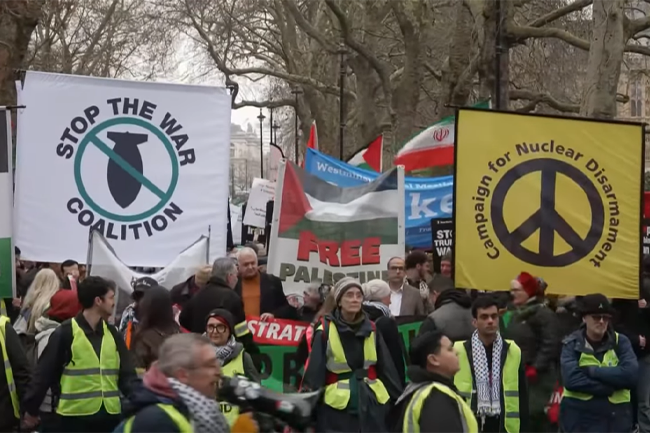
Anti-war protesters in the United Kingdom are beginning to make themselves heard, with multiple demonstrations taking place across the country last weekend demanding an end to the latest U.S. aggression in the Middle East.
And while the numbers aren’t yet on a scale to rival the Iraq War protests nearly a quarter of a century ago, the similarities between the two – and the groups organising them – are eerily familiar.
Independent Australia attended one such event in Manchester last Sunday to find out more about the people mounting a challenge to UK Prime Minister Keir Starmer’s tacit support of the U.S. aggression and what they are hoping to achieve.
A common purpose
As we walk into the centre of Manchester’s Piccadilly Gardens – the venue for today’s event – we are reminded that this is the place where the Suffragette movement was born.
A statue of local girl Emmeline Pankhurst – notorious for her motto “deeds not words” in the struggle for women’s suffrage – adorns nearby St Peter’s Square.

On International Women’s Day, it’s a subtle nod to the fact that this northern city is famous not just for its footballing clubs but also for its history of protest.
The lady we met – Steph Pike – is a local Mancunian with a similar passion and is one of the activists involved in the Stop the War Coalition that is participating in today’s event.
As she passionately explains, her group has come together with several others to make a stand against the recent events in Iran:
“Today’s protest is the Manchester launch of the Together Alliance, an alliance of trade unions and individuals who have come together to campaign against war and the [influence of the] far Right.”
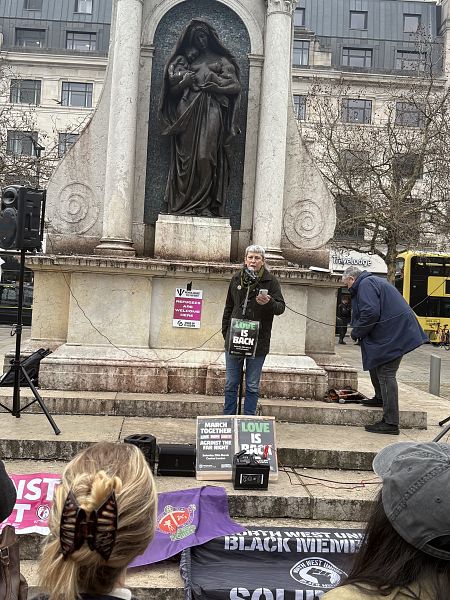
The mention of the far Right – which in UK terms means the increasingly popular Reform UK party and its nationalist counterparts – is a common theme among the speakers (of whom Steph is one), as one by one they make their feelings known.
It seems this event isn’t just anti-war, but also a reaction to growing anti-immigration policies of a party that has been leading opinion polls here for months. The two issues are inextricably linked in the eyes of most attendees we speak to.
Steph goes on to tell us that events such as these are being replicated across the country, with an estimated 5,000 people attending the London gathering on Saturday and cities such as Coventry and Liverpool also planning demonstrations in the coming days.
While the crowd is smaller here – around 200 people – the message amongst them is clear. This war is not in their name and they want to make that point as forcefully as they can.

Confrontation with history
Despite all the angst of the last two weeks since the U.S. Administration launched “Operation Epic Fury” on Iran for failing to negotiate an end to its nuclear program, the people organising this event have reacted quickly to the rapidly changing events.
As the rumblings of military action grew louder in the lead-up to the first American strike on Tehran, an initial Manchester Branch meeting of Stop the War Coalition was held on 26 February in Friends Meeting House, close to our current location.
Worryingly, this initial planning session was disrupted by far-right agitators who had learned of the group’s plans online.
While violence was fortunately avoided, Steph explains that the “threatening manner” these agitators acted in led to an ugly verbal confrontation.
The battle lines were being drawn not only in the Middle East but also in Manchester, although fortunately, there was no repeat at the event we attended.
Greater Manchester Police were present to ensure no issues resulted from the protest in one of Manchester’s busiest squares, informing us that no counter-protest had been either flagged or expected.
Such vehement opposition from your fellow countrymen is a far cry from when the Stop the War Coalition originated back in the early 2000’s.
“The Stop the War Coalition was formed in 2001 in the wake of George W Bush’s war on terror, when it helped organise mass protests against the UK’s involvement in the war on Iraq,” explains Steph proudly, recalling a time when millions marched in London to protest at then Prime Minister Tony Blair’s decision to join Bush’s “coalition of the willing”.
While they ultimately failed to change the Government’s mind on the issue, those protests are still the largest political demonstration in the UK, according to the London Museum.
And it certainly galvanised Steph’s group to continue campaigning for an end to war on multiple fronts.

Steph comments:
“We have continued to campaign against the UK’s involvement in imperialist wars, most recently the genocide in Gaza and the current war on Iran.”
Whether the campaign can reach the mass appeal of 2003 remains to be seen, but the mood in the nation is definitely one of shock and anger, based on the people we have spoken to on our visit to these shores.
What happens next?
As the Manchester protest winds to an end – including poetry readings and all – the organisers explain to us that Stop the War protests will continue in the coming weeks, or until the U.S. and Israel stop their bombing campaign on Iran.
They are quick to point to a big demonstration planned in London on 28 March as the next big event, informing us they already have seven sold-out coaches from Manchester that will be attending the “Together Alliance” event.
The “Together Alliance” is a group of trade unionists, community activists, environmentalists and even entertainers who are staging a march from Park Lane to Whitehall in the nation’s capital.
However, a quick look at their website indicates that, despite the celebrity attendees – UK comedian Lenny Henry and rock legend Paul Weller among them – the purpose is predominantly a protest against the rise of the far Right in the UK rather than a purely anti-war message.
It’s a theme that Steph reiterates, concluding that “the Stop the War Coalition will continue, along with other organisations, to organise protests against the ongoing genocide in Gaza and the war on Iran, as well as campaigning against the far Right”.
While it’s clear that many of these issues attract supporters from the same ilk, one wonders whether the mixed messaging may deter some people from getting involved.
Politics here, like in Australia, is a divisive issue.
The Brexit Referendum still looms large over this divided country and the anti-war mood we have encountered to date may be drowned out by party politics.
Whatever the outcome, it’s clear from our time in Manchester and elsewhere in the UK that the voice of protest against the current military campaign in Iran – and British involvement in it, however limited – is gaining traction.
Whether that has any impact on the governments prosecuting this action remains to be seen.
 This work is licensed under a Creative Commons Attribution-NonCommercial-NoDerivs 3.0 Australia License
Support independent journalism Subscribe to IA.