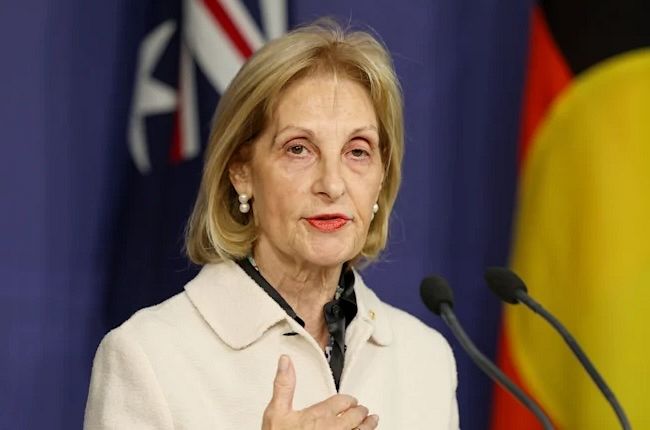
Critics say Jillian Segal’s role as antisemitism envoy could threaten open debate, silence dissent and stifle support for Palestine, writes Lyn Bender.
THERE IS MUCH that is appalling about the whole concept of a special envoy to combat antisemitism, especially as her report is announced at a time of revelations regarding racism against Indigenous people.
But even more outrageous than the position of envoy is the choice of Jillian Segal, who is a blatant lobbyist for Zionism. Segal’s “report” suggests that outrageous censorship and funding cuts could be applied to the ABC and SBS, universities, academics and creative artists for voicing support for Palestinians who are suffering a genocidal final solution.
Purporting to and, in fact, charged to speak for all Jewish people, she has dismissed opposing voices such as The Jewish Council Australia as an irrelevant fringe group.
But her major overriding assertion is that education regarding the Nazi Holocaust will end, or at least counter antisemitism in Australia.

But “Night”, metaphorically speaking, has already fallen in the Victorian school curriculum.
(A Google search reveals that it is also taught in British and U.S. schools.)
Night is an account by Holocaust survivor Elie Wiesel. It portrays the experience of 15-year-old Elie, rounded up by the Hungarian fascist Government almost on the brink of the defeat of Nazism in 1944.
The book is written in the narrative voice of the older man recording an insane trauma that occurred at a crucial developmental period. This is the age at which young people will be reading this account as part of year ten.
Wiesel’s story includes graphic descriptions of selection for death, or work and public camp executions, including that of a child. The child endures a long death as he is too small to weigh down the hangman’s rope. He died by slow strangulation.
Wiesel also describes truckloads of babies being thrown into fiery pits. He is confused as to whether they were still alive when burned. There are constant references to suicidal thoughts and being numb to witnessing atrocities. Nazi guards are indifferent to their prisoners’ suffering, beating and starving them until the final death march.
As a child of Holocaust survivors who fled, leaving family behind, I grew up amid holocaust survivors with intermittent and traumatising graphic references to atrocities.
I am wondering whether most teachers, no matter how dedicated, are equipped to manage the impact of this account on children who may already be troubled.
How will these children be protected?
In later additions to his account, Wiesel alludes to the famous declaration of “Never Again” being never again for anyone and all.

But this message may be lost within this account of endless suffering and crushing of hope.
Surviving from one selection to the next, where filial love is yet another casualty.
Elie remains staunchly beside his father until almost the end. His father whispers to him where he had hidden their jewellery, in the cellar of their village home. But at the last, when his father lies dying and calling to him, “Eleazer, Eleazer”, he dare not go to him from fear that he would suffer blows from the SS guards.
In the preface to the new translation, Elie is now able to voice his guilt and shame. His father’s last cries remain with him.
Elie Wiesel became a journalist and an academic. He believed in salvation through Israel. The new foreword by François Mauriac provides the emotional response that seems eerily absent from the original translation.
The Jews of Sighet were warned, but they adapted to a form of denial. As late as 1944, they went on with their lives, despite warnings to flee. They told themselves that all would be well. After all, what pain did wearing a yellow star bring? It was a small thing. As they were displaced into ghettos and homes of Jews already transported, they clung to their bundles of possessions and told themselves that they would eventually return to their homes. The Jews of Hungary were the last to be processed by the Nazi death machine.
It is deeply, inexpressibly sad and an outrage that this Holocaust pain has now been claimed politically, by Zionist Israel, to deny, hide and justify the atrocities that they are committing.
The genocide of Palestinians is the most well-known and at the same time, the most normalised, enabled and denied genocide of modern times. The protests of those who call for an end to the genocide are being suppressed. Those who call for an end to genocide are deemed more criminal than those who are committing this genocide.
Fostering this Zionist denial is the silent agenda of Jillian Segal, the envoy.

Segal is dishonouring the victims of the Holocaust by using it to eclipse sight of what is being perpetrated by Israel.
Holocaust Museums tell the story. The United States Holocaust Memorial Museum in New York is impressive. Yad Vashem in Israel as well. And yet in these places, history’s lesson and the oft-repeated phrase of “Never Again” seem to have a narrow interpretation.
Night was published by Wiesel when he was twice the age of the boy who had experienced the Holocaust.
Wiesel, in his later acceptance speech of the Nobel Peace Prize, declared never to be silent whenever and wherever human beings endure suffering and humiliation. That no human race is superior; no religious faith is inferior.
In 1999, Wiesel spoke of the perils of indifference to the suffering of all others, including starving children.
This is the deeper message of Night. Do not be indifferent.
Under Segal’s recommendations, would year ten classes be able to discuss the obvious parallel of genocide being perpetrated on Palestinians?
Would this be classified as antisemitic?
Would consideration of the genocide identified by UN Special Rapporteur on the occupied Palestinian territories, Francesca Albanese, be considered antisemitic, as Israel accuses?
Finally, why is this unelected person a voice to government?
A voice that our First People are denied.
Why is Segal’s blueprint for reporting on universities, the creative arts, the ABC and SBS being given credence?
Who the hell is this woman to offer her Trumpian prescription for suppression of free speech and expression?
The most obvious question, not identified by Segal, is:
How much are Israel’s war crimes fostering rage against Zionism and fermenting anti-Jewish sentiment?
Lyn Bender is a professional psychologist. You can follow Lyn on Twitter @Lynestel.
 This work is licensed under a Creative Commons Attribution-NonCommercial-NoDerivs 3.0 Australia License
Support independent journalism Subscribe to IA.