Pauline Hanson's latest overseas tour exposes the irony of a movement that rails against foreign influence while importing its politics almost wholesale, writes Wayne Hawkins.
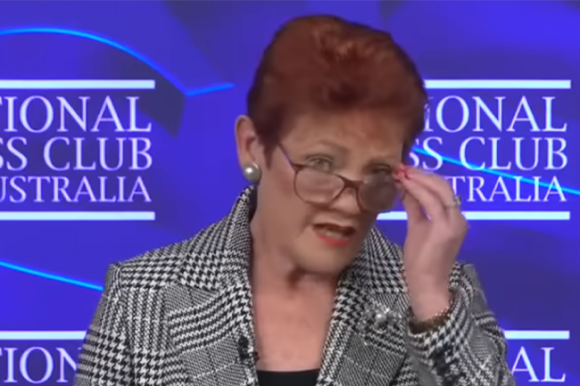
LAST WEEK, Senator Pauline Hanson took a trip.
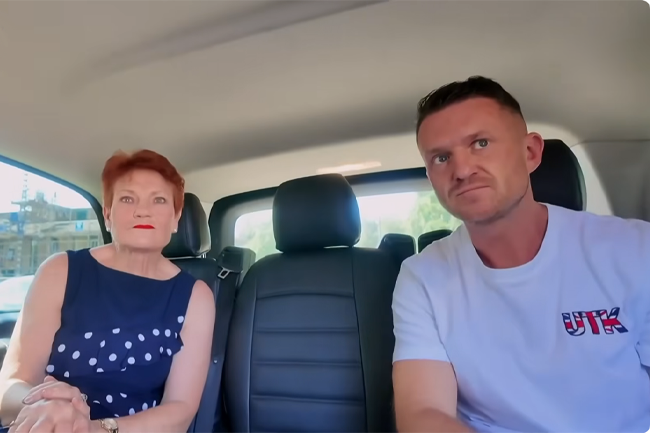
Hanson flew to London and recorded a podcast with Tommy Robinson, the British activist whose recent interview with Karl Stefanovic ended a 30-year career at Nine. She is booked to speak at CPAC Britain — the London franchise of the American Conservative Political Action Conference. She was due to meet Nigel Farage.
And the Senator shared a beer at Jeremy Clarkson's pub with Holly Valance, who was recently photographed with her arm around Robinson wearing a cap that read ‘Make England Great Again’ — a slogan cloned, word for word and stitch for stitch, from an American presidential campaign.
Robinson, for his part, declared Hanson “hopefully the next leader of her nation”.
Hanson also sat for a half-hour interview on the show of Liz Truss — Britain's shortest-serving Prime Minister, whose mini-budget was rejected by the bond market faster than by the voters and who happens to be the person who brought CPAC to Britain in the first place.
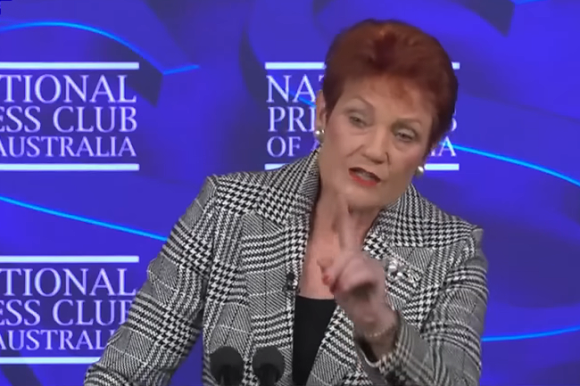
The supply chain, end-to-end: an American conference brand, imported by a failed British Prime Minister, now platforming an Australian Senator on a self-described “fact-finding mission” about protecting national culture from foreign influence.
Hanson explained the purpose of the pilgrimage herself: Britain, she wrote, is ‘where the Australia we know today was born’ and we must 'learn the lessons of other countries that are further down the path of multiculturalism'.
Let's take stock of that itinerary. An Australian Senator travels overseas to appear on a foreign activist's platform, address the local branch of an American conference brand, network with a foreign party leader and pose with an expat wearing a foreign campaign slogan — all to warn Australians about the dangers of foreign influence on our national culture.
The woman who wants a monoculture is a walking node in a transnational political import network.
The imports nobody notices
Here is a rule worth writing down: cultural imports are invisible when they come from people you consider your own.
Walk through any Australian suburb where One Nation polls well. American country music in the utes. UFC on the big screen at the pub. The shops run Black Friday sales — a ritual named for American Thanksgiving, a holiday we don't have. The telly plays American police dramas that have quietly taught two generations of Australians how they think crime works and after dark, Sky News runs a format lifted straight from Fox.
The political vocabulary – “woke”, “deep state”, “fake news”, “MAGA” – has been transplanted directly from American soil into Australian mouths, roots and all. There are Trump flags at Australian street rallies. The conference Hanson is speaking at isn't even pretending — CPAC is an American brand, franchised out like fried chicken.
None of it registers as foreign. Nobody at a One Nation rally has ever demanded that Black Friday assimilate.
Meanwhile, a Vietnamese grocery is “changing our way of life”. A kebab shop is a threat to social cohesion. The test was never whether the culture came from somewhere else. It was who it came from.
Not even a White nations policy
Here's where it gets more revealing. If the filter really were “culturally compatible White nations” – the polite version of the argument – the import queue would look very different.
Norway is White, Christian-heritage, prosperous and cohesive. Its great national idea is a sovereign wealth fund that has turned the country's resources into more than US$2 trillion (AU$2.9 trillion) — nearly $400,000 of collective savings for every citizen. Sweden's is parental leave. Denmark's is a labour model that gives workers real security.
These are the most successful social experiments run by the Whitest nations on Earth — and not one of them has ever made it through One Nation's customs. They get stamped “socialism” and turned back at the border.
Spain and Italy – European, Catholic, as culturally “Western” as it gets – offer a different lesson: what it costs a nation when democracy is captured and hollowed out. Both lived it within living memory. That import is even less welcome, for the obvious reason that it's a mirror.
Germany delivers the starkest case of all. It has two exports on offer. One is the hardest-won democratic lesson of the 20th Century: what ethnonationalism does to a country and the institutional vigilance Germans built in response — including a constitutional watchdog that in May 2025 formally classified the entire Alternative für Deutschland party as a right-wing extremist organisation.
The other export is that party itself. Guess which one clears customs? An AfD parliamentarian shared the stage at Tommy Robinson's Unite the Kingdom rally; researchers describe Robinson, the AfD's militant factions and the convoy movements as all borrowing tactics, memes and sometimes money from the same American original.
The network Hanson just joined by podcast imports from Germany the one thing that Germany's own democracy has flagged as a hazard — and refuses the lesson that came free with it.
So the filter is not race. It is not culture. It is not even language. The only imports that clear customs are those that serve the politics of blame: the grievance vocabulary, the fear-of-crime programming, the conference circuit, the podcast ecosystem, the endorsements and whoever funds it.
Failed assimilation
One Nation has a definition of failed integration. It goes roughly: loyalty to a foreign movement, values imported from elsewhere, refusal to adopt the norms of Australian public life.
On that last point, it's worth recording what Hanson told Truss on camera. Asked about progressive politicians in Australia, she offered: “How about we just round them all up and give them an island or somewhere?”
An elected Senator, proposing the deportation of elected representatives for the crime of disagreeing with her. Truss's reply – “Didn't we try that with Australia in the first place” – was meant as a joke, but it was the most historically literate thing said in the entire interview. The norms of Australian public life include, at a minimum, not transporting your political opponents. Even Britain gave that one up.
By that definition, the most conspicuous case of failed assimilation in Australian politics today is One Nation itself. Its leader tours Britain collecting endorsements from foreign activists. Its talking points arrive by American podcast. Its conference is a franchise. Its merchandise is a translation. The kebab shop owner in Claremont – who learned the language, built the business, coached the junior footy team – has adopted more Australian culture in a decade than the MEGA cap ever will.
None of this is the fault of the people at the rallies. They are not the exporters; they are the market. They have real losses – wages, housing, shopping districts hollowed out by the same franchise economics now hollowing out their politics – and they have been sold a foreign product with “locally made” printed on the box.
But the brand ambassador should at least declare what's in her suitcase.
The authentic voice of Australian sovereignty, as certified this month by a man from Luton with convictions for assault, mortgage fraud and travelling on a false passport — who has twice been denied a visa to enter the country she wants to run.
You couldn't import a better punchline.
Wayne Hawkins is an independent commentator based in Tasmania and an independent candidate for the federal seat of Clark.
 This work is licensed under a Creative Commons Attribution-NonCommercial-NoDerivs 3.0 Australia License
Support independent journalism Subscribe to IA.


Related Articles
- Media's fear of Pauline Hanson is her greatest weapon
- CARTOONS: 'Mono' is an avoidable virus
- Pauline Hanson's multiracial Australia shift puts supporters to the test
- The A to Z of who Pauline Hanson does and does not represent
- How Pauline Hanson turned grievance into political power