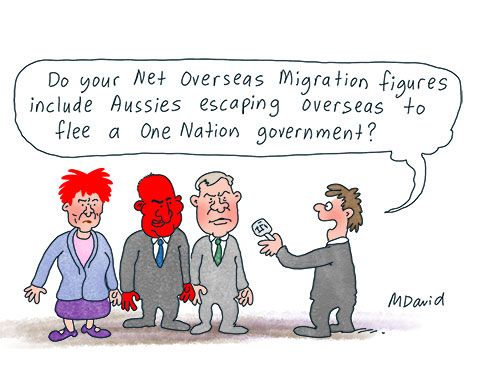
Pauline Hanson’s revised immigration maths may finally add up, but the economic consequences of her policy would be devastating, writes Dr Abul Rizvi.
ACCORDING TO The Noticer (a new far-right media outlet that tries to compete with Sky After Dark), Senator Pauline Hanson has revised the arithmetic on her immigration policy. She may now be comparing like with like, which is a huge positive in trying to understand her policy. But what would her new policy involve?
Her previous policy (still on the current website as at 6 March) was to:
‘Cut immigration by over 570,000 people from current Labor levels by capping visas at 130,000 per year to ease pressure on housing, wages, and infrastructure.’
It now seems the 570,000 is a reference to net migration arrivals in 2024-25. That was around 568,000 (less departures of around 263,000, giving a preliminary estimate of net migration of 306,000).

The previous reference to 130,000 visas was also not clear. If it referred to permanent visas, that would not get net migration down to the zero her Chief of Staff previously said he wanted. If it were all visas, it would effectively be the end of international people movement across Australia’s borders, as we issue around eight million visas per year.
But that no longer matters, as Hanson said to The Noticer that her new policy is that:
‘...immigrant arrivals would be capped at 130,000 per year under One Nation, resulting in net overseas migration of -100,000.’
Presumably, “immigrant arrivals” refers to net migration arrivals. That would mean One Nation is at last talking arithmetic sense, even if it has no idea how net migration arrivals could be capped at 130,000.
Capping net migration arrivals is not the same as capping visas. A visa is an authority to enter Australia for a specified period. There are powers in the Migration Act that enable the Government to cap most visa categories (but not by nationality, as One Nation wants to do).
There are no Migration Act powers to cap net migration arrivals. The blocking of just about all international movements during COVID was enabled by emergency public health powers held by the Minister for Health. In Australia, these cannot be triggered on a Trumpist or Hansonite whim.
Net migration arrivals are people (irrespective of visa category or citizenship, thus including Australian citizens) who have been out of Australia for more than 12 months out of 16 who arrive and then remain for at least 12 months out of 16. At the time a person arrives, the Australian Bureau of Statistics (ABS) (and thus Department of Human Affairs) can only estimate whether they will become a net overseas migration arrival. There is no way to know with certainty how long a person will remain in Australia.
Even if legislation were enacted to cap net migration arrivals, it would be impossible to implement because, at the time of arrival, we cannot determine whether a person is a net migration arrival or a non-net migration arrival. If we tried to do this at airports, the situation would become even more chaotic than it is now.

But let’s assume a method can be found to limit net migration arrivals to broadly around 130,000 per annum (most likely through drastic changes to visa design and capping). Which categories of net migration arrivals would Hanson target?
Net migration arrivals in 2024-25 were as follows:
- Students: 156,660.
- Temporary skilled: 45,780.
- Visitor: 56,080.
- Working holiday: 78,340.
- Other temporary: 26,170.
- Permanent family: 24,390.
- Permanent skill: 40,410.
- Special eligibility and humanitarian: 14,870.
- Other permanent: 8,540.
- NZ citizens: 53,020.
- Australian citizens: 64,060.
- Total: 568,400.
Presumably, a Hanson government would not place limits on the return of Australian citizens (that would be illegal despite the carry-on about ISIS brides) or on arrivals of New Zealand citizens (a difficult negotiation with NZ) or the return of existing permanent residents (legally very difficult).
In addition, current law prohibits the Government from limiting visas for the partners and dependent children of Australian citizens and permanent residents. Once these groups are accounted for, net migration arrivals would already be well over Hanson’s 130,000 based on 2024-25 data.
Visas for the rest would have to be abolished or severely curtailed.

It would mean the end of Australia’s international education industry, with 10,000s of university and private college staff being laid off. That would not just be in metropolitan Australia but would also impact universities in regional Australia.
Universities would no longer be able to cross-subsidise domestic students or their research activities from tuition fees paid by overseas students. The many small and large businesses around universities that rely on overseas students would face bankruptcy.
The tourism and agriculture industries would largely lose access to working holidaymaker visa holders. These industries rely heavily on this labour as not enough Australians want to do this work. Many businesses in these sectors would have to close or downsize, leading to more Australians being laid off.
Australian employers would not be able to access skilled workers from overseas. That would include the very large numbers of health and aged care staff who are recruited from overseas, including by health and aged care operators in regional Australia. Hospital and aged care waiting lists would further blow out, particularly in regional Australia, due to staff shortages.
In fact, regional Australia may be hardest hit by Hanson’s drive to negative 100,000 net migration.
None of that may bother Hanson. But Australians should note that we have never before experienced net migration of negative 100,000. Not even during the height of COVID did net migration fall that far. It didn’t fall anywhere near that far during the Great Depression, although the lowest levels of net migration have always been during recessions with very high levels of unemployment.
A recession may be the only option a Hanson government has to get net migration down to negative 100,000. Both Canada and NZ were able to get net migration close to zero, partly through a very sharp increase in unemployment driving up departures.
Would a Hanson government try to engineer a recession and higher unemployment to get to its net migration target? She may get a recession even without trying!
Dr Abul Rizvi is an Independent Australia columnist and a former Deputy Secretary of the Department of Immigration. You can follow Abul on Twitter @RizviAbul or Bluesky @abulrizvi.bsky.social.
 This work is licensed under a Creative Commons Attribution-NonCommercial-NoDerivs 3.0 Australia License
Support independent journalism Subscribe to IA.


Related Articles
- EDITORIAL: Meta and Murdoch deceive public pushing Pauline Hanson
- Pauline Hanson anti-Islam backlash amid tidal wave of AI misinformation
- EDITORIAL: One Nation's popularity surges amid tidal wave of disinformation
- How Pauline Hanson turned Gen X disillusionment into political fuel
- The regional visa dilemma facing Pauline Hanson