Nepal’s youth surge into politics after the “Gen Z” protests, raising hopes for reform but questions about how much change can truly follow, writes Douglas Connor.
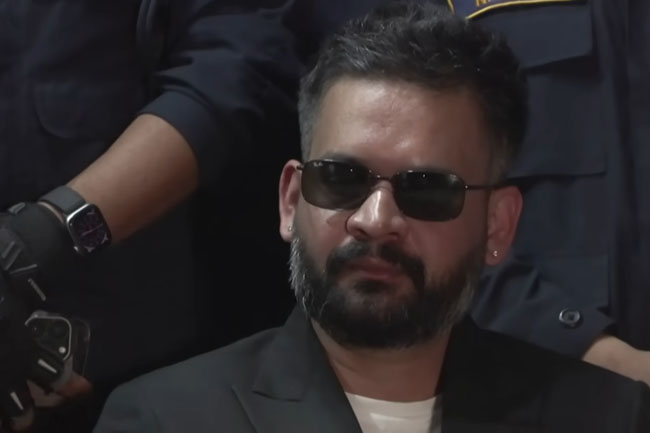
A 35-YEAR-OLD rapper will lead Nepal into a distinctly youth-focused future, six months after the nation’s deadly “Gen Z” riots.
The former mayor of Kathmandu, Balendra “Balen” Shah has secured a landslide victory for his four-year-old Rastriya Swatantra Party (RSP) in the election held on 5 March.
According to results issued by the Nepalese Election Commission, the youth-inspired RSP has claimed almost two-thirds of House of Representative seats, with Balen beating former prime minister Khadga Prasad Sharma Oli – who was ousted after September’s riots – in his own constituency.
Voters who headed to the polls across Nepal last week were faced with a very different political proposition than in recent elections.
Aside from ousting Prime Minister KP Sharma Oli, last year’s youth-led anti-corruption protests completely reshaped Nepalese politics, with young people placed firmly in focus in terms of campaigning and agenda.
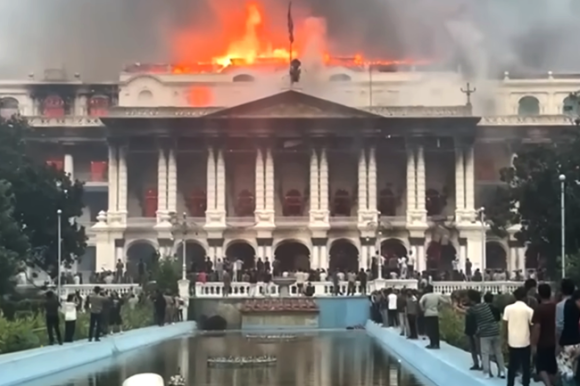
Young people like Amit Lama, 26, a bartender in Kathmandu’s backpacker district, Thamel, were buoyed by the presence of youth on the ballot this time around.
Ahead of the election, Amit’s message to prospective leaders was simple: no more corruption:
This election is most important for change and for the development of our country.
This time is for youth and I'm damn sure this time a younger candidate will win.
Because this time power and support is with younger candidates.
‘The whole political climate is in their favour’
Dr Pramod Jaiswal heads up the Nepal Institute for International Cooperation and Engagement (NIICE), a Kathmandu-based think tank focused on issues of security and foreign policy.
Jaiswal says the Nepalese political landscape has undergone a seismic shift in recent months:
“The politics that used to be in the hands of those 70 and 80 years old are now in the hands of those below 50. The whole political climate is in their favour.”
Far beyond a simple change of leadership, Dr Jaiswal says young people are now dictating Nepal’s political agenda, with a focus on economic development and international cooperation:
Traditionally, political parties used to look at Nepal from a very Cold War era type of geopolitical perspective. They would say that India or China are expansionists that can conquer Nepalese territory.
But the new generation has seen that no, all these nations can be partners. They think we should engage with India and benefit from India. We should engage with China. We should engage with the West and the U.S..
Dr Jaiswal said witnessing the meteoric rise of their nearest neighbours had compounded the frustrations of Nepal’s youth in recent years:
The youth were asking why is there the rise of China, the rise of India, but no rise of Nepal? They are now regional and global powers. Why are we not even moving towards that?
What is lacking in the country? Is it resources?
Young people realise that it is because of corruption. We have everything here to create Nepal into a prosperous country, but corruption remains a major issue.
Wiping out institutional corruption was a key campaign promise for some major parties, with significant pressure for the new leadership to strengthen the nation’s Commission for Investigation of Abuse of Authority (CIAA).
One key change since September’s protests, according to Dr Jaiswal, is improved political literacy and a willingness to ask tough questions of the leading class:
These Gen Z youths grew up at a time when Nepal was under armed Maoist revolution, followed by political instability.
Gen Z used to think that politics was not something they should look at. They viewed it as corrupt, something that is polluted, dirty and you shouldn’t touch it.
Now, youth are out on the street. They are campaigning. After the Gen Z movement, almost one million people got registered as first-time voters.
They are active youth who will be mobilising other people. I see them as youth activists who will very actively be participating in the election process.
Dr Jaiswal characterises the shift as a “political awakening”.
For the first time in Nepal’s election history, people are really asking questions. What is your agenda? How will you bring change for us?
For the first time, people are fearless to ask questions.

Watching a nation swept up by hope for political change, Dr Jaiswal is more reserved in his predictions:
Obviously, the desire is there. People are ready to support the younger candidates. How much they will deliver is yet to be seen.
People expect institutional reform. I am not very hopeful that they can make marked changes overnight, because they will be operating within the same system.
There will be obstacles. The new forces may have a lack of experience. It will depend on how long the parties can sustain themselves, how effectively they can get across their agenda, how effectively they can manage opposition.
How will these young people and new parties be able to deal with China, India and the U.S.? These are major geopolitical powers and it could prove very challenging if they are not able to balance that.
Life after the riots
Six months after taking seven bullets in the “Gen Z” riots, Mohan Shrestha is living with the repercussions of the protests, which claimed more than 50 lives.
Speaking ahead of the election, Mohan said that despite the emergence of youth-led policy, he holds little hope of meaningful, long-term political change.
Mohan, 31, a bike mechanic from bustling Kathmandu, says he went to September’s protests with the aim of doing something positive for his people.
Mohan has long been frustrated by a lack of opportunities for youth, systemic inequality, and institutional corruption:
“I wanted to do something for my country. I wanted more from the Government.”
Attending a protest at Parliament House, Mohan says he thought the demonstrations – and the response – would be peaceful:
“Suddenly, [the police] started firing. I didn’t expect there to be shooting.”
Mohan was shot seven times, five in the stomach. Months of recovery have followed, leaving him unable to work.
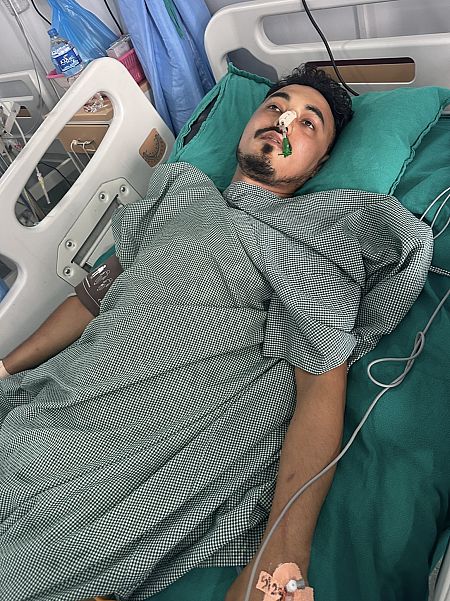
With a family to support, including his wife Asmita and an almost-one-year-old, Mohan says he now deeply regrets his attendance at the protest:
I went to protest for my country, to make change, but now I realise it was a mistake.
Now life has got worse. After getting shot I cannot work, I cannot move easily, daily life is very difficult.
It is still painful. I need to go to work because I have a baby, to feed him.
Douglas Connor is a journalist and editor based on the mid-North Coast of New South Wales.
 This work is licensed under a Creative Commons Attribution-NonCommercial-NoDerivs 3.0 Australia License
Support independent journalism Subscribe to IA.