One Nation’s proposed immigration cuts could cost taxpayers billions, devastate universities and fail to deliver the Party’s ambitious migration targets. Dr Abul Rizvi writes.
ONE NATION’S immigration policy has both negative and positive budget impacts.
However, because key details are lacking in the policy, costing it requires making some important assumptions, including the size and composition of the permanent Migration Program. One Nation’s immigration policy doesn’t mention the permanent program but still pretends to have a negative Net Overseas Migration (NOM) target for three years.
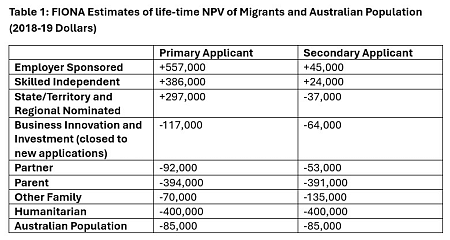
Treasury’s Fiscal Impact of New Australians (F.I.O.N.A.) model estimates the lifetime net present value (NPV) impact of each type of permanent migrant. It takes into account all relevant Commonwealth and State revenues and expenses, including infrastructure requirements. The results are summarised in Table 1 for permanent migrants in different visa categories, with a comparison with the general Australian population.
The life-time impact of the general Australian population is marginally negative due to governments running ongoing deficits and the fact that the general Australian population takes into account the whole life-cycle from birth. Whereas new migrants generally arrive when they are young adults, which means Australian governments do not incur the costs associated with childhood, school and post-school education.
Permanent Migration Program
For the purpose of costing, I have assumed One Nation will set its annual Migration Program at 130,000 per annum (a favourite number of the Party, although it would mean One Nation’s Net Overseas Migration target of below zero for three years could not possibly be met).
I have also assumed a permanent Family Stream comprised of 41,500 partner visas and 3,500 child visas (the current planning levels). Note there is no power in the Migration Act to limit visas for the partners and dependent children of Australian citizens and permanent residents. One Nation has not indicated if it would seek such a power.
I have assumed One Nation would provide for zero parent and other family visa grants.
The current Migration Program includes 7,060 parent visas and 400 other family visas. Cutting out places for these visas would represent a substantial long-term budget saving (around $2.76 billion in lifetime savings per annual cohort), although in the short term, parents make a significant budget contribution through the visa application fees they pay.
Contributory parent visa holders each pay around $50,000 upfront. They have no access to social support for four years and no access to the Age Pension for ten years. They must pay taxes on any income earned.
Given the size of the parent application backlog (well over 100,000), abolishing this visa would require retrospective action to take away the legal rights of these visa applicants and possibly refund visa application fees paid. In the short term, parents also provide childcare to support their adult children to participate in the labour market. I have not costed the impact of that on government budgets.
There would be a substantial short-term cost from cutting parent visas offset by a much bigger long-term benefit, mainly in terms of reduced use of health and aged care services towards the end of life.
I have assumed a Skill Stream of around 84,500 under One Nation (and a small Special Eligibility category). That would be a reduction of around 48,000. The simplest skill stream visa to cut would be the Skilled Independent. I have assumed One Nation would reduce this from 21,090 to zero, with 75% primary visa grants at a lifetime cost of $6.225 billion per annual cohort.
I have also assumed One Nation would be reluctant to cut the State/Territory and Regional Nominated Visas, as it has shown a desire not to restrict the ability of regional employers to access overseas workers. That means the remainder of the 48,000 cut would come from the Employer Sponsored visa (26,910 with around 50% primary). That would represent a lifetime cost of $8.1 billion per annual cohort.
Humanitarian Program
I have assumed One Nation’s policy is to abolish the Humanitarian Program (other than for successful onshore asylum seekers unless/until it can withdraw Australia from the Refugee Convention, as it has proposed).
A 16,000 reduction in the Humanitarian Program would represent a lifetime saving of around $6.4 billion per annual cohort.
The Labor Government has also introduced a Pacific Engagement Visa with an annual allocation of 3,270. This is a permanent residence visa which, for no logical reason, is not counted in either the Migration Program or the Humanitarian Program. This visa has very similar characteristics to a Humanitarian Visa. If it were cut by One Nation, there would be a further saving of $1.3 billion in lifetime costs per annual cohort.
Temporary Visas
The estimated average fiscal impact of temporary visa holders in F.I.O.N.A. is not based on a lifetime but the average period of stay on each visa type (both primary and secondary) and in 2018-19 dollars.
Table 2 is the summary provided by Treasury for the four main types of temporary entrants, not including NZ citizens. Note the four main types of temporary entrants are generally not eligible for government services such as public health services (they must hold private health insurance) or education (they must pay education fees) but must pay income and other taxes.
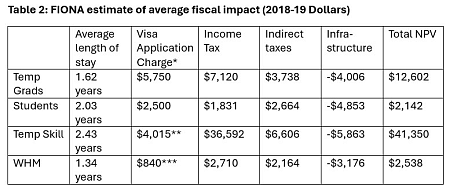
One Nation proposes to reduce temporary graduate visas by around 124,000 per annum with an annual cap of 20,000 visas. That would represent a net budget loss of $1.56 billion per annum.
Given the long-term size of the Student Visa cohort assumed by One Nation (350,000) with an annual cap of 115,000 new student visas each year, capping temporary graduates at 20,000 per annum would lead to a massive backlog of temporary graduate applications in the bridging visa backlog (inconsistent with its aim to reduce the number of temporary entrants in Australia by over 750,000).
One Nation would need to either:
- significantly further reduce the number of annual student visa applications; or
- better target which students are eligible for a temporary graduate visa. But the pressure to expand the skill areas that would be eligible for a temporary graduate visa would be much larger than 20,000 (as the Coalition is finding out with its plan to both abolish the temporary graduate visa while also using “transitional” arrangements for certain skills and regions where students have studied).
But let’s assume One Nation will stick to its proposed 222,000 reduction in student visas granted each year. That would represent a budget loss of $477 million per annum. However, that does not include the loss in tuition fees paid to education providers. In 2024-25, overseas students paid over $23.5 billion in tuition fees as part of export income of $53.57 billion. The industry directly employs around 50,000 Australians and many more indirectly.
There would be a very significant impact on public university budgets, forcing either an increase in fees for domestic students or taxpayer supplementation. There would also be a significant impact on university research budgets.
One Nation proposes that only primary applicants for temporary skilled visas would be eligible and that they would all leave their partners and dependent children behind. That is patently nonsense. MP Barnaby Joyce admitted as much when asked if the overseas doctors employed by Armidale Hospital would have come to Australia if they could not bring their spouse/dependent children.
I have assumed One Nation will change its policy and allow temporary skilled migrants to bring their spouses/dependent children. If it still wants to reduce the number of temporary skilled visas granted to 70,000 per annum (including dependents), the cost to the budget would be around $2.89 billion per annum.
One Nation proposes to maintain the Working Holiday Maker program at current levels compared with Labor policy to cut these by 38,000 per annum. That would mean a budget benefit from the One Nation policy of $96 million per annum.
Mass deportation
One Nation also proposes a mass deportation program to reduce the stock of overstayers by 80,000 over three years. While there is considerable merit in increasing immigration compliance funding to reduce the stock of overstayers and the steadily growing number of unsuccessful asylum seekers who have not departed, the cost of a mass deportation program similar to that adopted by the Trump Administration would rapidly run into the many billions of dollars but achieve only a modest further increase in removals.
As with the Trump Administration, One Nation would quickly learn that a large portion of undocumented workers in Australia work on farms, particularly during the harvest season. As with the Trump Administration, One Nation would back off undertaking compliance raids on farms.
There would also be significant costs associated with faster processing of onshore applicants on bridging visas, particularly asylum applicants.
Summary
The overall budget impact of One Nation’s permanent migration (which I have assumed, as One Nation hasn’t announced a permanent migration policy) would be a cost to government budgets of $3.859 billion in lifetime NPV per annual cohort.
The overall budget impact of One Nation’s policy on temporary entrants would be a net cost to government budgets of $4.831 billion per annum. This does not include the billions of dollars that its mass deportation program would cost. It also does not include any costs associated with taxpayer-funded bailouts of Australian universities to try and limit massive job losses and increases in tuition fees for domestic students. Students and temporary graduates are a crucial feeder group for the high-budget benefit Employer-Sponsored Temporary and Permanent visas.
Note the policy actions announced by One Nation would not deliver the negative NOM of 250,000 per annum suggested by Barnaby Joyce. They would not even deliver a very modest level of negative NOM over the first three years without a very, very weak labour market. There has been no three-year period in Australian history where NOM has been negative for three years in a row, not even during/after the Great Depression or during/after the 1991 recession when the unemployment rate peaked at over 11%.
One Nation’s negative NOM target for three years would be unprecedented amongst developed nations as well as for Australia. That target, including One Nation’s mass deportation program, is far more about political propaganda for its core supporters than policy.
Dr Abul Rizvi is an Independent Australia columnist and former Deputy Secretary of the Department of Immigration. You can follow Abul on Twitter @RizviAbul or Bluesky @abulrizvi.bsky.social.
 This work is licensed under a Creative Commons Attribution-NonCommercial-NoDerivs 3.0 Australia License
Support independent journalism Subscribe to IA.


Related Articles
- One Nation’s James Ashby and the Liberals: Why orange is the new blue
- Want to know more about One Nation? Follow the money and 'sexy' planes
- EDITORIAL: Want to know more about One Nation? Follow the money and 'sexy' planes
- One Nation’s migration maths doesn’t add up
- Labor risks learning the wrong lesson from One Nation's Secret Harbour win