A tight by-election race in Farrer is set to spotlight One Nation’s call for negative net migration against the labour realities of regional Australia. Dr Abul Rizvi reports.
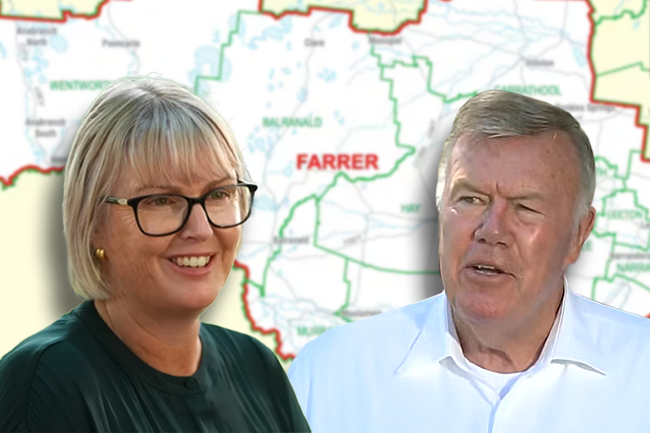
WITH THE One Nation candidate for the Farrer by-election, David Farley, apparently leading in the polls with 28.7% of the vote, immigration will inevitably be a key focus of debate leading up to the by-election, along with water policy.
But how will Farley explain One Nation’s immigration policies of negative 100,000 net migration to a huge electorate facing labour shortages?
Farley’s key opponent will be Independent candidate Michelle Milthorpe, who is currently polling around 23.3% and gave former member Sussan Ley a fright at the last election. Milthorpe is a moderate who supports an inquiry into water policy, as does Farley. At the last election, she won every booth in the city of Albury (around 30% of the electorate) but did poorly in the outer areas, which are dominated by a range of farming enterprises.
These would also be areas more likely to support One Nation, even though many of them have an ageing and shrinking population.
The Nationals and Liberals are also likely to run candidates, polling 5.2% and 19% respectively. The ALP is polling 9% but may not run a candidate.
The Riverina region which includes the local government areas of Bland Shire Council, Carrathool Shire Council, Coolamon Shire Council, Cootamundra-Gundagai Regional Council, Griffith City Council, Hay Shire Council, Junee Shire Council, Leeton Shire Council, Lockhart Shire Council, Murrumbidgee Council, Narrandera Shire Council, Snowy Valleys Council, Temora Shire Council and Wagga Wagga City Council is covered by Designated Area Migration Agreement (DAMA).
DAMAs are negotiated by regional and remote areas because they consider their specific labour needs are not adequately met by standard migration rules in terms of salaries, English language ability or occupations. The Orana DAMA, which covers the Riverina region, was negotiated in 2019 and has been extended for another year into 2026.
According to the Orana website, the DAMA is designed to provide:
‘...businesses in the region with an avenue to address current workforce shortages and to support future workforce planning.’
According to the Riverina RDA, which manages the Orana DAMA, its role is to:
‘...assess Riverina businesses for endorsement under the Orana DAMA.’
The key is to ensure these are Riverina businesses of good standing with a genuine labour shortage that cannot be filled from within the region.
The current Orana DAMA covers 129 occupations. Not surprisingly, the occupations covered are dominated by the agriculture, health/aged care, manufacturing, teaching, meat processing and construction trades.

On her website, Milthorpe says:
A smarter system would slow the concentration of new arrivals in metropolitan areas while creating clear, supported pathways for people who want to build their lives in regional communities. Migration should not be a one-size-fits-all policy designed in Canberra.
Align skilled worker visas with real local demand rather than outdated national lists.
Milthorpe says she is opposed to a state-wide DAMA. This may reflect the NSW Government’s decision to centralise processing of nominations under all NSW DAMAs in Sydney.
What specific problems Milthorpe has with the concessions in the current Orana DAMA, or the occupations listed in that DAMA, are not clear. I suspect she may be looking for more regional concessions as well as the removal of the NSW Government from vetting nominations approved by the Riverina RDA. Regional area visa concessions have existed since 1995.
Millthorpe also says she wants to:
‘Establish Multicultural Centres in key locations like Griffith and Leeton and create structured welcome programs [and] crack down on unethical labour-hire firms that exploit migrant labour and increase oversight of accommodation and work conditions.’
Millthorpe wants to:
‘Fast-track employer-sponsored regional visas to meet workforce demand; reduce red-tape for businesses sponsoring workers and provide clear, achievable pathways to permanent residency for migrants who commit to living and working in regional Australia.’

While more specifics would be useful, it is clear Millthorpe is supportive of higher migration to her region.
David Farley’s personal views on immigration to regional Australia are not known, but presumably, he will have to support One Nation’s immigration policies. Farley has an agri-business background and will therefore understand the workforce challenges farmers across the electorate face, but may have to keep those views to himself (generally a challenge for One Nation candidates).
One Nation’s most recent position on immigration is for net migration of negative 100,000 per annum. Australia has never got anywhere near net migration of negative 100,000 per annum, not even during the first year of COVID or during the Great Depression did net migration fall that far.
To deliver an ongoing net migration of negative 100,000 per annum outside a major and ongoing labour market downturn would require a One Nation government to abolish all skilled visas, including regional visas, as well as the working holiday maker program that regional Australia relies on extensively. It would also have to abolish the overseas student visa program, including for Charles Sturt University, which has campuses in the electorate.
It would also have to abolish the Pacific Australia Labour Mobility visa that farmers in the electorate rely on, as well as the mass deportation of the large number of undocumented migrants who work on farms in the electorate.
But that is the arithmetic reality that David Farley would have to support. Farley may focus his criticism on Milthorpe’s proposal to establish more multicultural centres in the electorate in the hope that businesses and farmers in the region don’t notice the impact of One Nation policies on their businesses and farms.
That would be his best hope when debating Milthorpe on immigration policy.
Dr Abul Rizvi is an Independent Australia columnist and a former Deputy Secretary of the Department of Immigration. You can follow Abul on Twitter @RizviAbul or Bluesky @abulrizvi.bsky.social.
 This work is licensed under a Creative Commons Attribution-NonCommercial-NoDerivs 3.0 Australia License
Support independent journalism Subscribe to IA.