
Angus Taylor’s proposal to mandate English for permanent visa holders raises serious questions about fairness, practicality and its underlying political intent. Dr Abul Rizvi reports.
OPPOSITION LEADER Angus Taylor says he would make learning English “an obligation for permanent visa holders, not an option”.
As with most of his policy announcements, Taylor gives no details on how this policy would work, the extent to which this is a problem or whether he has actually read any of the extensive research in this area. So how might his policy work?
Presumably, he is not proposing that the English language be a prerequisite for granting visas in the humanitarian and family migration streams. Very few people living in refugee camps around the world have strong English. Australians don’t marry people based on the strength of their English.
We also do not know what consequences Taylor intends if permanent residents don’t adequately progress in their learning of English. Is he suggesting their visas should be cancelled and they should be deported? What level of English language progression is he proposing for such an action?
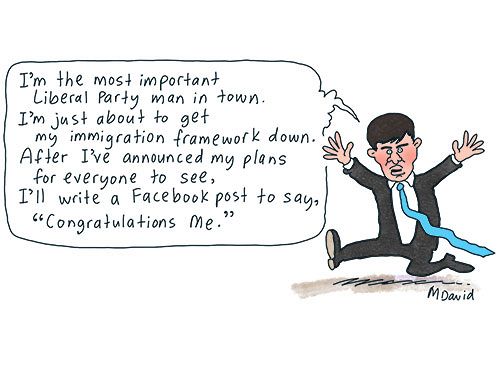
What if the partner of an Australian citizen does not make sufficient progress in learning English? Would they be deported? Would Taylor try to deport humanitarian entrants who do not make sufficient progress in learning English back to refugee camps? What of the spouses of skill stream entrants who do not make sufficient progress with English? Are they to be deported?
Perhaps he thinks we should go back to the 1950s and 1960s, when we used the strap for students who did not make adequate progress in learning their studies?
There is no question that it is vitally important for people to have at least basic English to live in Australia. Very few would disagree with that. That is why applicants for citizenship are required to sit a test that is conducted in English. If Taylor thinks that is inadequate, he could require citizenship applicants to sit a formal English test.
But deporting permanent residents who don’t make adequate progress with English sounds like pure Hansonism. Perhaps that is the objective?
Because of the importance of learning English, Australia has operated the Adult Migrant English Program (AMEP) since the start of post-war migration. The first AMEP classes took place in 1948.
AMEP has been frequently modified based on regular evaluations. In 2017, major changes to the program were made to the AMEP at a time when Taylor was a senior minister.
We do not know if Taylor agreed with the changes but they included:
- offering additional hours of English tuition to eligible students;
- introducing a new reporting system, the Australian Core Skills Framework (ACSF) to monitor student progress;
- establishing two new AMEP service streams: Social English and Pre-Employment English;
- improving targeting of existing subprograms, such as through uncapping access to the Special Preparatory Program (SPP);
- allowing service providers to choose curricula suited to their needs;
- simplifying accountability processes by reducing the number of KPIs for service providers;
- trialling of a multi-provider model in the Sydney South-West contract region, where two providers were contracted to deliver the AMEP;
- improving the efficiency and accountability of funding through changes in the funding model, including for child care; and
- increased alignment between the AMEP and Skills for Education and Employment (S.E.E.) program. S.E.E. provides English language training for Australians more generally. A material portion of Australians have inadequate English language skills.
The 2017 changes were evaluated in 2019.

This included recommendations for:
- the Special Preparatory Program remaining uncapped and available to all AMEP humanitarian entrants;
- AMEP Extend funding to be increased to better meet demand;
- stakeholders should consider ways to more systematically recruit and retain volunteers as part of the Volunteer Tutor Scheme;
- the Department of Home Affairs should consider introducing multiple Distance Learning (DL) providers to the AMEP; and
- a review of childcare provision within the AMEP.
The 2019 Review recommended a focus on four Key Performance Indicators:
- KPI 1 (Participation): 90% of eligible clients who complete an initial AMEP assessment or are referred to AMEP Distance Learning actually commence in the program within six months.
- KPI 2 (Attainment): 80% of clients in Pre Employment and Social English Streams attain one ACSF indicator per 200 hours of tuition.
- KPI 3 (Timeliness): 95% of data is recorded and reported within the required timeframes.
- KPI 4 (Accurate Assessment): 80% of client assessment outcomes are accurate against the ACSF.
A further evaluation of the AMEP was conducted in 2024. This used longitudinal research analysing the effectiveness of the AMEP by linking participant information for over 400,000 AMEP clients with administrative data from social services, taxation and the national census, from 2003–2019. This is the first time AMEP participant data was linked with other data sets.
This evaluation found that:
‘AMEP participation was associated with improved English proficiency of clients, especially when clients studied for longer periods. Migrants with higher levels of English on-entry had better labour market outcomes, higher income levels (male and female), lower rates of public housing tenancy, and were less likely to receive income support in the years following program exit.’
If Taylor were actually concerned about the English language levels of permanent residents, he would use this evaluation to identify further ways to increase AMEP participation. But sensible policy such as that is unlikely to meet his political aim of combating Pauline Hanson.
Dr Abul Rizvi is an Independent Australia columnist and a former Deputy Secretary of the Department of Immigration. You can follow Abul on Twitter @RizviAbul.
 This work is licensed under a Creative Commons Attribution-NonCommercial-NoDerivs 3.0 Australia License
Support independent journalism Subscribe to IA.


Related Articles
- Australian Values compliance for One Nation voters? Well done Angus!
- CARTOONS: Angus Taylor is seriously talking turkey
- Taylor and Hume's 'Tarzan and Jane' 1950s revival
- Angus Taylor disowns Coalition policies behind 2022–23 migration surge
- Angus Taylor’s One Nationfication of the Liberal Party is Australia’s MAGA moment