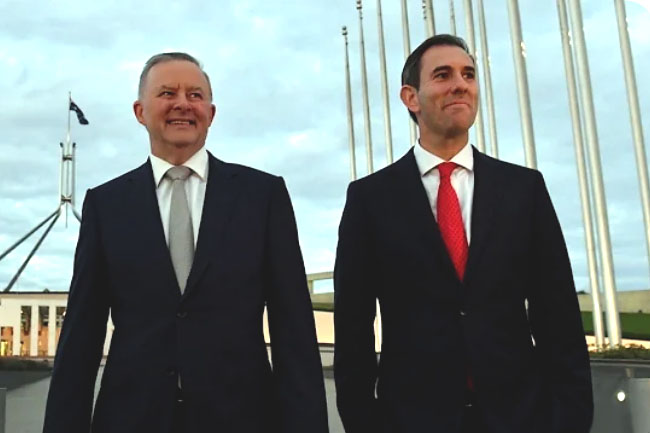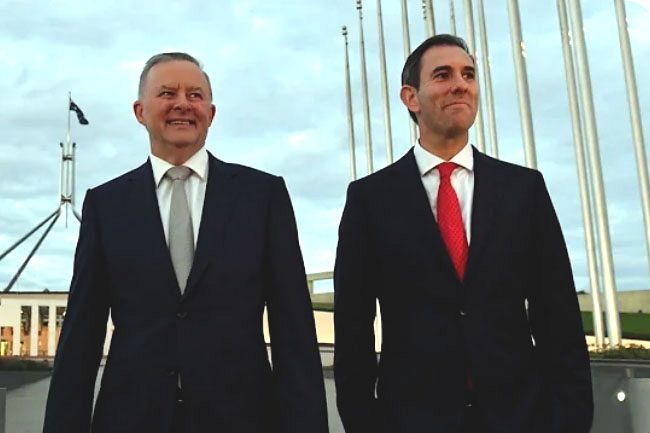
Treasurer Jim Chalmers could turn Labor’s political fortunes around with spending cuts that deliver budget surpluses, lower inflation and interest rate relief ahead of the 2028 Election. Stephen Koukoulas writes.
Economic tough love now, political gold in future
If, over the next few weeks, Treasurer Jim Chalmers can convince Prime Minister Anthony Albanese to change and show a bit of spine on economic policy, Labor can go to the 2028 election campaign with the political gold dust of budget surpluses, lower inflation and interest rate cuts to present to the electorate.
With the Mid-Year Economic and Fiscal Outlook (MYEFO) about six weeks away, there is time for the Government to bring together policy changes to transform the economic and political landscape.
Why budget policy change would help the economy
There is no doubt that a significant revamp of the budget settings will help to create a perception that the Government is playing a critical role in the strategy to get inflation back to target. A series of spending cuts would help to cap the level of interest rates and, it is increasingly likely, could be a critical part in getting lower interest rates in 2027 and early 2028, just in time for the next election.
If ever there was a time for the Government to successfully prosecute a budget tightening, it is now.
- Inflation is too high and is likely to stay high for some time.
- Interest rates are high, which is political poison — doing nothing on the budget will let this issue fester.
- A budget tightening would get the budget very close to a surplus, which at the current time is economically responsible and, for the Government, political gold.
Spending cuts are likely to be accepted by the electorate in these troubled economic times. Consumer sentiment, like support for the Labor Party, is floundering near 50-year lows. Consumers are under financial pressure as they deal with high interest rates, falling house prices and weak real wages.
If they can see the Government taking the “tough decisions” to help fix these problems, the electorate will be more likely to be positive about this rather than negative about the cuts that should be delivered.
Context of a budget tightening
Based on the latest available budget data from May 2026, the Government was pitching for a deficit of $31.5 billion in 2026-27 and a deficit of $31.0 billion in 2027-28.
It appears that prior policy decisions and favourable economic times, at least for the budget, are kicking in, resulting in a marked narrowing of the deficit for 2026-27. For the first three months of the financial year, stronger-than-forecast tax receipts and lower-than-forecast outlays have delivered a $10.6 billion narrowing in the deficit. That’s an average of $3.5 billion a month.
While it may not be prudent to extrapolate this improvement for the whole year – if you did, you’d get a budget surplus in excess of $10 billion – there is no doubt that the budget is on an improving trajectory.
A budget surplus is in reach.
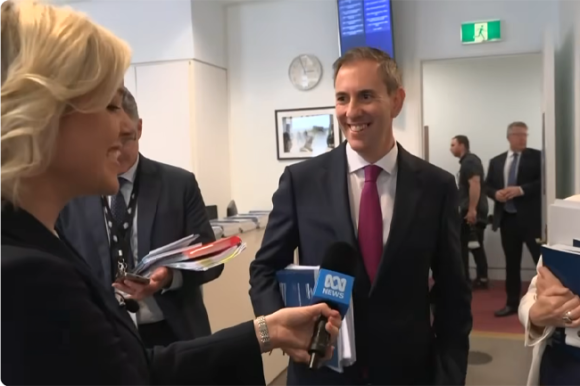
The MYEFO in December will update those numbers and include the impact of decisions taken by the Government in the next few weeks.
With some cuts in government spending, the budget would have a strong probability of getting to a surplus not only in the current year, but into the following year as well.
The politics as well as the economics of this are compelling.
Budget surpluses, prudent management of the nation’s finances, taking pressure off inflation, helping the Reserve Bank (RBA) to get interest rates stable and then lower, would be a mantra for political virtue.
And voter confidence.
Spending cuts in defence, segments of infrastructure, the absurd cash payment to Western Australia and even, at the margins, welfare and social security can yield meaningful savings.
Any flak that might be directed at the Government from vested interest groups and the Opposition parties from the cuts will be more than offset by more favourable inflation and interest rate trends, particularly into 2027 and 2028.
Yes, it is difficult.
Yes, some cuts will be unpleasant for those impacted.
But some economic tough love is needed to more forcefully address the problems that show few signs of moderating and to arrest the freefall in support for the Government.
Stephen Koukoulas is one of Australia’s most respected economists, a past chief economist of Citibank and senior economic advisor to an Australian Prime Minister. You can follow Stephen on Twitter/X @TheKouk and on Bluesky @thekouk.bsky.social.
 This work is licensed under a Creative Commons Attribution-NonCommercial-NoDerivs 3.0 Australia License
Support independent journalism Subscribe to IA.


Related Articles
- Labor must embrace the Greens or risk losing its political future
- The Labor paradox: Too progressive, not progressive enough
- Forest carbon scheme puts Great Koala National Park at risk
- One against six in Labor’s battle for reform
- Victoria’s wildlife pays the price for Labor’s bushfire failures