Australia's bid for a UN Security Council seat could strengthen its role as a diplomatic bridge between global powers and smaller nations, writes Dr Muhammad Imran Ashraf.
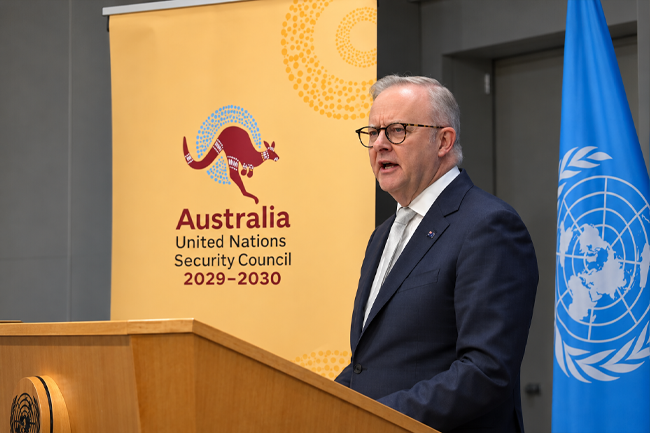
AT A TIME when the international system is under extraordinary strain, Australia is asking a simple question of the United Nations: should a middle power from the Indo-Pacific have a stronger voice in determining how the world responds to conflict, humanitarian crises and threats to international peace?
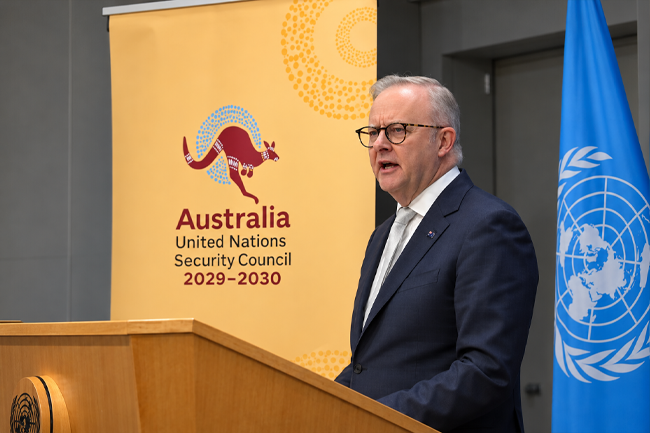
Australia is campaigning for election to the United Nations Security Council for the 2029-30 term. If elected, it would be Australia's sixth term on the Council, following service in 1946-47, 1956-57, 1973-74, 1985-86 and 2013-14. Australia also served as the Council's first president in 1946.
The Security Council is not a parliament of the world. It has 15 members, including five permanent members with veto power, while ten non-permanent members serve two-year terms. A non-permanent member cannot impose its will on the Council. Its influence instead comes through diplomacy, coalition-building, negotiation, agenda-setting and credibility.
That is precisely where Australia's strengths may lie.
Canberra's campaign is built around four priorities: upholding international law and state sovereignty; preventing conflict and protecting civilians through diplomacy; amplifying the voices of small and middle-sized states; and strengthening a more effective and representative United Nations.
In a world where military and economic power remain unevenly distributed, international rules matter particularly to countries that cannot rely on sheer size to protect their interests. Australia has consequently made international law a central part of its diplomatic identity, arguing that the UN Charter and international law provide a framework in which disputes can be managed through rules rather than simply through power.
Australia's history gives this argument substance. Australian diplomat and politician HV Evatt played a prominent role in the creation of the United Nations, while Australia participated in the organisation from its foundation. Australia says its previous Security Council term produced concrete outcomes, including work on accountability following the destruction of Malaysia Airlines Flight MH17, humanitarian access and the Women, Peace and Security agenda.
There is also the practical business of peacekeeping. According to the Department of Foreign Affairs and Trade (DFAT), more than 65,000 Australian personnel have participated in more than 60 UN and other multilateral peace and security operations since 1947. In 2025, the Australian Federal Police launched a UN-accredited police peacekeeping program designed to build capacity in the Pacific and Timor-Leste.
Australia is also making a specifically Pacific argument. Canberra presents Australia as a Pacific country with connections across Southeast Asia, the Indian Ocean and Antarctica, while emphasising listening to smaller states and working across regional and political differences. Its campaign highlights relationships with Pacific island countries and the interests of smaller states whose concerns can receive less attention in global institutions.
This matters because the Pacific faces security challenges that do not fit neatly into traditional definitions of military conflict. Climate change, disaster resilience, maritime security, economic vulnerability and digital technology increasingly overlap with questions of peace and security. Australia's stated approach includes listening to women, young people, First Nations peoples and communities directly affected by conflict and instability.
Yet Australia's candidacy should not be romanticised.
The permanent members retain veto power and disagreements among major powers can prevent collective action even when a majority of countries support it. Critics may also ask whether Australia's close strategic relationships with the United States and United Kingdom could complicate its claim to be an independent middle-power voice. Australia is a close ally of both countries and is deepening defence cooperation through arrangements such as AUKUS.
But these relationships can also be understood as a source of diplomatic reach rather than simply a constraint.
Australia operates across several levels of the international system. It maintains longstanding relationships with major powers while also developing extensive diplomatic, economic and security relationships with middle and smaller states, particularly across the Indo-Pacific. Rather than preventing Australia from acting as a bridge, this breadth of engagement can give it access to conversations that do not always occur across the traditional great-power divide.
Its previous Security Council experience reinforces this potential. Australia's record does not mean it can solve today's crises alone; no non-permanent member possesses that capacity. It does, however, demonstrate experience in navigating the Council's complex diplomatic environment and negotiating among states with very different interests.
Australia's most valuable role may therefore be that of a bridge between great powers and the wider UN membership — bringing concerns from smaller states into discussions with more powerful countries, translating competing priorities into negotiation and creating space for constructive debate.
Such a role would not require Australia to abandon its alliances or national interests. Effective middle-power diplomacy instead requires maintaining relationships with powerful allies while retaining sufficient credibility to engage countries whose interests differ from Australia's.
This balancing role could become increasingly important as the international system confronts challenges extending beyond traditional battlefields. Climate change, displacement, cyber threats, artificial intelligence, economic instability and emerging military technologies increasingly intersect with international peace and security. Foreign Minister Penny Wong has also warned that artificial intelligence could transform warfare and diplomacy and that international rules will be needed to manage its risks.

Australia's Indo-Pacific experience adds another perspective. The region contains major economies, sea lanes and strategic rivalries. A Security Council that pays greater attention to the region does not necessarily need another great power; it can benefit from a country working simultaneously with major powers, regional organisations and smaller Pacific states.
Ultimately, Australia's bid is about more than winning a diplomatic election. It is an argument about what a middle power can contribute when the international system is becoming more fragmented.
Australia cannot remove the veto from the Security Council. It cannot end wars by itself or guarantee that international law will always prevail. What it can do, if elected, is use its diplomatic weight, regional relationships, peacekeeping experience and capacity for coalition-building to push issues that might otherwise struggle for attention.
The real test will be whether Canberra can translate those strengths into sustained diplomacy when choices are difficult and the interests of major powers collide.
The case being put forward by Australia is that the world does not need only great powers around the Security Council table. It also needs countries prepared to build bridges between them, listen to smaller states, defend the rules on which international cooperation depends and turn diplomatic influence into practical action.
Australia is asking for the opportunity to do exactly that. Whether the international community agrees will be decided by members of the UN General Assembly. But the debate is worthwhile because the future of international security will depend not only on who possesses the most power, but also on who is willing and able to use diplomatic power responsibly.
Dr Muhammad Imran Ashraf is an associate professor and executive director of HYIERI Australia.
 This work is licensed under a Creative Commons Attribution-NonCommercial-NoDerivs 3.0 Australia License
Support independent journalism Subscribe to IA.


Related Articles
- Russia's place on UN Security Council should be revoked
- Non-Western nations will not wait for the UN to solve humanity’s challenges
- Australia's border protection regime is most definitely not the 'envy of the world'
- 'Alarm bells ringing': Global CO2 levels highest in 3 million years
- Australia's weak COP21 climate goal sends 'shudder through the Pacific'