By refusing to sanction Israel, Australia is exposing a double standard that threatens its claim to moral leadership on the world stage, writes Vince Hooper.
AS THE HUMANITARIAN catastrophe in Gaza worsens, Australia's refusal to impose sanctions on Israel is drawing international and domestic scrutiny — not only for what it implies, but for what it undermines: our credibility as a principled middle power.
Australia once prided itself on being a global advocate for human rights. We sanctioned Russia with vigour following the invasion of Ukraine. We condemned Myanmar's junta. We were vocal on apartheid. And yet, in the face of credible allegations of war crimes, collective punishment and indiscriminate attacks in Gaza, the Albanese Government offers little more than rhetorical concern. Why?
The credibility gap
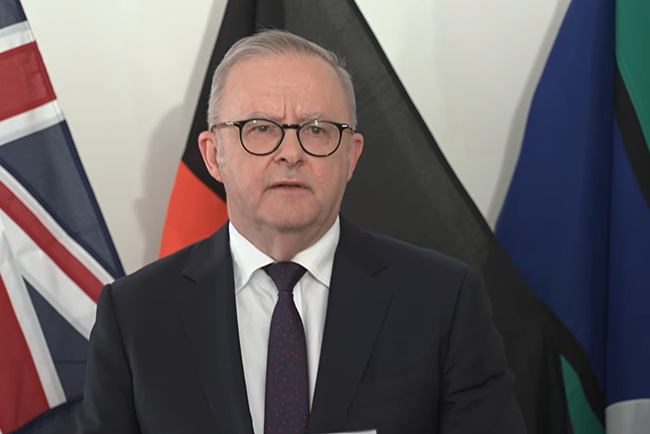
Prime Minister Anthony Albanese has asserted that Australia will pursue its own foreign policy approach and refrained from endorsing sanctions on Israel over its actions in Gaza, despite calls from allies such as the UK, France and Canada. These countries have already imposed or signalled targeted sanctions in response to Israel’s ongoing blockade of essential aid to Gaza, which has triggered a severe humanitarian crisis.

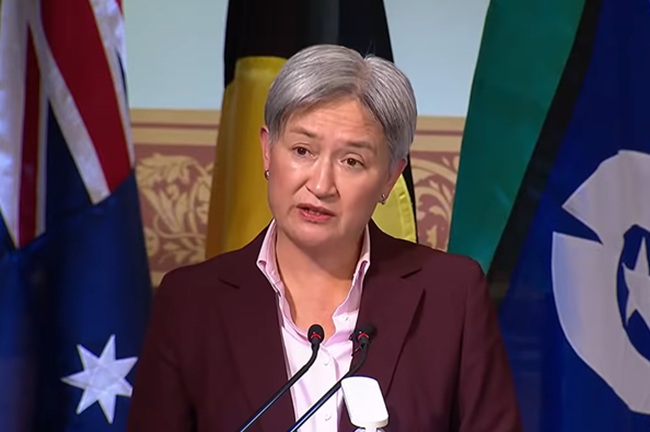
Foreign Minister Penny Wong supports the notion that Australia does not “speculate on sanctions”.
Yet that hasn’t stopped us before. The real reason, it seems, lies in political expediency and alliance management. But such selective morality is eroding our international standing. If Australia claims to support a rules-based international order, then we must uphold it even when it’s uncomfortable, even when our allies are implicated.
There is a growing perception globally that Australia's foreign policy is not guided by ethics, but by which countries we can afford to criticise. This double standard is not lost on emerging nations, who now question the legitimacy of Western human rights rhetoric altogether.
Domestic pressures, diaspora realities
Australia’s internal political calculus cannot be ignored. The Jewish and Palestinian diasporas both exert influence socially, economically and electorally. The Government’s equivocation reflects an attempt to appease both, but ends up satisfying neither. In effect, it reduces a moral crisis to a political balancing act.
The consequence? Rising polarisation at home and a growing generational rift. Young Australians, particularly students, are not buying the Government’s “neutrality”. Mass protests, sit-ins and petitions underscore the widening gap between government policy and public conscience.
Complicity through trade and arms
Australia exports military and dual-use technology to Israel. While small in dollar terms, these exports are symbolically and legally significant. Under the Arms Trade Treaty and our own national guidelines, such exports should not occur if there’s a substantial risk they could be used to commit serious human rights violations.
By failing to suspend these exports, Australia risks complicity, not just morally, but potentially under international law. When future legal proceedings scrutinise the Gaza conflict, Canberra may find itself on the wrong side of history and jurisprudence.

AUKUS, the U.S. and strategic cowardice
Some argue that standing up to Israel could jeopardise our strategic relationship with the United States. This is a false binary. Other U.S. allies, like Ireland, Spain and now even Canada and the UK, have taken principled stances without severing ties with Washington.
Are we really so diplomatically fragile that we must outsource our moral compass to the Pentagon?
Australia must resist being cast as the deputy sheriff of U.S. foreign policy in the Global South, especially when that role contradicts our stated values.
There are alternatives
Even if full sanctions are politically infeasible, there are meaningful middle-ground measures:
- suspend military cooperation or intelligence sharing;
- publicly support international investigations (such as the International Criminal Court and International Court of Justice cases);
- impose targeted visa bans on known human rights abusers, as our allies have; and
- increase aid to the United Nations Relief and Works Agency (UNRWA) and push more forcefully for unimpeded humanitarian corridors.
These are not radical demands, they are the minimum expected from a nation claiming to champion human rights and the rules-based international order.
A turning point for Australia's moral identity
Australia’s current inaction is not neutral. It is a statement of complicity. It signals to the world that our principles are for sale and that the victims of one conflict matter more than those of another.
For a nation seeking influence in Asia and the Pacific, where memories of colonial duplicity still run deep, this hypocrisy may come at a high cost. Geopolitically, morally and diplomatically, the time to act is now.
If Australia wants to be taken seriously as a global citizen, it must match its words with action, beginning with accountability, even when it’s inconvenient.
Vince Hooper is a proud Australian/British citizen who is professor of finance and discipline head at SP Jain School of Global Management with campuses in London, Dubai, Mumbai, Singapore and Sydney.
 This work is licensed under a Creative Commons Attribution-NonCommercial-NoDerivs 3.0 Australia License
Support independent journalism Subscribe to IA.


Related Articles
- Republic should be top priority for Albanese re-election
- Economic growth slows, incomes surge and Coalition hypocrisy hits new high
- Australia sets impressive trade records which newsrooms refuse to report
- ‘Labor big spenders’ myth can finally be laid to rest
- Cost of Australia's wildlife destruction immeasurable