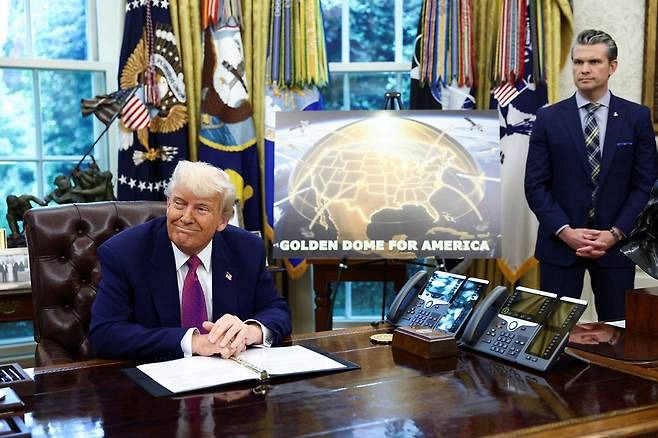
Doubts remain over Donald Trump's ambitious 2025 "Iron Dome" space-based missile shield plan to protect continental United States from attacks from above. Benjamin Gonda reports.
Shortly after the inauguration of President Trump's second term (27/1/25), Executive Order (EO) 14186, ‘The Iron Dome for America’ marked a notable shift in United States defence policy, taking its first proactive step to advocate for effective deterrence against any ex-atmospheric threats. This included any aerial or ballistic attacks against all U.S. territories and critical infrastructure from its peer-near and near allies, as well as its adversaries.
An ambitious initiative laid out in early 2025, it may seem a near-impossible feat to achieve an extraordinary administrative, financial and legal hurdle at taxpayers' expense to contribute to the establishment of the Golden Dome missile defence system. Estimated projects from the White House put the cost of implementation at around USD$175 billion (AUD $248.65 billion), with completion of the project within the timeframe around 2029. Preliminary concepts laid out have the Golden Dome consist of multi-tier layered defences against current and next-generation aerial threats of advanced cruise missiles, ballistic and hypersonic attacks as well as drones.
Ultimately, the question of benefit to the United States homeland defence in the scope of its implementation remains to be seen. Previous administrations have practised restraint on expanding the scope of threat from intercontinental ballistic missiles (ICBMs), clear emphasis on near-peer and peer-to-peer allied state deterrence in the United States force projection across various overseas theatres and joint intelligence collaboration across federal and transnational security threats. Whether the readiness in missile defence capabilities under the Trump Administration can be adequately developed against first-strike capabilities from American adversaries, such as China or Russia, any blueprint for a reference architecture remains to be seen.
The Executive Order of note stipulates that the fundamental prerequisite of choosing a tactical and strategic set of locations to provide a buffer against current and next-generation conventional weapons in high-priority non-military targets such as major population centres. This may portend to the implication that there is a tolerable degree of risk for the absence of aid in the defence of forward-deployed troops and that, of Coalition partners with strong bilateral and multi-lateral relations. The feasibility of a replicated architecture to defend both United States and Coalition assets presents a different challenge altogether, further made complicated by countries in various theatres susceptible to their own individual political cleavages to complicate a unified missile defence posture in technology, capabilities and operations.
The Golden Dome initiative may be seen as a reassurance for near-to-peer and peer states covered under its scope, but may be seen as a privileged access for ones that fall outside; potentially altering a confident, stable symmetry of deterrence guarantees where allies and Coalition partners may see Washington abandon its status quo policy of global strategic deterrence. Overall, the isolationist stance of prioritising homeland defence can perhaps undermine future partnerships between allies of the United States, in an already precarious inflection point. One in which the United States faces massive backlash in its global standing from its retreat as the "police of the West", where many countries look to the United States as its enforcement mechanism in providing effective deterrence against security threats.
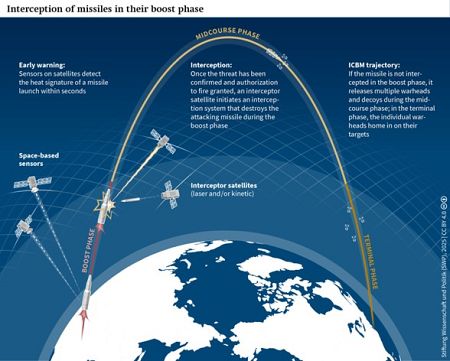
Figure 1: Schematic illustration of the Various Flight Phases of Ballistic Missiles prior to atmospheric entry (Source: Liviu Horovitz and Süß Juliana, '‘Golden Dome’ and the Illusory Promise of Invulnerability)
As major adversaries continue to develop novel, kinetic delivery systems to exceed the scale and sophistication of the United States' defence capabilities, policymakers within Washington have struggled to come to a consensus for a defensive shield within the unregulated space domain. The Golden Dome System aims to seek the interception of incoming missiles — regardless of notional launch points (that is, from mobile platforms to missile silos) where a comprehensive array of orbital and terrestrial defence nodes will provide dual functions, for detection and neutralisation of kinetic projectiles at all stages of missile flight.
Incorporating high missile sensor sensitivity, interceptor kinematics and precise engagement timelines to detect these aerial targets would require software integration with low-Earth orbit satellites (LEOs) to help in calculating projectile trajectory and probable flight path. This would be aided with dedicated command-and-control (C2C) centres, radars, missile interceptors and directed-energy weapon (DEW) platforms, like Israel's Iron Beam and High-Powered Microwave (HPM) systems. With these low-orbiting satellites, their limited field of view over kinetic projectiles highlights the issue for effective surveillance coverage to defend against a saturated attack.
Comprehensive coverage for software-based cyber architecture for established space-based sensors and relay networks that must operate in precise synchronisation and in real-time, is a massive undertaking. Paradoxically, a resilient missile defence shield poses a target-rich environment for adversaries. In the event of a counter cyberattack, systemic data breaches, including that of target processing and imagery within a deeply networked system of software-defined defence nodes, can jeopardise time-sensitive missile defence engagement, where uncertain variables are the most fluid that can make a difference in inflicting any damage to both military and civilian infrastructure. By addressing these potential points of failure, a resilient missile defence architecture can readily adapt to any acts of retaliation, such as reducing downtime and communication latency across different theatres.

Figure 2: Expected multi-domain capabilities for the Golden Dome Initiative to incorporate state-of-the-art innovation in missile defence (Source: Carter Palmer and Shaun McDougall, ‘How LEO, MEO and GEO Satellites Could Power Trump’s Golden Dome)
With existing technologies, we see different countries increasingly assert their respective satellite activity and even deny access to orbital corridors to other countries. Strategic orbital positioning of satellites in space itself becomes a prelude where transformation of these satellites is paramount to utilise a dual-use function; a combination of surveillance and interception functionality becomes an access-denial of strategic terrain in the domain of orbital geography. It should be stressed that the time taken for data processing of aerial threats occurs in a compressed timeframe and that low-orbit satellites can only monitor a certain number of aerial threats.
And should the Golden Dome system be established, this would put the United States on the defensive, forcing Washington to disproportionately spend its budget expenditure on proactive system maintenance and active defence should any threat of attacks arise. Washington's force projection of deterrence with the presence of the Golden Dome may reach a point of saturation, to which it may be overwhelmed by any offensive weapon capabilities by its adversaries.
There is also a cost asymmetry to the defence against aerial threat engagements and offensive assets to undermine the interceptor rate effectiveness. Cheaper offensive systems can be greatly utilised to perform a variety of functions: from mere deliberate acts of provocation, usually to test for exploits in key defensive systems and if sufficient data is gathered, a protracted, saturated attack can be executed to overwhelm these systems.
Confidence is low in the United States' ability to complete this goal within a tight window, given that armed forces readiness elsewhere is impacted; with the Navy facing lengthy delays, cost overruns and consistent under-performance in its shipbuilding capacities and inferior shipyard facilities lagging in maintenance work of commissioned vessels.

Figure 3: Concept for space-based missile interceptors to form part of the Golden Dome 'Missile Defence Shield' to emphasise outward focus on the United States mainland, not just forward-deployed forces overseas (Source: Lockheed Martin)
In relative peacetime, where geopolitical tensions of relevant theatres remain at an all-time low, discretionary funding (covering defence and non-defence funding) for the Department of Defence (DoD) for 2026 and consequent years (according to the annual fiscal year defence-spending appropriations Congress must pass) may be cost-prohibitive. Private-sector funding may reduce the deficit if prominent aerospace companies like General Dynamics, Lockheed Martin and Northrop Grumman make strides in innovation and efficiency. In 2025, the Pentagon's Missile Defence Agency allocated only a fraction of the estimated USD$151 billion (AUD$214.55 billion) cost. The Wideband Global SATCOM System (WGS), a network of satellite communication services jointly utilised by the DoD, as well as Canadian and Australian defence counterparts, which enable real-time bandwidth and communication capabilities, would cost (without including operating costs) USD$40 billion (AUD$56.83 billion), which will aid in the Golden Dome initiative. Furthermore, low-orbit satellites would have to be replaced frequently under this initiative — an estimated 10,000 satellites. Missile interceptors, on the other hand, would require USD$20 billion (AUD$20.42 billion) in replenishment per usage of rounds.
The Golden Dome initiative, whilst bold in its visionary plan, rests confidence in its deterrence upon its cyber-resilience and adaptability in the conceptual stage. Otherwise, long-term constant patchworks to address plaguing weak points in the system may be expected.
Benjamin Gonda is a freelance writer from Brisbane.
 This work is licensed under a Creative Commons Attribution-NonCommercial-NoDerivs 3.0 Australia License
Support independent journalism Subscribe to IA.