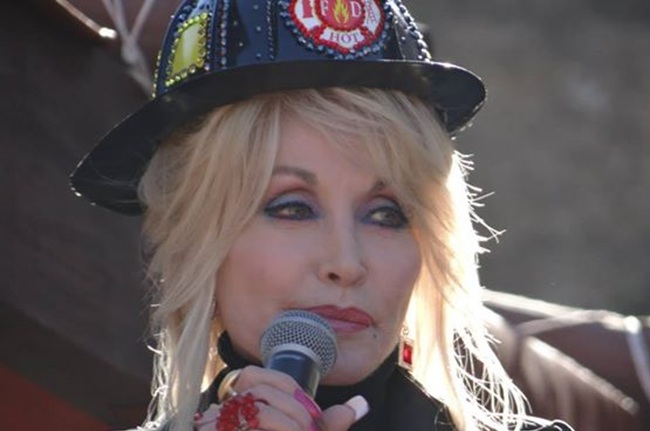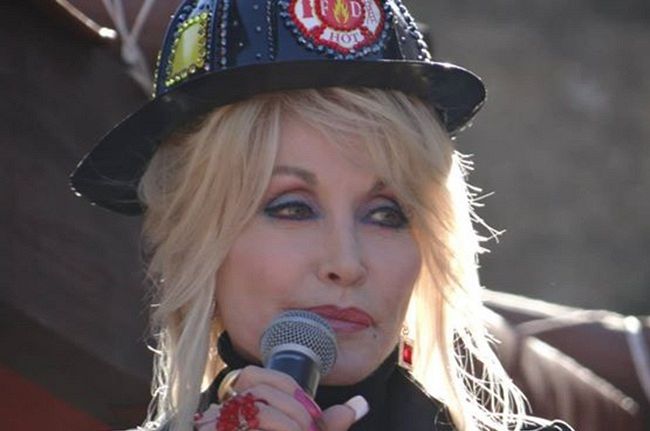
A tribute to Dolly Parton, who touched lives across the globe and never forgot her humble beginnings, writes Jenny LeComte.
A COUNTRY SUPERSTAR with a heart of gold, Dolly Rebecca Parton touched many lives and never forgot her humble beginnings.
She was famous for her flamboyant style — pneumatic breasts, tiny waist, outrageous blonde wigs and flashy clothes. Dolly often found herself cast into the role of a dumb blonde, but as the old joke goes, Dolly wasn’t dumb — and she wasn’t blonde.
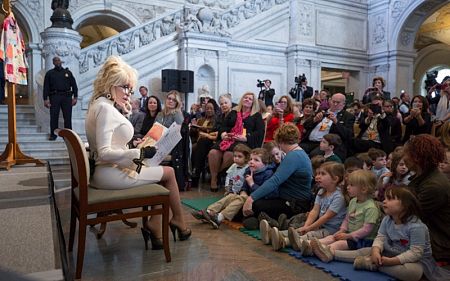
Over a six-decade career, Dolly earned 11 Grammy Awards, six Golden Globes, two Oscar nominations, and a Tony Award. She sold more than 100 million records, making her one of the most prolific and successful musicians of all time.
Dolly was also a fine actress, winning accolades for her roles in 9 to 5 (1980) and The Best Little Whorehouse in Texas (1982), Rhinestone (1984) and Steel Magnolias (1989).
Dolly was also a philanthropist of note, lending her sweet image and mega bucks to causes such as children’s literacy and animal rights. A pro-vaxxer during the COVID-19 pandemic, she donated one million dollars to research into the deadly virus; she had her vaccination filmed and said:
“I am a very proud girl today to know I had anything at all to do with something that’s going to help us through this crazy pandemic.”
In addition to this, Dolly – a proud gay icon – was a vocal supporter and advocate for marriage equality and LGBTQ+ causes in general.
She famously said, tongue in cheek:
“I think everyone should be with who they love. I don’t want to be controversial or stir up a bunch of trouble, but people are going to love who they are going to love. I think gay couples should be allowed to marry. They should suffer just like us heterosexuals.”
She was born Dolly Rebecca Parton on January 19, 1946, in a one-room shack in the Smoky Mountains of Tennessee, the fourth of 12 children.
Her father, Lee, was initially a sharecropper and later managed his own tobacco farm. He never learned to read or write, but despite his illiteracy, Dolly described him as one of the smartest people she ever knew.
Dolly’s earliest performances were at the age of six at the local Church of God, where her grandfather, Jake Robert Owens, was a preacher.
She learned to play the guitar and showed signs of being a musical prodigy from the age of eight.
After graduating from high school, Dolly moved to Nashville and scored regular work on television. She also performed at the legendary Grand Ole Opry, where she met one of her first mentors — the first in a long line of kindred spirits — country legend Johnny Cash, who introduced Dolly as “a little girl from up in East Tennessee” and gave her sound advice about her career.
In 1965, 19-year-old Dolly signed a contract with Monument Records and was initially marketed as a lightweight, bubble-gum pop singer.
However, in 1967, she met another powerful mentor, Porter Wagoner, who featured her on his popular television show and performed several duets with her, which, unfortunately, went nowhere even though they were great.
By 1970, Dolly and Wagoner were both frustrated by her lack of chart success and Dolly decided to go solo.
She struck gold in 1973 with a deep, heartfelt song about feminine rivalry called 'Jolene', which raced to the top of the country charts and cracked the Billboard Hot 100. It was also successful in the UK, peaking at number seven.
The inspiration for 'Jolene' came from Dolly’s interesting and often complex relationship with Carl Dean, whom she married in 1966.
The fateful first meeting happened at the Wishy-Washy laundromat in 1964, shortly after Dolly graduated from high school. While watching their mutual undies going through the spin cycle, the pair bonded on a very deep level and remained together in their own form of married bliss until Dean’s death in 2025.
It was an attraction of opposites that somehow worked. Dolly was outgoing and gregarious. Dean hated the limelight, and following Dolly’s death, journalists became increasingly frustrated because photos of him and Dolly were as rare as hen’s teeth. She was country and Dean was heavily into rock ‘n roll.
Dolly was aware of the fascination with her marriage, saying:
“People are always gossipin’ about what a weird arrangement it must be and all but they don’t know me like he does. The man gives me what I need, which is freedom. And love. And security.”
'Jolene' was based on a true story. When Dolly started making serious money, Dean was going to the local bank in Nashville, Tennessee, rather a lot. More than was seemly.
Parton followed him one day and discovered that the bank teller was an absolutely gorgeous woman with auburn hair, green eyes and a slender six-foot frame that made Dolly, who was five foot two on a good day, feel lumpy and frumpy.
She, of course, confronted the “red-headed hussy” and sublimated her feelings of inadequacy and jealousy and turned them into a song. Not knowing the bank teller’s name, Dolly took the name Jolene from a young fan with the same auburn hair and green eyes.
Dolly followed 'Jolene' with other blockbuster hits, including 'I Will Always Love You' (1973), which Whitney Houston later covered and which sold more than 24 million copies worldwide. Dolly famously dedicated it to her husband.
She also won accolades for a deep-felt romantic ballad called 'Islands in the Stream', a duet written by The Bee Gees and released in 1983 that she performed with fellow country superstar Kenny Rogers.
Dolly was famous for her honky tonk bordello style and famously said:
“It costs a lot of money to look this cheap.”
She discussed her passion for outrageous fashion at length in her autobiography Behind the Seams: My Life in Rhinestones, which documents her life and career in clothes and costume.
Dolly said:
“I’ve been at this so long, I’ve worn some of the most bizarre things — my hairdos have always been so out there. At the time you think you look good, then you look back on it, like, what was I thinking?”
In her book, she discusses the dresses made from sacks she wore as a child, and her “coat of many colours”, sewn by her mother from fabric scraps, which Dolly turned into one of her best-loved songs in 1961.
Dolly has often said that her style was modelled on the “town tramp”, a local woman who wore high heels and tight skirts, whom Dolly idolised.
She said of her style icon:
“She was flamboyant. She had bright red lipstick, long red fingernails. She had high-heeled shoes, little floating plastic goldfish in the heels of them, short skirts, low-cut tops, and I just thought she was beautiful. When people would say, ‘She ain’t nothing but trash,’ I would always say, ‘Well, that’s what I’m gonna be when I grow up.'"
Dolly’s male relatives, including her grandfather, who was a preacher and gave her a few spankings because of the way she dressed in sexy clothes and applied heavy makeup, did not approve.
She said:
“I was willing to pay for it. I’m very sensitive; I didn’t like being disciplined — it hurt my feelings so bad to be scolded or whipped or whatever. But sometimes there’s just that part of you that’s willing, if you want something bad enough, to go for it.”
Dolly’s passing at the age of 80 from a brief battle with cancer prompted a flood of tributes.
U.S. President Donald Trump ordered American flags to be flown at half-mast for a seven-day period, arguably the first such gesture for an entertainer.
He said:
'Very sad to report that Dolly Parton, one of the greatest country singers and far beyond ever has passed away. This is a true loss for millions of people. There has never been anyone like her and never will… rest in peace, Dolly. The world loves you.'
Dolly’s godchild Miley Cyrus, a musical star in her own right, wrote on her Instagram:
'The feeling of losing my Aunt Dolly is beyond what it feels right now. Our most sacred moments were private and they’ll stay there behind the stage, beneath the glamour and between our hearts.'
Emine Saner, a music writer with The Guardian, quoted Dolly as saying:
“Recording these classic rock songs has been a big deal for me, and I felt very responsible. I didn’t want to maim them up, and I tried really hard to sing them well and stay as true as I could to the form, but with my voice.”
Saner added:
'Her version of Lynyrd Skynyrd’s 'Free Bird' is, I think, even better than the original. Her roar of freedom, when you know the legend of her life story – the impoverished girl who grew up in the backwoods of Tennessee, defied all expectations and grew up to be the all-conquering country star – is made for it.'
Pop superstar Beyoncé posted on her website:
Dolly, you were the barometer. The north star. Bold and brilliant. Talented and tenacious. You taught so many lessons on how to be uniquely oneself. I am grateful for your art, your heart, your generosity, your humour, your entrepreneurship. I’m honoured that I had the privilege to work with you. I will treasure that forever. Thank you for your profound impact on the world. You are an angel who has made this world a happier place because of your joyful art. You are truly one of one. Rest peacefully.
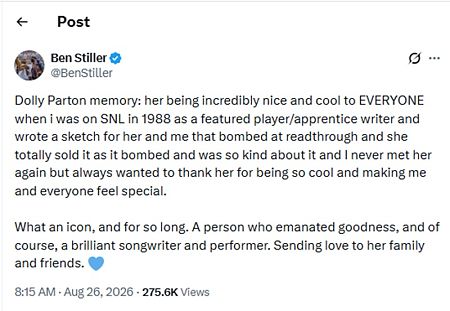
Actor Ben Stiller, writing on X:
Susie Rae of Narromine, NSW, which hosts an annual Dolly Parton Festival, was reported as saying Dolly’s music, love and generosity breathed life into the community after it endured a prolonged drought and the COVID-19 pandemic:
It was just off the cusp of COVID and I remember standing there with [a local politician], and he said, "Susie, I haven’t felt the power of love like this for a very long time."
I said, "Well, that’s Dolly"… It was incredible.
The Coles supermarket chain also paid tribute to Dolly by playing a one-hour set of her greatest hits at all of their Australian stores.
"We're inviting our customers and team members to enjoy a little 9 to 5 and Jolene for one special hour," Coles Executive General Manager Supermarket Operations Martin Smithson told Yahoo News.
It's a first for Coles to honour a music legend in this way, the supermarket revealed.
Smithson said:
"There was only one Dolly Parton. Her music brought joy to generations of fans, so to honour her today we're turning up the volume and celebrating an extraordinary entertainer."
Dolly was very spiritual and left some very moving words to remember her by:
“I’ve been grateful for every good thing ever happened,” she said.“God has always blessed me, surrounded me with good people. I pray that every day God will bring all the right things, all the right people, into my life.”
Jenny LeComte is a freelance journalist currently based in Port Lincoln, South Australia.
 This work is licensed under a Creative Commons Attribution-NonCommercial-NoDerivs 3.0 Australia License
Support independent journalism Subscribe to IA.