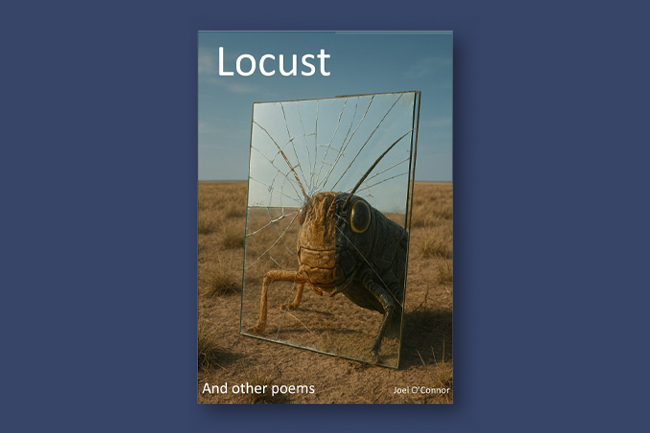
Poet Joel O’Connor’s latest collection blends science, politics, philosophy and everyday observations into a thoughtful and engaging exploration of the modern world, writes Jenny England.
ONE OF THE AIMS of poetry is to encourage readers to explore deeper levels of our everyday reality.
The choice and thoughtful use of figurative language to create imagery; the rhythm the poem generates as it is read; and even its visual impact on a page, all play a part.
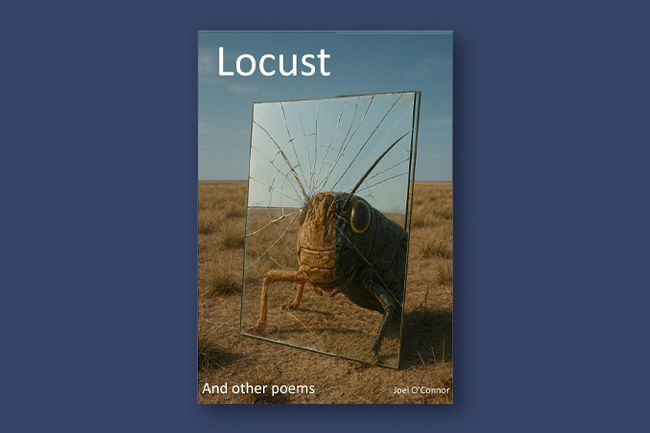
Locust and Other Poems, the collection of poems published this year by Joel O’Connor, ticks all these boxes.
Metaphor is a powerful tool in poetry, bridging seemingly unrelated concepts to offer fresh perspectives. Locusts have found metaphorical places in folklore, literature and imagery as powerful symbols from early times. In biblical times, locusts were seen as harbingers of disasters like famine as divine retributions for moral failures.
Since then and more generally, locusts have been portrayed as an unstoppable force, leaving mass destruction in their wake as they swarm. More recently, locusts have been used as symbols of mass mania and mob mentality with the potential of leading to social upheaval.
In the nine-poem epic Locust, highlighted first in the collection, O’Connor uses the metaphor of the locust to liken a locust swarm to how a nation might slide into fascism. He celebrates bringing scientific knowledge and poetry together. In the foreword, he explains how his Locust poems ‘draw on the scientific study of how grasshoppers turn into locusts with the potential of causing social and environmental chaos’. Towards the end, he even reminds us that ‘the plasticity of thought that makes locusts of us all’.
His words are sharp and tight, but there is a steady flow from one of the nine poems to the next. As an added bonus, O’Connor provides a QR code and a link to a movie he made to deepen a reader’s exploration by watching it as they read.
The Locust poem only takes up about half the pages. What then follows are 27 extra poems to complete the collection. These poems range from everyday themes (Toast and Secret Sound), to philosophical (How We Start Again), to current issues (AI Found the Easter Raffle). I chuckled a little when I first read If Women Ruled the World. It’s something I often wonder, with all the ongoing tensions around the world, especially at the moment.
Some poems are short and sharp (Our Trees), others longer and more highly researched (Magpies), but all are enjoyable additions to the collection.
At the moment, there is great potential and an eager readership for poetry such as this, exploring some of the political realities we have faced in the past, still face today and most probably will contend with in the future. By showing he can also reflect on the lighter aspects of life at the same time, Joel O’Connor has demonstrated he is a significant part of such a movement.
Locust and Other Poems is available directly from the author. Contact: joel@joeloconnor.net
This book was reviewed by an IA Book Club member. If you would like to receive free high-quality books and have your review published on IA, subscribe to receive your complimentary IA Book Club membership.
Jenny England worked for many years as a freelance journalist.
 This work is licensed under a Creative Commons Attribution-NonCommercial-NoDerivs 3.0 Australia License
Support independent journalism Subscribe to IA.


Related Articles
- More than words: One man's journey through dyslexia
- X Rubicon: The hidden casualties of secret wars
- BOOK REVIEW: Albert, Alan and the Guṯkuṯ
- BOOK REVIEW: 'Domination – The Fall of the Roman Empire and the Rise of Christianity'
- BOOK REVIEW: 'Fathering' — a century of change and what endures