On the arrest of Andrew Mountbatten-Windsor, the intelligence services and the fine British tradition of looking the other way, Vince Hooper comments.
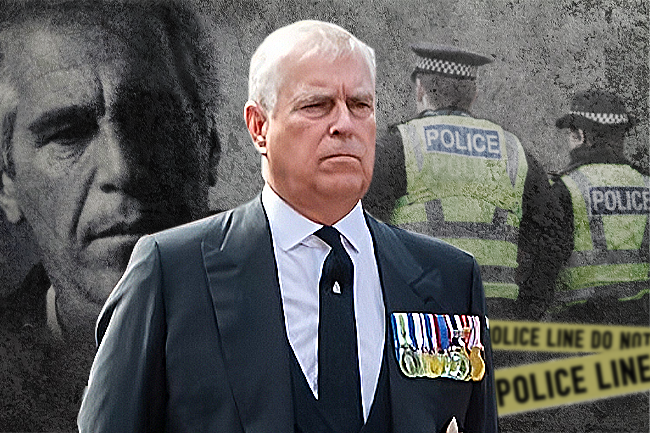
On the morning of 19 February 2026 – his 66th birthday, of all days – Andrew Mountbatten-Windsor, formerly His Royal Highness the Prince Andrew, Duke of York, was arrested by Thames Valley Police on suspicion of misconduct in public office. He was driven to Aylsham Police Station in Norfolk, questioned for eleven hours, and released under investigation. It was the first arrest of a senior member of the British Royal Family in modern history. Happy birthday, Randy Andy!
The charge relates to allegations that Andrew, while serving as Britain’s Special Representative for International Trade and Investment, passed confidential government documents to the convicted sex offender Jeffrey Epstein. The documents emerged from over three million pages of Epstein files released by the United States Department of Justice. Among them was an email in which Andrew offered Epstein a confidential briefing produced by the Provincial Reconstruction Team in Helmand Province on international investment opportunities, cheerfully adding that he planned to circulate it elsewhere in his network.
This is, by any measure, the biggest story to hit the British monarchy since the death of Diana, Princess of Wales. One might argue that Harry and Meghan’s confessional tour of Californian television studios deserves honourable mention, but the Sussexes never managed to get themselves arrested. Andrew has dragged the House of Windsor into territory that even the most creative scriptwriters at Netflix would have dismissed as implausible. A former prince. Arrested. On his birthday. For allegedly leaking state secrets to a convicted paedophile. You cannot make this up.
Let us begin with perspective, because Andrew clearly needs some. The last time Britain experimented with republican government, under Oliver Cromwell, the monarch lost rather more than his reputation. Charles I lost his head — literally, on a scaffold at Whitehall on 30 January 1649. By those standards, Andrew is getting off lightly. No axe, no scaffold, merely an eleven-hour interview in a Norfolk police station followed by a drive home. In the seventeenth century, that would have counted as a pardon.
But the real farce is not Andrew himself. Andrew is, and always has been, the supporting act in a drama whose principal players have quietly exited stage left. The real question – the one that should keep the editors of every serious newspaper awake at night – is breathtakingly simple: what did the intelligence services know, and when did they know it?
Prince Andrew was just arrested for working with Epstein—now do Trump.
— LongTime邏FirstTime (@LongTimeHistory) February 19, 2026
TRUMP: "I don't know Prince Andrew, but it's a tough story. I don't know him, no."
FOX: "Here is a photo of Trump alongside the Prince and First Lady at his party at Mar-a-Lago that Epstein also attended."… pic.twitter.com/Qh7VYGyq9W
Andrew served for a decade as Britain’s Special Representative for International Trade and Investment, from 2001 until his forced resignation in 2011. This was not a ceremonial role performed from a desk in St James’s Palace. It required him to travel the world as a trade envoy, meeting heads of state, oligarchs, arms dealers, and the kinds of billionaires whose wealth has the opacity of a well-stirred Martini. He was, in the language of the intelligence community, a high-value target for foreign influence operations. Indeed, in 2024 a court case revealed his relationship with a suspected Chinese spy who was subsequently barred from the United Kingdom as a threat to national security. The idea that MI5 and MI6 were not monitoring his associations, his travel, his contacts — well, if that were true, it would make the British secret services more Brooke Bond than James Bond.
For our younger readers unfamiliar with the reference, Brooke Bond is a tea company. A perfectly respectable tea company, founded in Manchester in 1869 and once the largest in the world. But not the sort of outfit you would entrust with the delicate task of keeping tabs on a prince who appeared to have the social discernment.
The security services almost certainly knew. Which means someone, somewhere in Whitehall, made the calculation that Andrew’s activities were either useful, tolerable, or someone else’s problem. The misconduct charge now before the police makes this calculus all the more damning: if Andrew was sharing confidential Helmand Province investment briefings with Jeffrey Epstein and offering to circulate them through his international network, this was not a man operating in the shadows. This was a man sending emails. Emails that somebody, somewhere in the apparatus of the British state, could and should have been reading.
This is the great unspoken scandal — not that a prince behaved badly, because princes have been behaving badly since the invention of primogeniture — but that the institutional apparatus of the British state permitted it, perhaps even facilitated it, and is now content to let one man absorb all the opprobrium. King Charles, to his credit, has acted with the ruthlessness the situation demanded: stripping Andrew of his princely title, his dukedom, his honours, and evicting him from Royal Lodge at Windsor. “The law must take its course,” the King said on the day of the arrest. Quite so. But whose law, and for whom?
Andrew, in short, is a smoke screen. A very expensive, very embarrassing smoke screen, but a smoke screen nonetheless. While the tabloids feast on his perp walk from Aylsham Police Station, the more interesting characters in this drama remain comfortably anonymous — or, in some cases, not quite anonymous enough. The Epstein files have also drawn scrutiny towards Peter Mandelson, the Labour grandee and former Ambassador to Washington, who was dismissed by Prime Minister Starmer and is alleged to have shared sensitive government documents with Epstein. Mandelson denies wrongdoing. The magician’s trick is as old as magic itself: look at this hand, not that one.
There is a pattern here that students of British scandals will recognise. When the Profumo Affair erupted in 1963, it was John Profumo and Christine Keeler who were destroyed. Stephen Ward, the osteopath and social connector at the centre of it all, was prosecuted with such ferocity that he took a fatal overdose during his trial at the Old Bailey. But the Soviet intelligence operation that had exploited the whole network? That was allowed to fade from public consciousness with remarkable speed. The establishment protects itself not by denying scandals but by carefully curating which parts of the scandal the public gets to see.
From an Australian vantage point, the Andrew affair carries an additional layer of absurdity. This is, after all, a country that held a referendum on whether to retain the British monarch as head of state in 1999 and — somewhat against the odds — voted to keep the arrangement. Every time a member of the Royal Family does something spectacularly foolish, Australian republicans dust off their arguments with renewed vigour. Andrew has single-handedly done more for the Australian Republican Movement than a decade of constitutional seminars. The sight of a former prince being driven out of a Norfolk police station on his birthday, released “under investigation” for leaking state secrets to a sex offender, is not exactly the stuff of which monarchist recruitment posters are made.
Imagine when you had to get to the part where you had to also explain that despite the fairytale nonsense of the whole thing, there were still AUSTRALIANS that wanted to buy in to the whole cringeworthy facade!#ausrepublic https://t.co/hBjW9GkmnB
— Peter FitzSimons (@Peter_Fitz) February 22, 2026
Yet we should resist the temptation to treat this as mere entertainment. Behind the tabloid nicknames and the satirical cartoons, there are real victims. Virginia Giuffre, who accused Epstein of trafficking her to Andrew when she was seventeen, took her own life in April 2025 at the age of forty-one. Her siblings responded to the arrest with painful dignity: “At last, today, our broken hearts have been lifted at the news that no one is above the law, not even royalty. He was never a prince.”
The British establishment’s willingness to sacrifice Andrew while protecting the wider network of complicity is not justice; it is reputation management dressed up as accountability. It is the equivalent of sacking the intern when the CEO has been caught embezzling.
Andrew should indeed count his blessings. He still has his head. Cromwell’s republic was rather less forgiving. But the rest of us should look past the pantomime villain and ask the harder questions: who else knew, who else was involved, and why is a system that prides itself on having the finest intelligence apparatus in the world now claiming it had no idea what one of its most prominent assets was doing on all those private jets and in all those emails?
The answer, I suspect, is that they knew perfectly well. They just assumed it would never come out. Which, when you think about it, really does make them more Brooke Bond than James Bond.
Vince Hooper is a proud Australian/British citizen and professor of finance and discipline head at SP Jain School of Global Management with campuses in London, Dubai, Mumbai, Singapore and Sydney.
 This work is licensed under a Creative Commons Attribution-NonCommercial-NoDerivs 3.0 Australia License
Support independent journalism Subscribe to IA.