As artificial intelligence fuels viral political fiction, Australia’s democratic debate risks being steered by outrage rather than truth, writes Dan Jensen.
THIS IS A dangerous time for Australian democracy. Fabricated political dramas, powered by artificial intelligence and spread through opaque digital networks, are no longer fringe curiosities — they are shaping perceptions, mobilising voters and influencing polling momentum.
As politics migrates deeper into the digital sphere, the capacity for lies to outpace truth is expanding at an alarming speed.
This digital vulnerability is unfolding even as Senator Pauline Hanson faces bipartisan backlash for inflammatory comments about Australian Muslims — a reminder that outrage can fuel attention even when it attracts condemnation.
A fabricated “live TV meltdown” between Hanson and Prime Minister Anthony Albanese is spreading rapidly across Facebook, and its viral success reveals something deeply troubling about Australia’s information ecosystem.
The post claims Hanson stormed onto the set of Sunday Morning ABC – a program that does not appear to exist – confronted Albanese in a fiery exchange, forced producers to “cut her mic” and then dramatically walked off set as the studio descended into chaos.
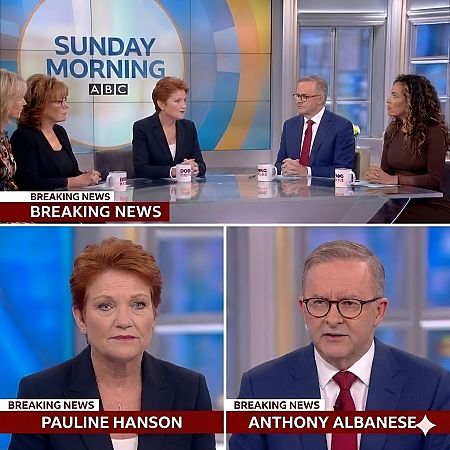
The story reads like a political thriller: capitals everywhere, breathless pacing, a Prime Minister slamming his hand on the desk and a dissident voice silenced by the establishment.
There is just one problem.
It never happened.
There was no ABC broadcast. No transcript. No footage. No reporting from any credible outlet.
In fact, one detail in the fabricated article gives the game away: it claims the ABC cut to a “commercial break”. The ABC, of course, does not run commercials.
At the time of writing, the Facebook post has attracted more than 22,000 likes, 3,700 comments and over 1,300 shares — many praising Hanson for “standing up to bullies”.
This is not satire. It is engineered political fiction.
And thousands are treating it as fact.
Following the link trail
The Facebook post initially appeared to link to a site called glimra.info — a domain that does not appear to exist.
The actual link embedded in the post redirects to this site called cafex.biz.
The site, cafex.biz, does not clearly disclose its operator. Its registration details are redacted. According to Scam Detector, the domain carries risk indicators.
Other sections of cafex.biz infrastructure have been flagged in connection with phishing activity.

The platform appears structured as a content-hosting site for sponsored posts, often used for search engine optimisation purposes, but it is equally capable of distributing political misinformation.
Who is behind cafex.biz?
We do not know.
There is no publicly available evidence linking the site directly to One Nation. It may not be operated by the party at all. It could be opportunistic actors seeking traffic revenue. It could be overseas ideological groups amplifying Australian populist narratives.
What is clear is that the infrastructure is opaque, unaccountable and capable of influencing political discourse at scale.
That alone should concern Australians across the political spectrum.
The propaganda pattern
The Facebook page promoting the fabricated story, Voices of the Nation, was originally created in 2023 under the name Lexie Stephenson. On 16 January this year, it was rebranded into what is now effectively a One Nation-aligned propaganda outlet.
Its listed location is Los Angeles. The contact phone number carries a Vietnamese country code. The link in its bio leads not to political policy material, but to a page advertising music beats for creators.
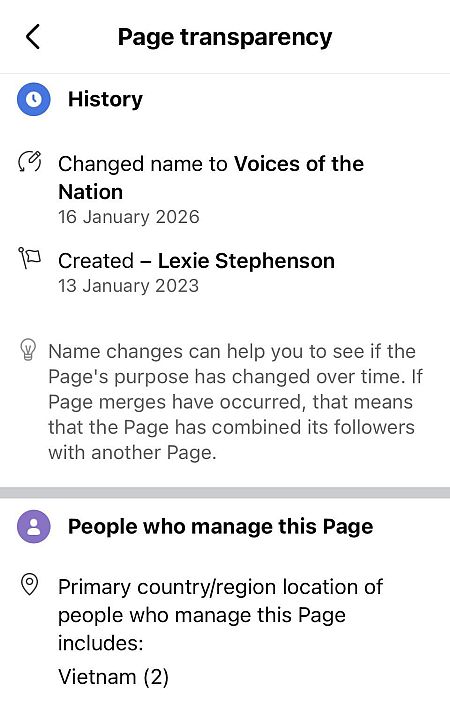
None of this proves criminality. But it does underscore how little transparency surrounds the network distributing politically charged content to Australian audiences — 6,200 of whom have liked the page and over 14,000 following it at the time of writing.
Since its rebrand, the page has published numerous fictional confrontations in which Pauline Hanson verbally dismantles high-profile figures – Waleed Aly, Fatima Payman, Penny Wong – in exchanges that never occurred.
Other fictional storylines include Hanson enraging Donald Trump after publicly revealing his 1970 Wharton intellectual test results on live TV (which was actually the basis for a recent Stephen Colbert comedy sketch), turning American talk show The View into chaos after a heated exchange with host Whoopi Goldberg and sending ‘shockwaves through Canberra’ after an explosive clash with the Greens.
The pattern is consistent: elites panic, microphones are cut, Hanson remains composed and victorious.
In multiple posts, she is depicted smiling from a hospital bed, supposedly fighting cancer while continuing to battle the political class.
There is no corroborated reporting of these hospitalisations. No footage. No verification.
Yet supporters respond with messages such as:
‘Get well soon as Aussies everywhere need you and know this now, we stand with and are prepared to be with you now more than ever.’
This is not random misinformation.
It is emotional construction.

Outrage as strategy
The fabricated ABC showdown reinforces familiar themes:
- Hanson as a persecuted outsider;
- Albanese as intolerant of dissent; and
- institutions silencing inconvenient voices.
It persuades not through evidence but through familiarity.
If you already distrust institutions, the story feels plausible. If you already believe migration policy is betrayal, it feels validating.
This matters because such narratives do not exist in isolation.
Rallies branded as “March for Australia” protests mobilise around claims of uncontrolled “mass immigration” overwhelming the country.
In reality, Australia’s migration program is legislated, publicly reported and subject to parliamentary oversight. Net overseas migration rises and falls according to economic demand and policy settings.
IA’s immigration columnist, Dr Abul Rizvi, has repeatedly dismantled misinformation on migration using fact-checked analysis linked to verified sources.
But when apocalyptic framing dominates segments of the media ecosystem, fictional confrontations slot neatly into existing grievances.
Narrative reinforces grievance.
Grievance fuels mobilisation.
Mobilisation influences polling.
When fiction aligns with fear, it begins to feel like confirmation.

The AI accelerant
What makes this moment more dangerous than previous misinformation cycles is the role of artificial intelligence.
The accompanying images to the Facebook posts appear convincingly real at first glance. The language is grammatically polished. The emotional beats are carefully structured.
Generative AI now allows almost anyone to produce cinematic political fiction in minutes.
AI brings enormous benefits across medicine, research, accessibility and journalism itself.
But it also lowers the barrier to manufacturing plausible political reality.
Deepfake imagery, synthetic transcripts and fabricated “live” confrontations can now be created cheaply and anonymously.
When such content is combined with opaque hosting platforms and algorithmic amplification, disinformation spreads faster than correction.
If you've seen any of these posts on social media, feel free to comment with a link to this article. Let's stop the spread of disinformation!
This is not the whole story! Subscribe HERE to read this article in full and receive regular updates directly to your inbox, from as little as $1.15 a week.
You can follow digital editor Dan Jensen on Bluesky @danjensen.bsky.social or check out his podcast, Dan and Frankie Go To Hollywood. Follow Independent Australia on Bluesky @independentaus.bsky.social and on Facebook HERE.
Related Articles
- EDITORIAL: One Nation's popularity surges amid tidal wave of disinformation
- How Pauline Hanson turned Gen X disillusionment into political fuel
- The regional visa dilemma facing Pauline Hanson
- CARTOONS: Pauline Hanson is playing dress-ups again
- CARTOONS: Pauline 'court' playing with words again
 This work is licensed under a Creative Commons Attribution-NonCommercial-NoDerivs 3.0 Australia License
Support independent journalism Subscribe to IA.