A Moon mission dressed as humanity’s triumph reveals itself as a glossy rehearsal for American-led space colonialism, complete with billion-dollar bravado and a $23 million toilet stealing the spotlight, writes Dr Binoy Kampmark.
THE EARTH is in a fine mess, but human beings sealed in laboratories full of energy and vigour, attached to screens, and running tests about conditions in space, have another reason to cheer.
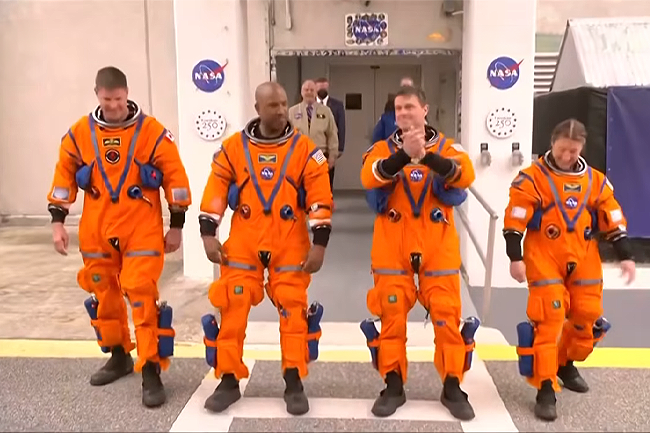
Between 1 and 11 April, the Artemis II undertook a flyby of the Moon and returned safely. News bulletins, live stream feeds and podcasts afforded it saturating room and coverage. This was the first Moon mission with a crew in over five decades. Cue, then, for the grand claims, the exaggerated hopes, the silliness of it all.
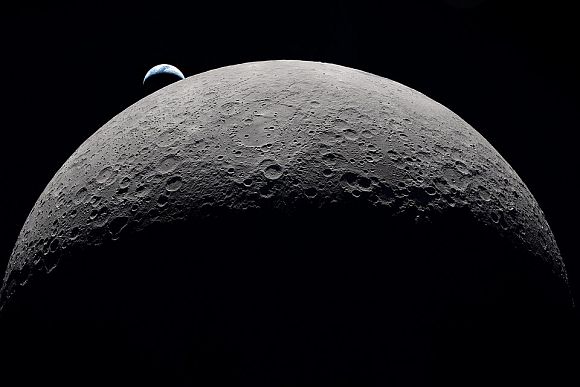
Absurdly, the effort is being heralded as a collective push by humanity despite its distinct NASA credentials, yet another instance of coarse patriotism yoking itself to scientific endeavour. This is an American gig and it will be assessed along with every other expensively patriotic mission launched by any number of States believing that the dark side of the moon is the next big thing in competition and exploitation.
President Donald Trump’s Executive Order of December 2025 promises ‘American space superiority’, with the Artemis Program intended to return ‘Americans to the Moon by 2028... assert American leadership in space, lay the foundations for lunar development, prepare for the journey to Mars, and inspire the next generation of American explorers’.
It is also worth considering the statement by NASA administrator Jared Isaacman made in March:
“NASA is committed to achieving the near-impossible once again, to return to the Moon before the end of President Trump’s term, build a Moon base, establish an enduring presence and do the other things needed to ensure American leadership.”
Nothing about humanity here so much as a bald MAGA admission that:
“The clock is running in this great-power competition, and success and failure will be measured in months, not years.”
Just to complete the trio of examples, Sean Duffy, when he was acting NASA administrator, did not shy away from the messianic zeal of the American space program. In an internal staff briefing held last year, he was unambiguous that the U.S. had to get to the Moon before China before venturing on to Mars. This was only natural, as his country had a ‘manifest destiny to the stars’.
Colonial pursuits are often preceded by the spirit of discovery, economic reconnaissance and inquiry. Then comes the appropriation, the brazen theft, the seizure wrapped in the jolly packaging of blood, civilisation and empire. Thankfully, in this case, there are no Indigenous populations to exterminate, no extant human cultures to extinguish. That extermination will take the form of great powers vying over rare mineral real estate as an exercise in colonial escapism.
Much of the mission, because the lay audience could have no sense or truck with the finer details of the travel, was reduced to soap opera banalities and focal points of sheer triviality. In some instances, it was even worse than a soap opera, crying out for some definitive, asteroid finish. Prosaic details were offered about lavatory failures, which only matter because people relate to them with faecal and urinary familiarity.
NASA revealed on 2 April:
‘The Artemis II crew, working closely with mission control in Houston, were able to restore the Orion spacecraft’s toilet to normal operations following the proximity operations demonstration.’
That lavatory, at the cost of $23 million, was also said to be the second-dearest toilet system ever built. We were also told with quotidian certainty that all lavatories in space tend to end up having failings of some sort, which will no doubt launch a thousand theses on faeces in due, and easy comfort. University examination boards can look forward to the excessive discharge.
Moving items in the spacecraft were also the source of various bromide observations. Nutella, with its hazelnut spread, got what was regarded by the press as the “greatest free advert in history”, floating about fairly unnoticed by the crew — though noticed on the live feed.
PRWeek declared:
‘When Artemis II broke Apollo 13’s distance record of 248,655 miles from Earth on Monday [April 6], it was one small step for man... and a giant leap for Nutella’s marketing team.’
How wonderful to also note that Nutella was founded in 1964, the same year NASA successfully completed its first lunar mission with Ranger 7.
As for global public interest, NASA and any of those in the business of filming their exploits in space need to be reminded of a rather disturbing truth. Dark, even slightly sadistic, voyeurism is never far away from such missions. Impassive spectators are a callous sort, seeking jubilation in shock. An attempt to inject drama is made in media outlets, fluffed up by pundits, about what might have happened to the crew on losing communications for several hours. They must surely make it. Surely.
Yet, sickening voyeurism is heavy in such messages, a thanatotic urge. ‘As the astronauts pass behind the Moon at about 23:47 BST (18:47 EDT) on Monday, the radio and laser signals that allow the back-and-forth communication between the spacecraft and Earth will be blocked by the Moon itself,’ came the bland observation from the BBC.
The retching platitude, however, could not be resisted:
‘For about 40 minutes, the four astronauts will be alone, each with their own thoughts and feelings, travelling through the darkness of space. A profound moment of solitude and silence.’
A rather different reading of what being “alone” means, let alone solitude.
On their return to Earth, the press conference given by the crew was saccharine, charmless and unspeakable, suggesting that space travel may narrow the mind. There was the mandatory carpet-crawling tribute act for NASA’s management. There were bucketfuls of inanities on team enterprise, the insufferable jargon of organisational teamwork.
With emetic conviction, astronaut Jeremy Hanson went so far as to call the crew a “joy team” and claim that humans “don’t always do great things. We’re not always in our integrity, but our default is to be good and to be good to one another.”
Another crew member suggested that Earth was a “dream boat” (interestingly enough, China’s own spacecraft destined for lunar exploits is named Mengzhou, or Dream Vessel) while the Artemis team were but a mirror for humanity. (Some crew, some mirror.)
Artemis II commander Reid Wiseman, along with the rest of the crew, seemed so dazzled as to mischaracterise this proto-colonial endeavour as an effort to unify the fractious human species:
“We wanted to go out and try to do something that would bring the world together, to unite the world.”
Astronaut Christina Koch spoke of her husband’s assuring words that she had “made a difference” in transcending divisions. Other competing nation-states are unlikely to agree, let alone care for such guff.
Logistically, mechanically and in terms of engineering, the Artemis II mission can be seen as stunning, startling and impressive, humankind showing yet again an ability to reject nature’s limitations, to foil it, if you will, by going to areas where they have no natural right to be in. In that, we can be impressed.
But in everything else, best return to the problems of the Earth, which remain in desperate need of resolution, whatever the wide-eyed space colonists claim.
Dr Binoy Kampmark was a Cambridge Scholar and is a lecturer at RMIT University. You can follow Dr Kampmark on Twitter @BKampmark.
[el]30]/el]
Related Articles