With unemployment rising, house prices falling and consumer confidence plunging, the RBA's aggressive interest rate policies risk pushing Australia's economy into recession. Stephen Koukoulas writes.
IT IS INCREASINGLY clear that the extreme monetary policy actions of the Reserve Bank of Australia (RBA) are smashing the economy towards a hard landing. Recession maybe.
Whether it’s a recession or not is heavily dependent on artificial intelligence (AI) and data centre investment, and whether it can keep growing at its recent pace, as well as some residual growth in household spending. If these parts of the economy keep expanding, a recession is unlikely. If they stall, a recession is likely.
Quite extraordinarily, the RBA keeps pretending that it can tackle the increase in the consumer price index and the inflation surge that has largely resulted from the oil shock in the Middle East and the cost pressures in the housing sector. The housing sector had been growing strongly, as planned, due to a range of government economic policies designed to add to dwelling supply as a means to help fix the housing affordability issue.
At the time of writing, the oil price has jumped back to US$110 (AU$158) a barrel (Brent crude), a level which, if sustained, will add to Australian petrol prices and inflation in the months ahead. It’s not clear whether the RBA will misread these signals and hike interest rates in reaction to geopolitical issues risks already smashing the economy which is seeing what is now a sharp rise in unemployment.
The lowdown on the slow-down
The scoreboard of issues that have been bludgeoned by interest rates being at a 15-year high is growing.
Here is a list that should be sending shivers up the spine of the RBA Monetary Policy Board:
- The unemployment rate is at a five-year high of 4.7% – it is up 1.3 percentage points from the cyclical low in 2022, with 0.6 percentage points of that increase registered in the last eight months alone.
- Consumer sentiment remains mired near 50-year lows.
- House prices are falling sharply, with nationwide prices down around 7% from the peak, with larger falls being registered in Sydney and Melbourne.
- Business conditions and confidence are both negative, with the interest rate issue a critical factor feeding into the risk of business dislocation in the months ahead.
Other parts of the economy are turning lower and are at risk of falling sharply:
- Household spending registered zero growth in August after a couple of months of decent growth. Even the zero growth rate was boosted by sales of electric vehicles and petrol. Growth in underlying spending was negative.
- Dwelling building approvals, which had been growing strongly, have fallen 15% since the peak in February. Builders are shelving their construction plans due to cost and interest rate pressures, and there are anecdotes of prior approvals being shelved because of falling house prices which threaten to make new construction uneconomic for the building sector.
- The iron ore price, so vital for export receipts and national income growth, has slumped to just US$90 (AU$129) a tonne which is hovering near a decade low. If there are further falls, the downside risks to the economy will come from the export side.
The RBA and its actions
The RBA is the only central bank to have hiked interest rates to a 15-year high despite the worldwide surge in inflation and all central banks missing their inflation targets by a larger quantum than the RBA.
Even after a few tentative hikes abroad, current interest rates remain below their peak in all but Australia.
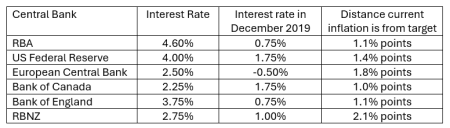
The table shows just how extreme the RBA has been.
Not only does it have the highest interest rate in this sample, the net change in rates since the end of 2019, prior to the pandemic, but it has also been most extreme.
At the same time, its current “miss” of the inflation target is amongst the lowest at just 1.1 percentage points. The Reserve Bank of New Zealand (RBNZ) is more than 2 percentage points from its target, yet has interest rates at 2.75%; the European Central Bank is 1.8 percentage points from target with rates at 2.5%.
The RBA policy action has been extreme and painful.
Which brings us to the outlook for RBA interest rates.
It is remarkably difficult to have a firm opinion of the RBA given that for the bulk of the last decade, its actions have been erratic and sometimes irrational. That said, with interest rates now super high, the unemployment rate very high, and house price falls reaching a level that is destroying wealth and threatening financial stability in the banks, it would be unfathomable for it to hike in November.
Sure, inflation is still “too high”, but when one considers that the price changes to petrol (geopolitics), tobacco (excise), dwelling construction costs (a desirably strong part of the economy) and electricity (the unwinding of the rebates in 2026), inflation would be 2.6% in August. There are huge downside risks to inflation given the policy tightening still percolating through the economy.
Indeed, in 2027 it is looking like another miss of the target by the RBA, but this time it will be to the downside as these issues unwind.
Stephen Koukoulas is one of Australia’s most respected economists, a past chief economist of Citibank and senior economic advisor to an Australian Prime Minister. You can follow Stephen on Twitter/X @TheKouk and on Bluesky @thekouk.bsky.social.
 This work is licensed under a Creative Commons Attribution-NonCommercial-NoDerivs 3.0 Australia License
Support independent journalism Subscribe to IA.


Related Articles
- Facts in, garbage out: Why the RBA needs functional finance
- The failure of Reserve Bank independence
- RBA’s labour market call risks overtightening the economy
- The RBA did not make a mistake in 2025 — the facts changed
- How rising house prices can help the economy