The crypto derivatives market has fundamentally changed how exchanges compete. Raw leverage ceilings aren't the differentiator anymore — margin flexibility, onboarding pathways and verifiable transparency have taken their place.
Here we dig into perpetual futures mechanics and examine how BYDFi, founded in 2020 and now in its sixth year of continuous operation, is responding to what the market actually wants.
Verdict up front
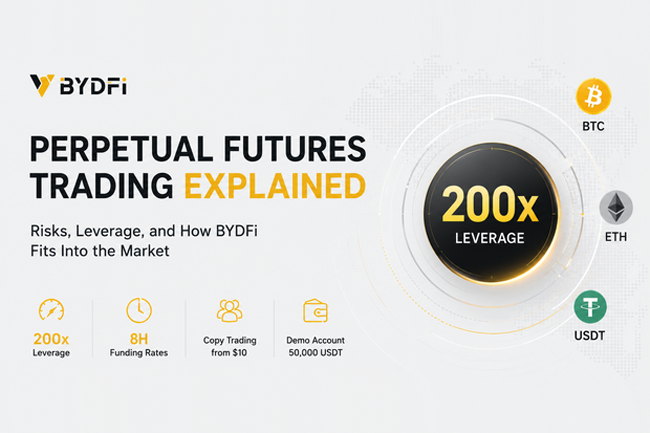
BYDFi offers a wide range of perpetual futures with up to 200x leverage. Perpetual futures are crypto derivatives contracts with no expiry date, meaning traders can hold positions indefinitely. Copy-trading and demo-account features carve out a separate entry path for newcomers, while granular leverage and margin controls cater to experienced traders. Forbes listed BYDFi among its Best Crypto Exchanges in Canada in 2026.
Six years of operation is a meaningful track record — though shorter than some established competitors. Institutional-grade liquidity data isn't publicly disclosed. Traders should verify regulatory coverage for their jurisdiction independently.
How perpetual futures markets are shifting heading into 2026
The derivatives arms race has moved past leverage maximums toward flexible margin architecture, copy-trading as onboarding and exchange transparency proofs.
BYDFi's product timeline tracks that shift closely. Perpetual contracts with 1x–200x flexible leverage launched in August 2022. The perpetuals engine got a significant upgrade in December 2024: bi-directional long/short hedging, shared funds in full-margin mode and the ability to open new positions without unrealised profits. By August 2025, USDC-margined perpetual contracts and Perpetual Smart Copy Trading had both gone live.
Leverage, margin modes and risk mechanics
Understanding how leverage works is the starting point. At 10x leverage, a 1% price move translates to roughly a 10% gain or loss on the posted margin. BYDFi offers 1x to 200x — higher leverage dramatically amplifies both gains and losses.
Expecting a price rise? Open a Long. Expecting a drop? Open a Short. Shorts carry asymmetric risk because price can theoretically rise without limit, making a Stop Loss non-negotiable. A practical hedge: a trader holding spot BTC can open a BTC Short to offset downside risk while keeping the spot position intact.
BYDFi's margin architecture supports three settlement types — USDT-M, USDC-M, and COIN-M — along with Cross and Isolated margin modes for choosing between capital efficiency and per-position risk control. The December 2024 full-margin upgrade lets shared funds cushion individual positions, reducing isolated liquidation events. Bi-directional hedging may support delta-neutral strategies for advanced users. In testing, switching between Cross and Isolated margin on an open BTC/USDT position took a single tap without requiring position closure.
Fees and funding costs
BYDFi perpetual futures fees start at 0.06% taker / 0.02% maker at VIP 0, scaling to 0.032% taker / 0.008% maker at VIP 6. A 7-tier VIP program based on 30-day volume or asset balance offers up to 60% futures fee discount.
Funding rates hit every 8 hours — when positive, Longs pay; when negative, Shorts receive. For positions held across multiple intervals, these periodic costs can easily outweigh commissions.
BYDFi also lists TradFi perpetual contracts on tokenised U.S. stocks — AAPL, TSLA, MSFT, AMZN — plus forex pairs and Gold (XAUUSD), all USDT-settled with zero trading fees. This reflects a broader convergence trend worth watching as futures markets evolve.
Beginner pathways: Copy trading and demo accounts

BYDFi's copy-trading lets users allocate as little as $10 to mirror a selected trader's perpetual futures positions, with proportional sizing and isolated-margin risk controls applied automatically. Perpetual Smart Copy Trading launched in August 2025.
BYDFi's demo account comes preloaded with 50,000 USDT, supporting both USDT-M and COIN-M perpetuals across the full leverage range. All expected order types were available — Limit, Market, Stop Limit, Stop Market, Take Profit/Stop Loss, Reduce-Only and GTC. Traders can also deploy a Futures Grid bot. Multiple entry paths are available in 22 languages, supporting 100+ fiat currencies.
Trust and transparency
BYDFi states it holds licenses in multiple jurisdictions, though traders should independently verify coverage. BYDFi publishes Hacken-audited Proof of Reserves showing ratios of BTC 157% / ETH 171% / USDT 154% at the most recent audit. These snapshots don't constitute a full financial audit. An 800 BTC Protection Fund established in September 2025 serves as an additional reserve.
In August 2025, BYDFi became the Official Crypto Exchange Partner of Premier League club Newcastle United through a multi-year deal, placing branding across St James' Park and Newcastle's digital channels. Sponsorship agreements aren't indicators of platform reliability.
Three signals to watch next
- Multi-asset collateral becomes standard. When three or more exchanges let traders post ETH, BTC and stablecoins simultaneously as margin for a single position, margin flexibility shifts from differentiator to baseline.
- Copy-trading AUM crosses critical share. If copy-trading allocations exceed 10% of total derivatives activity, it confirms copy trading as a structural onboarding channel.
- TradFi perpetual contract listings double. Zero-fee tokenised stock and commodity perpetuals are already available as part of a broader convergence trend tracked across the industry. If listed TradFi perpetual pairs double by mid-2026, expect traditional brokerages to respond.
Where perpetual futures go next hinges on how quickly exchanges iterate on margin innovation, transparency and cross-asset coverage. BYDFi's evolution — growing over six years from a basic perpetual futures trading platform into one offering a broad range of perpetual pairs, USDC-M settlement, copy trading and TradFi derivatives — illustrates how the sector is actively tracking that trajectory.