Protecting a forest costs money — and the governments closest to that forest are often the ones least able to pay for it.
That mismatch is one of the quieter obstacles in climate finance. National governments set environmental targets, but the work of meeting them frequently lands on sub-national governments that rarely receive enough funding to deliver. Conservation usually shows up on their books as a cost and often as forgone revenue from more immediately profitable uses of land. There’s a free-riding wrinkle too. A healthy forest upstream improves water quality for communities downstream, sometimes across district or even national borders and the jurisdiction footing the bill doesn’t capture all the benefit.
Indonesia knows this tension well.
Where the money for conservation falls short
Over two decades of democratisation and decentralisation, Indonesia’s local governments gained real autonomy to make decisions suited to their context. That autonomy came with a matching financial responsibility: local governments now had to fund far more of their own budgets.
To help them do it, the central government let them keep a larger share of fiscal revenue, including a redistribution of timber royalties that raised the sub-national share to 80 per cent. Local budgets and natural resources were now tied directly together, and the predictable result followed: exploiting forests and other natural resources became an easy way to fund local development, often at the expense of conservation goals that mattered locally, nationally, and globally.
Ecological fiscal transfers: An innovative finance tool
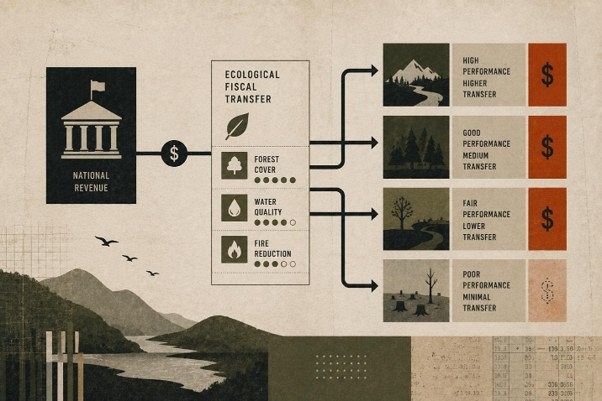
One mechanism gaining traction closes part of that gap: the ecological fiscal transfer — or EFT.
An EFT is a type of intergovernmental fiscal transfer, but with an ecological purpose. Traditional transfers compensate sub-national governments for things like infrastructure and public services. EFTs reward them for protecting biodiversity and ecosystems. It’s a piece of innovative finance that doesn’t require new money, which is part of the appeal. Instead of raising fresh funds, governments redistribute revenue they already collect, this time weighted by environmental performance rather than only by population and GDP.
Indonesia has been piloting EFTs at several levels, from national-to-province down to villages. Chemonics helped get the idea onto the national and regional agenda through the U.S. Government-funded BIJAK project. From 2016 to 2021, the program improved land-use governance, reduced wildlife trafficking, and strengthened conservation area management.
What EFTs can do for climate finance and conservation
The case for EFTs as climate finance rests on a few things they do well.
It is a timely question for the Indo-Pacific. Australia alone delivered USD$3.9 billion (AUD$5.6 billion) in climate finance over 2020 to 2025, with USD$1.3 billion (AUD$1.8 billion) going to the Pacific, much of it for adaptation. Public instruments that stretch existing budgets further, rather than relying on new money, sit comfortably alongside that kind of investment.
They reward conservation and restoration directly. Countries have tied transfers to the size of protected areas (Brazil), forest cover (India), and a mix of indicators such as air and water quality, waste management, and reductions in forest fires (Indonesia). Results have been mixed, but the wins include more protected and forested land and meaningful drops in pollution.
They also rebalance fiscal resources. Jurisdictions rich in natural resources often have the greatest need to protect nature and the least capacity to pay, because intact ecosystems don’t generate revenue the way agriculture or mining do. A district that loses out under GDP- and population-based formulas can come out ahead once forest cover or water quality enters the equation.
Locally led development and decisions made closer to the ground
EFTs also support something Australia and many of its regional partners increasingly prioritise: locally led development. They give national governments a practical way to resource and strengthen the local organisations, community groups, and village institutions that carry out conservation on the ground, building their capacity and autonomy to act. Under BIJAK, that meant advocating for criteria like the empowerment of forest farmer groups, working forest management units, and the area of forest under local management, which opened the door for villages and local organisations to take part directly in protecting biodiversity.
The partnerships and data that make EFTs work
There are three factors that correlate with successful EFTs.
The first is political will. Setting up an EFT means reforming fiscal policy to allocate funds by ecological indicators, and that takes momentum. In Indonesia, Chemonics leveraged strong partnerships, including with the multi-donor trust fund Partnership for Governance Reform, to convene civil society, academia, donor projects, and a wide range of ministries. The Ministry of Finance and the Ministry of Environment and Forestry were enthusiastic enough to propose regulatory changes to institutionalise EFTs.
The second is conditionality. Following the logic of decentralisation, traditional transfers are usually unconditional, so recipients are free to spend as they see fit. That flexibility can divert conservation revenue to other priorities. Attaching conditions, so that funds raised through conservation go back into conservation or restoration, keeps the money working as intended.
The third is data. EFTs depend on ecological indicators, which can stretch beyond a government’s existing monitoring capacity. Richer measures like observed carbon emissions make for stronger transfers, but simpler ones such as tree cover and protected-area size work well too. In Indonesia, BIJAK proposed water quality, air quality, forest cover, and forest-management indicators. Once monitoring protocols are in place, the cost of collecting data drops sharply as it becomes routine.
Scaling innovative finance across the Indo-Pacific
If the goal is to halt deforestation, restore degraded land and use forests sustainably, every source of funding will be needed: public, private, and development assistance. EFTs are still rare, used mostly in Brazil, Portugal, France, China and India, but the scale is already significant. Globally, EFTs are worth around 20 times the official development assistance directed at forestry and that figure is expected to grow, even if their net effect on nature and livelihoods is still being measured.
For the Indo-Pacific, the timing is worth noticing. Australia is leaning into innovative and blended finance to mobilise private investment for climate outcomes in the region. It favours grants for adaptation in the Pacific and blended approaches for mitigation in Southeast Asia.
EFTs are a complementary, public-sector instrument: a relatively simple mechanism that encourages conservation, strengthens decentralised environmental governance, and can help set the table for larger programs like the United Nations-backed Reducing Emissions from Deforestation and forest Degradation (REDD+) program. For governments and partners across the region, they are a low-cost, locally led place to begin.