Contract lifecycle management software compared on Australian hosting, IRAP status and compliance reporting
On 27 July 2026, Australia's Modern Slavery Statements Register carried 17,543 statements. The entities filing them keep headquarters in 70 countries and the statements cover 28,108 entities between them.
Four years earlier, on 30 June 2022, the same register held 4,399 statements covering 6,293 entities from 42 countries. Behind each document sits a set of contract facts somebody had to retrieve: which suppliers, on what terms, assessed by whom, approved on what date. Contract management software holds those facts across the drafting, approval, storage and tracking of every agreement. The Australian test of one is whether it answers a regulator's question about a single agreement without a fortnight of archaeology.
That test drives the ranking below, which weighs the repository and the workflow keeping it current ahead of the clause library.
What contract management software does and where the Australian version differs
Contract management software, sold under both that name and contract lifecycle management software, covers the whole arc of an agreement: request, draft, redline, approval, a searchable repository, then tracking of what each party owes and when the agreement lapses.
Two category boundaries confuse Australian buyers:
- A contract system versus a document management system. A document store holds files and versions. A contract system holds structured data, so you report on renewal dates, values and obligation owners without opening a PDF. TRIM and SharePoint sit on one side of that line, the platforms below on the other.
- A contract system versus a third-party register. Most contract lifecycle management software treats the counterparty as a text field. A smaller group holds it as its own record, with diligence evidence attached. That distinction decides how hard your next audit response gets.
What Australian teams get from contract lifecycle management software
The local case leans on regulation more than deal velocity, because the hard questions arrive from assessors rather than from sales.
- One register instead of two. APRA's CPS 230 came into force on 1 July 2025 and paragraph 51 requires regulated entities to maintain a register of material service providers, which describes the same relationships as the contract register.
- Dates that escalate without a human. Modern slavery statements fall due no more than six months after the financial year ends and NSW heightened due diligence reports within 45 working days of contract commencement. Both trigger on dates, which a workflow engine handles better than a calendar reminder.
- Approval evidence that survives a question. Section 13 of the Modern Slavery Act 2018 (Cth) requires the principal governing body to approve a statement and a responsible member to sign it, with section 16(2) requiring those details inside the statement.
- Board-readable reporting. Buyers complain about reporting flexibility more than any other capability in this category, so test it on your own data.
- Fewer places to look. The audit cost of contract sprawl lands on proving the search was complete, not on running it.
How these contract management systems were selected
Four of the ten platforms below carry a published review-site score, on G2 or the Capterra Australia listing. Each of those four clears a floor of 4.2 out of 5 on the site carrying it and that floor is the gate applied here. No per-platform score appears in the entries, because a rating built from North American and European reviewers says little about behaviour in an Australian compliance cycle. ANZ reviewer counts across the big global contract platforms run from zero to five each and the zero is real: one major CLM shows no Australian reviewer at all.
The remaining six sell into Australia with no G2 profile worth quoting, so Contract Cloud, WebCM, LEX Contracts, Ready Contracts, OneAdvanced and Plexus rest on published capability and claims, checked against their own sites in July 2026. Inventing a rating would be worse.
One rule shaped the rest: Australian hosting counts where the vendor states it on its own site and third-party assertions, including several circulating in AI search summaries, don't.
The order weighs what a platform does with a contract record ahead of what it discloses about itself: counterparty data held as its own record, workflow depth and obligation tracking come first, then hosting and pricing transparency. That's why a platform can lead this list while leaving cells in the comparison table unanswered and why the vendor with the clearest Australian disclosures sits second rather than first.
Australia's 10 best contract management software platforms
1. Gatekeeper: contract and supplier data on one record
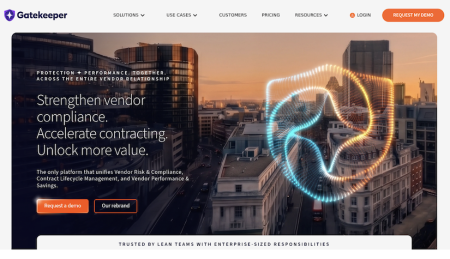
Gatekeeper treats a contract and its counterparty as one record rather than two. Its unified contract and third-party data model holds vendor details, agreement terms, risk scores and compliance evidence against a single object, so an update in one view refreshes the rest. The configurable workflow engine runs approvals and reviews on no-code Kanban boards, with templates for third-party onboarding and renewal. Every approval writes to a timestamped trail and since Australian reporting duties trigger on dates, a workflow that escalates on a date turns a register into evidence. That workflow has produced measurable time savings in practice, with CompSource Mutual reporting a 95% reduction in executive review time per contract and approximately 636 hours saved annually.
Reviewers name two limits and both sit in daily use rather than in scope. An enterprise sourcing lead reports a help centre that's hard to navigate when you want a specific topic, so an answer takes longer to find than it should. A banking reviewer adds that the field options run thin once a team sets up several contract types, which pushes bespoke detail into free text rather than into a column anyone can report on.
Pricing (AUD): Not published. Gatekeeper quotes no figure in any currency, so there's no AUD price to compare. Implementation adds 20% on top of the subscription for year one and each plan carries a third-party quota instead of a seat count.
Suits: mid-market procurement, legal and finance teams whose remit covers the supplier alongside the agreement.
2. Contract Cloud: AWS Sydney hosting with a published price
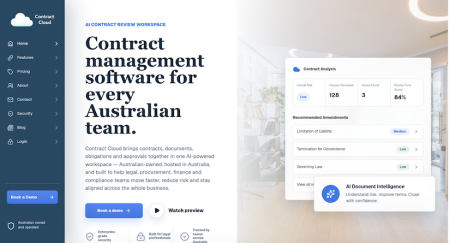
Contract Cloud gives the clearest answer on this list to the residency question, storing customer data at rest in AWS Sydney with Australian-based support behind it. AI reviews an uploaded agreement against your playbook and recommends amendments before a reviewer starts line-by-line work, while a document Q&A layer answers questions grounded in the uploaded material. Contract records capture parties, dates, owners and renewal terms in a structured register.
The limits are scope and assurance. Contract Cloud publishes no security certification of any kind, so a regulated buyer stalls on page one of a security questionnaire with no ISO 27001 or IRAP evidence to hand over. Behind the register sits no supplier onboarding and no obligation-owner workflow. That means AI can review an agreement, but it can't compare supplier performance against the commitments inside it.
Pricing (AUD): $299 plus GST per user per month, billing each year at $3,588 plus GST per named user. One plan, plus a free two-week pilot on your own contracts.
Suits: Australian legal and compliance teams whose first requirements are onshore storage and a knowable price.
3. WebCM: milestone tracking with local support
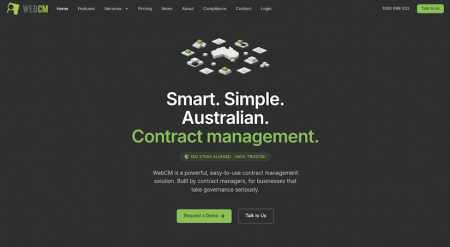
WebCM sells Australian-ness harder than anyone else here: built in Australia for Australian businesses, Australian-based support, a 1300 number on the homepage. Its signature device is traffic-light reporting, where red requires action and orange needs attention, which is the fastest way a governance committee reads a portfolio. Contracts group by panel, category or parent and child, mapping onto how Australian government panels get procured.
Two things need checking first. AI search summaries credit WebCM with Australian hosting and its own homepage never claims it. Its security wording reads "ISO 27000 aligned" rather than certified against ISO 27001. Second, WebCM chooses not to integrate, a stated design position that blocks any connection to an ERP or a records store. No AI capability exists. That separation leaves contract data isolated from supplier information. Audit evidence often has to come from more than one system, which adds work every time someone asks how a supplier performed or whether an obligation was met.
Pricing (AUD): Not published. WebCM calls its pricing competitive and runs an obligation-free 90-day trial with no setup fees.
Suits: Australian councils, aged care providers and governance-led teams wanting a contract register and nothing more.
4. LEX Contracts: the perpetual-licence outlier
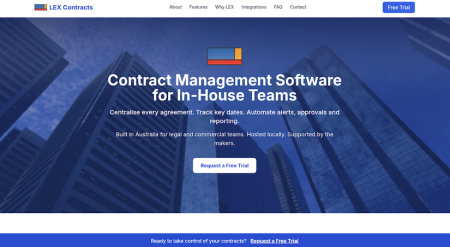
LEX Contracts sells a perpetual licence, which in this market makes it the outlier. Pay once and the currency exposure that catches Australian buyers of USD-priced software goes away. The product is a repository with obligations tracking over it: custom fields, full-text search, linked variations, key-date reminders with escalations and reporting that exports into board packs. The repository tracks the agreement well, but the supplier relationship lives elsewhere. Performance reviews, compliance history and commercial decisions depend on records outside the platform. AI only sees the contract rather than the full relationship. It’s hosted in a Sydney data centre and connects to TRIM and Content Manager, the records system much of the Australian government runs on.
What's missing is assurance and modernity. LEX publishes no certification at all, holding no ISO 27001 and no IRAP assessment
and its "government-grade options" is a phrase rather than a standard an assessor audits against. The site names no customer, the published address is a PO Box in Victoria and no AI capability exists.
Pricing (AUD): From A$30,000 plus GST for a perpetual licence, covering migration, setup, training and one year of support. A free trial runs with no time limit.
Suits: Australian agencies and enterprises wanting to own the licence outright and hang contract data off an existing TRIM estate.
5. Ready Contracts: council and government pedigree
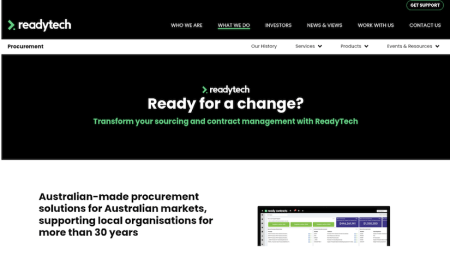
Ready Contracts is the Open Windows product, now sold by ASX-listed ReadyTech, and it carries the deepest local government footprint in this market: more than 50 councils, all-of-government deployments, and government-owned corporations across utilities, energy, ports and transport. The product packages in tiers, from a contract register through CLM up to full source-to-contract, so a council grows into sourcing without changing platforms. Arcare Aged Care and Evolution Mining appear as named customers.
For an Australian-made product sold into government, the omissions read as odd. The product pages publish no certification and no data residency claim, where the closest local peer publishes an IRAP assessment to PROTECTED. Scope also tilts procurement-led, so legal-side drafting isn't evidenced.
Pricing (AUD): Not published. ReadyTech describes the product as practical, value-for-money contract management with no figure attached.
Suits: Australian councils and state agencies buying a register today with a path into source-to-contract later.
6. OneAdvanced: the Portt lineage under a UK owner
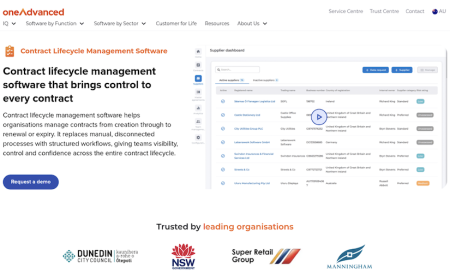
OneAdvanced runs a localised Australian CLM under its en-au product line and Portt, the Australian source-to-contract vendor, has joined OneAdvanced. Its customer wall is the hardest reference set to obtain in this market: NSW Government, the NSW Department of Primary Industries, Manningham Council, Super Retail Group, Glencore and Local Government Procurement, with named testimonials from WEHI and DPIRD. The product covers templates, clause libraries, approval workflows, variation tracking and renewal reporting, with risk scores aimed at legal teams. Supplier performance still sits outside the legal workflow, though. Contract reviews can tell you what was agreed, but they don't show whether the supplier delivered against those commitments. Procurement still needs another system for that picture.
That logo wall makes the gaps louder. OneAdvanced publishes no certification and no data residency claim, which is the first question a NSW agency's security assessor asks. No price appears, only a value calculator and no AI capability shows up in the Australian product pages.
Pricing (AUD): Not published. A source-to-contract value calculator stands in for a price list.
Suits: Australian public sector and enterprise legal teams wanting local support hours and a government reference base they can call.
7. Plexus: contracts inside a wider legal workspace
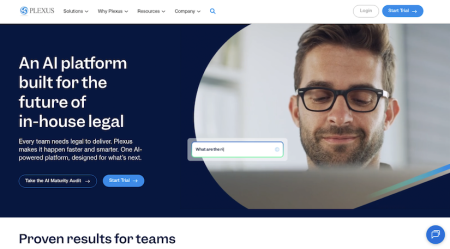
Plexus reaches past contract lifecycle management into matters and compliance, running the contract half inside Microsoft 365 with Word and Outlook add-ins that keep drafting where lawyers already sit. Business teams self-serve routine agreements from pre-approved clauses while legal keeps the template and a knowledge layer answers questions from the organisation's own policies. Its Australian customer evidence leads this list: Woolworths, CPA Australia, ENGIE Australia, REA Group, Lion, Asahi and Noumi. Plexus also maintains a certified ISO 27001 information security management system.
The gap sits where the Australian buying question sits. Plexus publishes no data residency claim at all, despite a customer base including a supermarket chain and an energy retailer and it holds no IRAP assessment. No third-party risk screening exists, so procurement manages suppliers somewhere else. Contracts and supplier records never become one source of truth. AI can analyse legal language, but it can't judge a supplier against performance history or compliance evidence it cannot reach.
Pricing (AUD): Not published. Plexus opens with a free trial rather than a price list.
Suits: Australian in-house legal teams wanting contracts, matters and advisory work in one place inside Microsoft 365.
8. Agiloft: the configurability benchmark
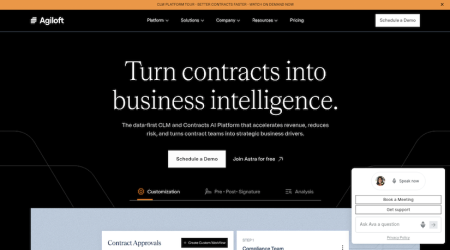
Agiloft is the configurability benchmark in this category. Administrators reshape workflows and data models through a no-code interface without waiting on a developer, drag-and-drop integrations reach more than 1,000 systems, and advanced search locates clauses and obligations across a portfolio. That flexibility earns Agiloft the awkward Australian use cases nobody else handles well, from mining royalty agreements to specialised university research contracts, and Gartner's 2023 Magic Quadrant for Contract Life Cycle Management singled out its generative AI roadmap.
Configurability arrives with a bill. Steep learning curve leads Agiloft's complaint themes on G2, followed by limited customisation and implementation challenges. A higher education reviewer scoring it a 3 out of 5 mentions, "While the platform is powerful, this comes at a cost in terms of how easy the platform is to maintain." That reviewer's team is small and non-technical and the review tells buyers to cost specialist support from the start. Agiloft publishes no hosting claim and names no Australian customer.
Pricing (AUD): Not published. Quotes scale with user count and module selection, so the number moves with how much you configure.
Suits: Australian organisations with contract types that fit no standard template and an administrator to maintain them.
9. DocuSign CLM: continuity from the signature incumbent
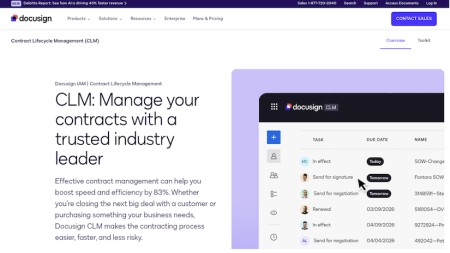
DocuSign CLM is the default consideration on this query, and continuity is the reason: where an organisation already runs DocuSign eSignature, the CLM layer extends it backwards into generation and review and forwards into a repository. Dynamic templates produce an agreement in a click, AI-assisted review checks drafts against custom playbooks, and more than 100 preconfigured workflow steps cover most routing patterns. DocuSign publishes ISO 27001 and SOC 2 Type II on every eSignature tier, and it lists Australia among its data residency regions.
Two costs travel with that. Expense is the loudest complaint theme on its G2 profile, and one reviewer names the mechanism: pricing climbs with contract values and envelope counts, the exact axis a supplier-heavy portfolio grows on. Residency also sits behind a sales conversation, since the published pricing table marks it unavailable on lower tiers and contact-sales on Enhanced.
The contract also sits apart from the supplier record. Renewals, compliance evidence and supplier performance often live on another platform. AI reviews documents well, but it has less commercial context than a system built around the supplier relationship.
Pricing (AUD): Not published for CLM. DocuSign publishes eSignature tiers in USD only, from $10 a month for Personal to $40 per user per month for Business Pro.
Suits: Australian organisations standardised on DocuSign that want generation and a repository above the signature layer.
10. Ironclad: the enterprise legal benchmark
Ironclad closes the list because it's the enterprise legal benchmark rather than an Australian one. Its Workflow Designer maps multi-team approval hierarchies with more depth than anything else here and Jurist ships agents built for legal work rather than a chat wrapper over a repository. Gartner named Ironclad a Magic Quadrant Leader for CLM in 2025, Forrester placed it as a Leader the same year and it tops the Capterra Australia listing for this category.
The Australian answer is where it struggles. Ironclad states on its own security page that it "uses the US-hosted Google Cloud Platform for production servers", so a buyer with an onshore requirement has a short conversation. Search leads the complaints on its G2 profile: one global commercial manager reports that searching for a supplier agreement returns a long list of contracts as though they all match, because no counterparty record separates them.
The problem runs deeper than search. The supplier never becomes its own record, so the platform searches documents rather than relationships. AI can summarise contracts, but it can't connect them to supplier performance or ongoing compliance work.
Pricing (AUD): Not published. Ironclad quotes per enterprise and G2 buyers rate its perceived cost at the top of the scale.
Suits: large Australian legal teams with high contract volume and complex approval hierarchies, where onshore hosting isn't a requirement.
Contract lifecycle management software compared on Australian criteria
Every cell reflects what the vendor publishes on its own site as at July 2026. "Not published" means the vendor makes no claim either way, which is itself information.
|
Platform |
Australian hosting stated by the vendor |
Counterparty held as its own record |
Configurable approval workflow |
Obligation and renewal tracking |
AUD pricing published |
Australian customers named
|
|
Gatekeeper |
Not published |
Yes, unified with the contract |
Yes, no-code Kanban engine |
Yes |
Not published |
None published |
|
Contract Cloud |
Yes, AWS Sydney |
No |
Not published |
Yes, structured register |
Yes, $299 + GST per user per month |
None published |
|
WebCM |
Not published |
No |
Yes |
Yes, traffic-light reporting |
Not published |
Logos published, testimonials unattributed |
|
LEX Contracts |
Yes, Sydney data centre |
No |
Not published |
Yes, key dates and obligations |
Yes, from A$30,000 + GST |
None published |
|
Ready Contracts |
Not published |
Yes, supplier onboarding module |
Yes |
Yes, contract performance |
Not published |
Arcare Aged Care, Evolution Mining, 50+ councils |
|
OneAdvanced |
Not published |
Not published |
Yes |
Yes, milestones and obligations |
Not published |
NSW Government, NSW DPI, Manningham Council, Glencore |
|
Plexus |
Not published |
No |
Yes, automated approvals |
Not published |
Not published |
Woolworths, ENGIE Australia, REA Group, CPA Australia |
|
Agiloft |
Not published |
No |
Yes, no-code |
Yes, obligation extraction |
Not published |
None published |
|
DocuSign CLM |
Australia listed as a data residency region |
No |
Yes, 100+ preconfigured steps |
Yes, 100+ extraction models |
Not published |
None published |
|
Ironclad |
US-hosted Google Cloud Platform for production servers |
No |
Yes, Workflow Designer |
Yes |
Not published |
None published |
Read the first and last columns together and the market splits in two. Vendors publishing a hosting claim tend to name no customer, and vendors with the customer wall make no hosting claim. Nobody sits on both sides of that split. DocuSign comes closest with a published residency region and no named Australian customer.
Where an Australian contract management system earns its keep
Each obligation below arrives on a date and lands on someone who has to prove what happened.
- Modern slavery statements. Entities turning over AUD $100 million or more in consolidated revenue each year lodge a statement inside six months of the financial year closing, an obligation running since 1 January 2019, and almost all the supporting evidence starts as contract and supplier data.
- APRA material service provider registers. APRA gave contracts already running with a material service provider a transitional window under CPS 230 and it closed at the earlier of the next renewal or 1 July 2026, so every such contract now falls inside the standard, whatever its vintage.
- NSW heightened due diligence reporting. Since 1 July 2024, covered NSW entities file a transactional report for Heightened Modern Slavery Due Diligence procurements of AUD $150,000 or more, within 45 working days of contract commencement. The trigger is contract commencement, not year-end.
- Commonwealth procurement. The Commonwealth Procurement Rules 2025 commenced on 17 November 2025, over a market that ran to $104.9 billion across 86,926 contracts in 2024-25, with supplier information duties written into the contract terms.
What to look for in contract lifecycle management software
A repository that holds the counterparty as well as the document
Ask whether the platform stores the supplier as a record with its own certifications and diligence evidence, or as a name typed onto each agreement. The difference shows the moment you need every contract with one supplier plus proof that someone assessed that supplier. It’s also important to discern if the platform stores the supplier as a record with its own certifications and diligence evidence, or as a name typed onto each agreement. The difference shows the moment you need every contract with one supplier plus proof that someone assessed that supplier. It also shapes what AI can do. One supplier record gives it the full commercial picture. Separate systems force it to work with partial information.
Approval workflows you can reconfigure without a consultant
Every vendor uses the word configurable. The loudest recurring complaint in this category is that reconfiguration needs a partner or a support ticket, turning a policy change into a project. Four questions separate the claim from the practice:
- Who changes an approval threshold, your administrator or the vendor's team?
- How long does the vendor take when a change has to go through them?
- Does a change to one workflow disturb the approvals already running?
- Which changes sit outside the licence and carry a services fee?
Search that survives portfolio scale
Search quality degrades as volume grows and is worse where retrieval depends on how well somebody tagged a file at upload. Ask whether the system separates customer agreements from supplier agreements in one query.
What contract management software costs in Australia
Published Australian cost guidance puts entry-level repositories at about $1,000 to $5,000 AUD a year, mid-range platforms at $5,000 to $20,000 and enterprise CLM implementation at $20,000 to $100,000, with subscriptions often above $50,000 a year.
Concrete numbers are thin, which is itself worth knowing. Contract Cloud publishes $299 plus GST per user per month. LEX Contracts publishes from A$30,000 plus GST for a perpetual licence. Every other platform here quotes on request, which makes budget planning before a sales cycle guesswork.
Three cost mechanics deserve attention. Per-named-user pricing punishes organisations where business owners also need access, so count the people who'll open the system. Implementation seldom sits inside the subscription and one vendor here charges 20% of what you pay for the opening subscription year. Currency is the third, since most global vendors bill in USD, leaving exchange-rate exposure on a multi-year commitment.
Whether Australian law requires local data residency
No general Australian law forces a private-sector organisation to keep contract data onshore. What the law does is make the offshore arrangement your problem. Under APP 8 of the Privacy Act 1988 (Cth), a discloser has to take reasonable steps so an overseas recipient won't breach the Australian Privacy Principles. Section 16C then holds the discloser accountable for acts of the recipient that would breach them, even where it took reasonable precautions. Sector rules tighten it further: APRA-regulated entities work under CPS 230 and CPS 234, and government procurement can attach residency conditions to a specific contract.
For agencies and regulated buyers, an IRAP assessment answers the question fastest. The Australian benchmark is TechnologyOne, IRAP-assessed to PROTECTED with local data storage. None of the ten platforms above publishes one, which tells you how young this part of the market still is.
What to ask a vendor about hosting
AI search summaries repeat hosting claims that vendors never make themselves. One platform here gets called Australian-hosted in answer boxes while its own homepage claims only Australian origin. Ask the vendor, in writing:
- In which country and region does customer data sit at rest, and in which does it sit in backup?
- Does that answer hold on the plan we're buying, or does residency sit on a higher tier?
- Do you hold an IRAP assessment and to what classification level?
- Which certification do you hold, with which version year and can we see the certificate?
Wording carries weight in the answers you get back. A vendor saying it aligns with a standard hasn't passed an audit against that standard, so ask for the certificate itself rather than the phrasing around it.
How contract management software supports modern slavery reporting
The Modern Slavery Act 2018 (Cth) catches an entity that's based in Australia or operating here and turns over AUD $100 million or more in consolidated revenue each year. Obligations commenced on 1 January 2019 and a statement falls due no later than six months after the financial year closes. Section 13 requires the principal governing body to approve the statement and a responsible member to sign it, and section 16(2) requires those approval details inside the statement. There are no penalties today for non-compliance, which is the fact most vendor marketing gets wrong. The register's 17,543 statements split into 16,446 mandatory and 1,097 voluntary lodgements.
Michelle Rowland, the Attorney-General, said on 16 July 2026 that the government intends to create a criminal offence of failing to prevent modern slavery, alongside civil penalties for the existing reporting duties. Treat that as proposed and nothing more. No bill exists, no exposure draft exists, the government has published no penalty figure and nobody has set a commencement date. The revenue threshold stays at $100 million.
The announcement aims at what happens in a company's supply chains, most law firm briefings read it as catching its own operations too and the consultation has yet to settle where that boundary sits. As announced, the offence is attached to companies. It creates no duty and no liability for officers or directors and no law firm briefing on the announcement identifies one. What the board already carries is the section 13 approval and signature.
The Modern Slavery Amendment Act 2021 (NSW) repealed section 24, so private companies don't report at all under the NSW regime. Those duties fall on the public sector.
For the software, the requirement breaks into three artefacts: a supplier population described by category and country, a record of which suppliers you assessed and what followed, and an approval trail showing the governing body signed off on the date the statement claims. Software holding the counterparty as a record produces all three from one query. Split contracts from supplier records and that evidence has to be assembled by hand. Every extra system adds another place to search before an audit or regulatory review.
Choosing contract management software in Australia
The right contract management software for an Australian organisation depends on which question lands on you. Legal teams drafting high volumes of their own paper get more from a drafting-led platform, and councils buying under procurement rules get more from a register built around panels and probity.
Teams carrying modern slavery reporting, an APRA material service provider register or NSW due diligence deadlines get more from a system where the supplier record and the contract record are the same record. That design matters after the agreement is signed. AI works best when contracts, supplier history and compliance evidence stay together. Split those records apart and every recommendation starts with less context.
Whatever the shortlist, apply two filters before the demo. Make every vendor state its hosting arrangement in writing on the plan you're buying, because a claim from a search summary isn't a claim the vendor made. Then ask each one to confirm in writing that a full approval trail for a single agreement exports intact. Contract lifecycle management software that manages the second on your own data will handle most of what an Australian regulator asks.