Two Brisbane cases may test Queensland’s speech laws in court, but the deeper question is why they restrict some speech while leaving its mirror untouched, writes M Dalton.
When Liam Parry and Jim Dowling return to Brisbane Magistrates Court on 29 April, the legal contest will be framed in the language of hate speech. The structural contest is simpler. Why was a law of this architecture built and who is protected by the fact that no law of the opposite architecture was built in its place?
The second question is the one that survives any magistrate's ruling.
Last week, IA carried an analysis of Jarrett v NSW [2026] NSWCA 62, in which the New South Wales Court of Appeal struck down a provision indistinguishable in structure from Queensland's Fighting Antisemitism and Keeping Guns out of the Hands of Terrorists and Criminals Amendment Act 2026. Chief Justice Andrew Bell, President of the Court of Appeal Julie Ward, and Justice Stephen Free held that the impugned provision could not survive the McCloy structured proportionality test and was incompatible with the implied freedom of political communication
The argument the Crown advanced in Sydney was that the provision protected social cohesion. That argument did not reach the adequacy of balance. It did not need to. It did not survive suitability. That was the legal story.
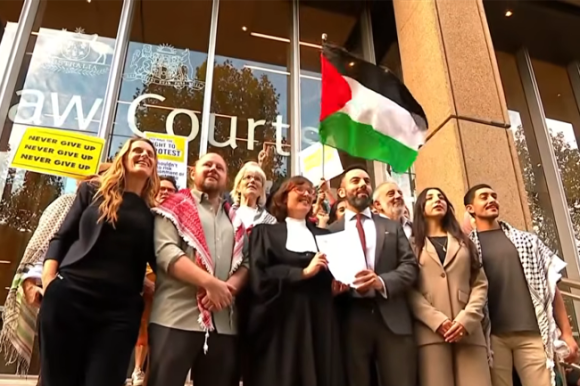
This piece takes up a different thread. Two Queensland magistrates will hear the first contested prosecutions under the Queensland statute on 29 April. Mr Parry was on the footpath outside Queensland Parliament for reciting six words. Mr Dowling outside the Brisbane headquarters of Boeing for a banner. Both magistrates will be asked to work through the Lange doctrine and the McCloy test.
Both will also sit inside a structural question that is older than the statute and that the statute cannot answer from the inside.
Two questions that will sit in the courtroom, whether or not they are pleaded
The first question is the one counsel will argue. Does the Queensland provision satisfy Lange? Is it compatible with the constitutional system that the High Court identified in that case and refined through Coleman v Power, McCloy v NSW and Brown v Tasmania? Is there a legitimate end? Is the measure suitable? Is it necessary? Is the restriction on the implied freedom adequate in its balance against the stated end?
The second question is not a Lange question. It is prior to Lange. It asks why a law of this specific architecture was built and whose interests are protected by the fact that no law of the opposite architecture was built alongside it.
That second question does not require the court to decide anything. It is not an argument. It is the context in which the first question arrives on the bench.
What Mr Parry and Mr Dowling will test on 29 April
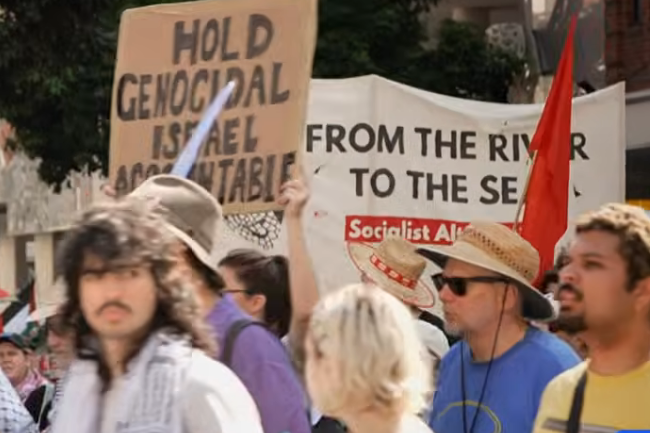
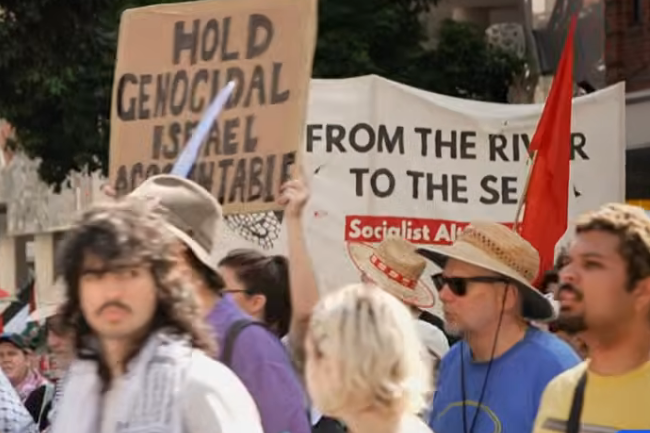
Mr Parry was arrested on 11 March 2026 for reciting the phrase “from the river to the sea” at a pro-Palestine gathering outside Queensland Parliament. His matter was first heard at Brisbane Magistrates Court on 8 April and adjourned to 29 April.
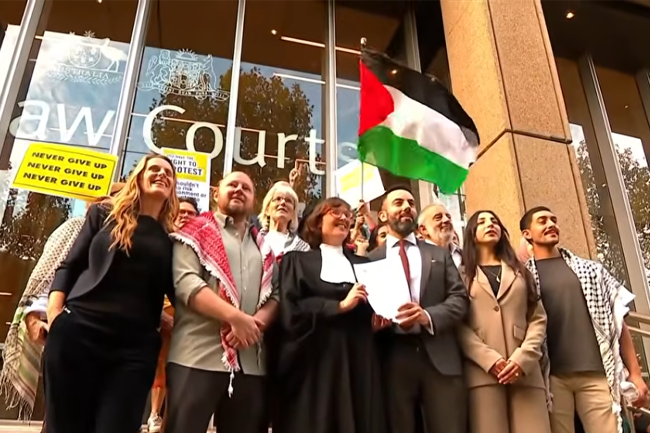
Mr Dowling, a 70-year-old Catholic worker, was charged on 18 March 2026 for a banner outside Boeing that read ‘From the river to the sea, Brisbane will be free of Boeing’. He appeared on 14 April. He indicated from the bar table that he would plead not guilty and that, in his words, “the charge is insane”. He did not foreshadow a mental-impairment defence. He was granted bail and the matter was adjourned to 29 April.
The distinction matters. A mental-impairment plea concedes the conduct and contests capacity. Mr Dowling contests the charge. That is a Lange-adjacent posture, not an insanity posture.
The first contest at the magistrate level will be whether the conduct meets the statutory elements. The second will be whether, if it does, the statute itself stands. In the second contest, the magistrates are not the forum of last resort. They are the forum of first contact with a law whose architecture has just been examined by the NSW Court of Appeal in a parallel statute and found wanting.
This is why the 29 April hearings matter beyond the two men standing in the dock. They are the first public sighting of the statute in contact with the constitutional framework. If the magistrates take judicial notice of Jarrett, the implied freedom point will arrive early. If they do not, it will arrive later in a superior court and the same contest will run the same way.
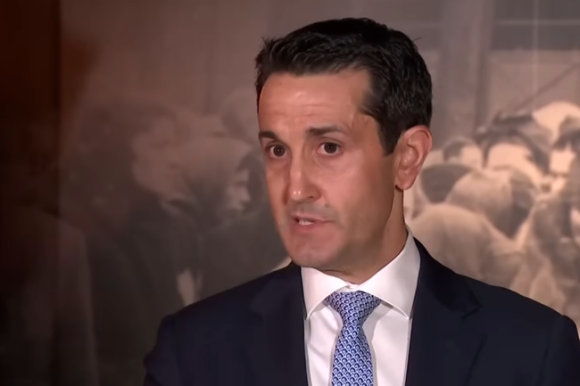
The architectural question: whose speech was protected, and whose was not?
Step outside the statute for a moment. A parliament drafting a speech restriction is making an architectural choice. The choice is not only what to prohibit. The choice is also what to leave unprohibited, what to leave unnamed and what to leave in the public domain unmolested.
The Queensland statute and the cognate Commonwealth package that received Royal Assent on 21 January 2026 as the Combatting Antisemitism, Hate and Extremism (Criminal and Migration Laws) Act 2026 and the Combatting Antisemitism, Hate and Extremism (Firearms and Customs Laws) Act 2026, criminalise a specific register of political speech.
They do not criminalise comparable speech targeting other identifiable groups. They do not criminalise the rhetorical incitement of other violence. They do not criminalise advocacy that could be characterised as dehumanising of other minorities.
Those choices are not neutral and they are not accidents. They are architecture. This is what the second question asks. Why was this architecture built? Who is protected by the fact that only this architecture was built and no reciprocal architecture was built in its place?
That is not a hate speech question. It is a law-of-the-statute-book question. Every speech restriction in Australia sits inside a corpus of speech non-restrictions. The shape of the restriction and the shape of the non-restrictions are the same shape read from two sides. They are the same document.
The Commonwealth problem, revisited
Previously, this masthead noted that the Commonwealth legislative response was drafted in substantially the same architecture as the Queensland statute and would, on the Jarrett reasoning, face the same implied-freedom problem on the same test. Since then, the Commonwealth package has moved from draft to law.
The Combatting Antisemitism, Hate and Extremism (Criminal and Migration Laws) Act 2026 (C2026A00002) and the Combatting Antisemitism, Hate and Extremism (Firearms and Customs Laws) Act 2026 (C2026A00001) both passed Parliament in a late-night sitting on 20 January 2026 and received Royal Assent on 21 January 2026.
The Commonwealth problem is therefore no longer a drafting problem. It is a standing statute problem. Provisions in the same architecture as the NSW provision struck down in Jarrett now sit on the Commonwealth books. The Solicitor-General's advice on Lange compatibility, if one has been provided, has not been tabled. It would be unusual for such advice to have been provided and for the legislation to have retained its current architecture without modification.
That is a public interest question. Parliament is entitled to answer it in public. So is the Attorney-General.

The ASIO question, revisited
The Director-General of Security's most recent public threat framing, delivered by Mike Burgess as the 2025 Lowy Lecture at Sydney Town Hall on 4 November 2025 and consistent with his open Senate Estimates evidence, did not name the speech registers that the Queensland and Commonwealth provisions target as the primary vector of politically motivated violence risk in Australia.
That is a data point. It does not decide anything. It sits behind the two questions as context. If the asserted legitimate end of the statute is the reduction of politically motivated violence risk and if the intelligence community's own threat picture does not align the prohibited speech register with that risk, then the statute's claim to suitability under McCloy is evidentially thinner than the drafting suggests.
Jarrett reasoned at this level. Queensland magistrates will be asked to reason at this level, too.
The frontier-AI analogue, and why it belongs in this conversation
It will surprise some readers to find AI governance discussed next to hate speech law. The connection is architectural.
On 13 April 2026, the Dutch public think tank De Balie in Amsterdam ran an event titled ‘AI at War’. The speaker was Shane Harris, national security journalist at The Atlantic (previously of The Washington Post, where he shared the 2022 Pulitzer Prize for Public Service).
Mr Harris's De Balie remarks sat alongside two Washington Post articles that had run in late February 2026 on a standoff between the AI company Anthropic and the United States Department of Defence.
The first, on 26 February 2026, was bylined Tara Copp and Ian Duncan. It reported that Anthropic had declined to permit use of its Claude model for either domestic mass surveillance or fully autonomous lethal weapons and that the Pentagon had pushed back.
The follow-up, on 27 February 2026, titled ‘Pentagon declares Anthropic a threat to national security’, was bylined Ian Duncan, Tara Copp and Elizabeth Dwoskin. It reported that Secretary of Defence Pete Hegseth had, on his X account on the same day, directed the designation of Anthropic-deployed Claude usage as a supply- chain risk.
A subsequent memorandum signed by Deputy Secretary of Defence Steve Feinberg on 9 March 2026, obtained and reported by DefenseScoop (Brandi Vincent), elevated Palantir's Maven Smart System to formal program-of-record status and directed the transition of system administration and oversight from the National Geospatial-Intelligence Agency to a new Maven Smart System Program Office within the Chief Digital and Artificial Intelligence Office, with full program-of-record transition due by the end of the United States fiscal year in September 2026.
The Copp-Duncan, Duncan-Copp-Dwoskin and Feinberg documents are the primary record of two distinct Pentagon actions in the same month: a supply-chain-risk designation of one vendor and a program-of-record elevation of another.

Mr Harris's De Balie appearance sat downstream of that reporting and gave it a European public reading. The architectural question, in the frontier AI case, is the same shape as in Queensland. Why was the procurement-backed targeting architecture built and not the procurement-backed civilian-protection architecture? Who is protected by the asymmetry?
This is not an analogy to Queensland. It is the same instrument. The speech statute criminalises one register of speech and leaves its reciprocal unnamed. The defence procurement architecture funds one class of AI application at program-of-record scale and leaves its reciprocal unfunded. The question survives in both cases and the answer is the same shape in both cases.
What the 29 April hearings will and will not decide
The magistrates will decide whether the statutory elements are met on the facts. They may, if counsel raises it and the bench accepts it, rule on implied freedom compatibility. They may not.
What the hearings will not decide is the architectural question. They cannot. A magistrate's jurisdiction does not extend to asking why a parliament chose to build a law of this shape and not the reciprocal shape. That question sits above the court, in the political organ that passed the statute and in the public record that attends the passage.
This is why the hearings matter and also why they are not sufficient. If the implied freedom point lands, the statute will be re-argued up the appellate structure and will likely fall in the same place that the NSW provision fell. If it does not land at the magistrate level, it will land higher.
Either way, the architectural question remains and it remains answerable only in the open record.
What to watch on 29 April
Three things are worth watching. First, whether counsel raises Jarrett as authority on implied freedom compatibility and whether the magistrates accept it as directly on point. They should. The architectural symmetry between the NSW and Queensland provisions is unusually close.
Second, whether the prosecution advances a social cohesion theory of suitability on the Lange limb. In NSW, that theory did not reach adequacy of balance. It collapsed at suitability. Queensland is not obliged to re-run the same approach, but there is no evidentially different approach available on the public record.
Third, whether any observer in either courtroom articulates the architectural question to the public audience of the proceeding. The magistrates cannot reach it. Counsel does not need to reach it. A public audience is entitled to notice it.
A structural observation
Two men stand in the dock on 29 April. Six words and a banner. The matters before the court are their matters. The matter before the court is the shape of the statute and the shape of the unwritten reciprocal.
A parliament that builds the first and not the second is making an architectural choice. The choice is answerable in the political record, whether or not the court chooses to answer it in the legal record. The court's work is its own. The architectural question is the readers' work.
On 29 April, it is available for reading. Approximately 2,280 words.
M Dalton is an independent researcher with a civil liberties and constitutional law focus.
 This work is licensed under a Creative Commons Attribution-NonCommercial-NoDerivs 3.0 Australia License
Support independent journalism Subscribe to IA.