Australia condemns human rights abuses abroad but still won’t protect them at home, writes Dr Bronwyn Kelly.
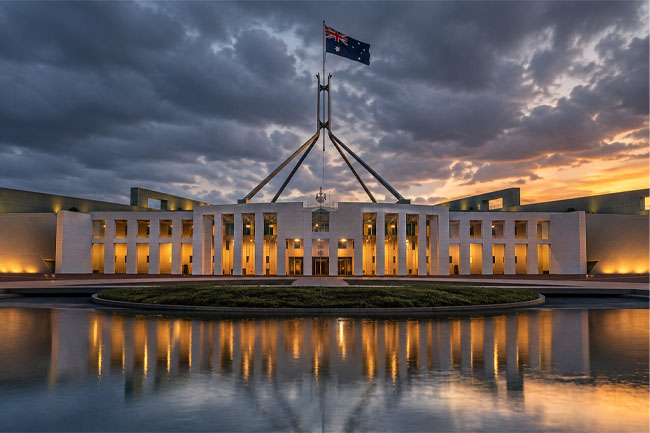
THERE IS A GLARING and galling hypocrisy in the call by Penny Wong, Anthony Albanese and Richard Marles.
In a statement to Iran, the Prime Minister wrote:
'We have called for the Iranian regime to uphold the human rights and fundamental freedoms of Iran’s citizens.'
Coming from the party that has persistently refused to introduce a human rights actin Australia, and coming as it does to justify an attack on the sovereignty and people of Iran, the whole posture is doubly offensive.
Labor governments, at the federal level at least, have for years stubbornly refused to legislate human rights for Australians. This refusal was manifest in 2010 when a federal Labor government refused to consider introducing a Human Rights Act and again in 2024 when another federal Labor government rejected a recommendation by the Joint Parliamentary Committee on Human Rights to establish a human rights act.
So the citizens of Australia and Iran both suffer from lack of human rights. But surely this does not justify a military attack on Iranians any more than it would justify a military attack on Australia (or any other sovereign country).
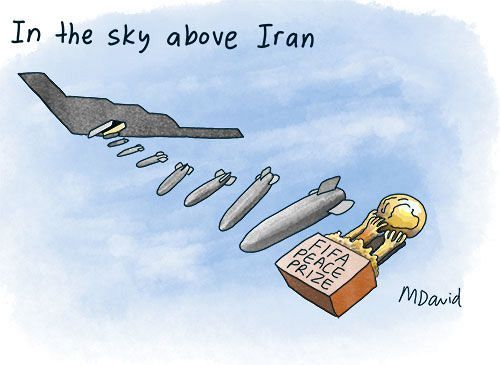
Doubtless, the government is attempting to send some sort of message that when a state attacks its own people, it is permissible for other countries to attack that state, even if a military intervention has not been approved by the UN.
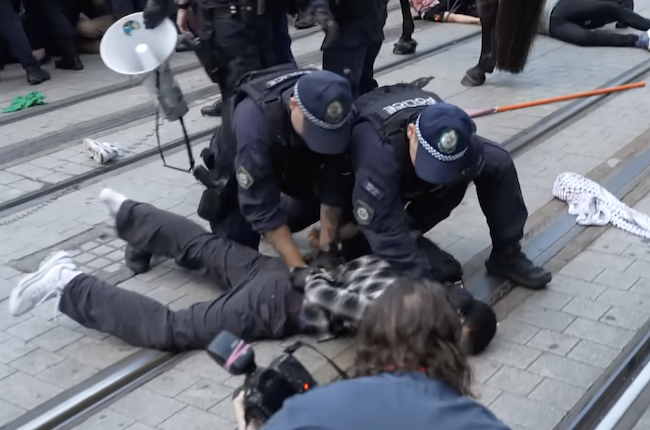
But if that is what our government truly believes, then it would be as well for the federal government to crack down on the recent surge by the New South Wales government in its sanctioned police violence against protesters, lest it create a moral basis for internally generated destabilisation of our governance or for external interference in our democracy.
Only two months ago, I published a new book in which I wrote that the state:
'... has not violently turned against the Australian people in the way it has, say, on the American people under the second Trump regime.'
But it looks like I spoke too soon. Events in Sydney on 9 February, when police violence against protesters flared to unprecedented levels, overtook me.
These events show that Australia is not a society that, in its laws, is sufficiently fortified against abuses of human rights by the state, particularly when it comes to the right to protest. Our silence in law on this matter is becoming a real, physical risk to everyday Australians — even when they are complying with the law and with directions from police.
Australia has arrived at a nasty tipping point in its cultural and democratic stability — and we have hit that point quite suddenly. A palpable disturbance has occurred in how we have always thought of ourselves as a free, democratic and largely harmonious society. The spectacle of coordinated, stormtrooper-like and quite apparently premeditated police violence unleashed on peaceful crowds is new in Australia but terribly chilling.
And so, a human rights act would be a very healthy step at this time. It would compensate, at least a little, for the hypocrisy over Iran (now sickening because of the killing of school children) and for the police violence in Sydney. And it might begin to reassure Australians that the state is with them, not against them.
Having said that, if past resistance to a human rights act is anything to go by, we should not realistically expect a turnaround. Current governments in Australia are too fearful of a probable growth in protest against them to pull back now, let alone to go so far as to finally legitimise human rights in domestic law.
Nevertheless, to bolster and be safe in any claim to legitimately govern Australia, federal and state governments do need to find a way to secure the human rights of Australians – in fact, if not in law – and to restore our confidence that they actually respect those rights. At the very least, they need to prevent further erosion of our confidence. Or to put that another way, they need to restore our trust that they will act in the public interest. One way they can do that is to establish a public-interest economy.
As has been shown across the Western world, trust in governments is eroded quickly when they directly attack their own people’s civil and political rights; but it’s also eroded gradually when they make decisions that eat away at their economic, social and cultural rights.
This is what American governments have been doing since the 1970s and it has resulted in bitterness by those left behind — a justifiable bitterness that has now fully destabilised that country’s governance. America is the divided society that, surely, we must not want Australia to become. And yet it seems likely that we are on the brink.
If so, it follows that any Australian government that wants to keep our society together, that wants community cohesion or what the Prime Minister prefers now to call unity – with overtones of an unfortunate reduction of cultural diversity, but let’s give him the benefit of the doubt on that – might consider doing something to slow down or even reverse the erosion of the economic, social and cultural rights of Australians. If they can do that, they might yet stave off the sort of civil and political dystopia now so evident in the U.S. and in other states where fascism is on the rise in response to the growth of poverty and inequality.

Access to the protection of economic, social and cultural rights is obviously in decline in Australia and has been so for most of this century. The cumulative effects of this are apparent in the rise in mental ill-health and chronic conditions and the substantial growth in poverty and wealth inequality in Australia, documented in detail here, here, and by the government itself here.
This socioeconomic atrophy is what leads to a decline in trust in governments, long before they start behaving hypocritically in blustering support for illegal wars and in denial of the rights of Australians who differ with them on vital matters like genocide or climate change.
No one trusts a hypocritical government to act in the public interest. But they might begin to trust a government that openly works with them in a partnership to at least make economic decisions that will clearly secure their welfare and well-being — and make a choice to do that before all our confidence is lost.
To that end, there is an option available to the government to embark on an Australian Public Interest Collaboration – a program of open community engagement where Australians can establish a new social contract with their governments that will reinforce their confidence in each other and hence stabilise our governance and strengthen our democracy in the face of rising global fascism and economic instability.
This sort of collaboration, or similar, might be the only way to restore equanimity in our society, or it might not; but if the government has a better option, then let’s hear it, before all confidence in their commitment to the rights of Australians is lost.
Dr Bronwyn Kelly is the Founder of Australian Community Futures Planning (ACFP). She specialises in long-term integrated planning for Australia’s society, environment, economy and democracy, and in systems of governance for nation-states.
 This work is licensed under a Creative Commons Attribution-NonCommercial-NoDerivs 3.0 Australia License
Support independent journalism Subscribe to IA.