A magical world, a legendary lion and a Hollywood icon have collided in Greta Gerwig’s Narnia adaptation. But with Meryl Streep cast as Aslan, some fans are already roaring in protest, writes Michael Gibbons.
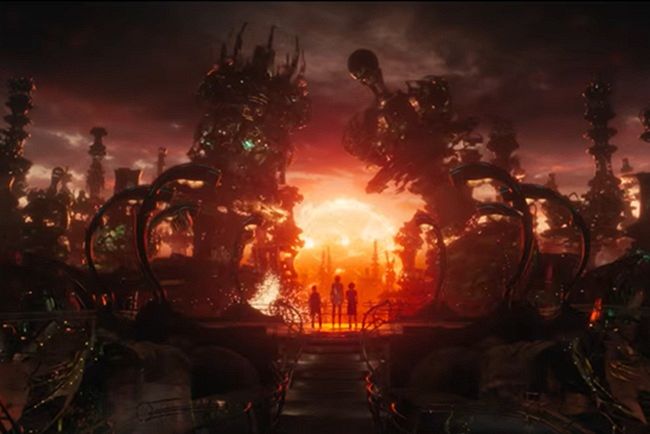
THE FIRST TRAILER for Greta Gerwig's adaptation of C.S. Lewis's book The Magician’s Nephew was released in Australia on 14 October.
With it came the familiar social media backlash that seems almost inevitable whenever a major blockbuster attracts the attention of online fan communities.
Published in 1955 as the sixth of the seven Chronicles of Narnia books, The Magician’s Nephew is the chronological prequel to The Lion, the Witch and the Wardrobe, taking readers to the beginning of Narnia’s story.
Opposition to the film stems from three main issues.
First, the setting shifts from the early 1900s of Lewis’s original story to the post-World War II 1950s in Gerwig’s adaptation.
Some fans see this as disrespectful to the source material. Although we don’t yet know the direction of any subsequent films, Gerwig has earned enough trust as a filmmaker to bring her vision to life, particularly if the plan is to adapt all seven books.
The second objection concerns the colour palette, with some fans lamenting what they see as the "Hollywoodification" of Narnia.
The trailer’s bright, fantastical colours may clash with the more subdued world some readers imagined.
That impression is reinforced by the choice of Led Zeppelin’s Stairway to Heaven for the trailer’s soundtrack, prompting concerns that Narnia is being given the kind of blockbuster makeover associated with Marveland DC superhero films.
Finally, and the focus of this article, there is the casting of Meryl Streep as Aslan.
The controversy raises several related questions. Should a woman voice a male character, or does the casting suggest Gerwig has changed Aslan’s gender?
And does the character’s significance as a Christ figure make the choice of a female voice actor particularly contentious?
The question of whether a woman can convincingly voice a male character is perhaps the less complicated aspect of this debate.
Animation has a long history of women voicing male characters, often without audiences realising it.
One of the best-known examples is Nancy Cartwright, the voice of Bart Simpson. She also voices schoolboys Nelson Muntz and Ralph Wiggum. I doubt many viewers hear these characters and imagine they are listening to a woman.
Indeed, many are surprised to learn that Bart is voiced by a woman. Other prominent examples include Pamela Adlon as Bobby Hill in King of the Hill and EG Daily as Tommy Pickles in Rugrats.
Australia has its own example in Robyn Moore, who voiced Simon, Dot’s brother, in Dot and Keeto (1986), as well as the much-loved Blinky Bill. The latter is a character many Australians will recognise from their childhoods.
Moore’s performance is a reminder that a character’s identity is not necessarily defined by the gender of the actor behind the voice.
Aslan is widely understood as a Christ figure, although Lewis’s own explanation was more nuanced than a straightforward one-to-one allegory. He imagined what Christ might become if he entered a world like Narnia, where he would appear not as a man but as a lion.
For some Christian readers, Aslan is not simply a character who resembles Jesus but represents Christ himself within the fictional world of Narnia. It helps explain why they see the casting of a woman in the role as a theological concern, rather than simply an unconventional choice of voice actor.
One commenter in a Reddit discussion about the casting argued that Aslan was not merely a representation of Jesus, but Jesus himself within the world of Narnia.
The commenter compared the casting to the hypothetical prospect of a woman portraying the Prophet Muhammad, suggesting that believers in other faiths might also object to what they regarded as an inappropriate representation of a sacred figure.
Of course, Aslan is not simply another portrayal of God. He is a male lion whose significance as a Christ figure is central to how many readers understand the character.
But that makes the distinction between the character and the performer all the more important. Does a female voice necessarily alter the character's identity, or can an actor bring a different interpretation to a role without changing what that character represents?
Hollywood has a history of casting women as God, including in productions that treat the subject with very different tones. Frances McDormand voices God in the television adaptation of Good Omens (2019), while Octavia Spencer portrays God, known as Papa, in The Shack (2017). Whoopi Goldberg played God in the comedy It’s a Very Merry Muppet Christmas Movie (2002), and Alanis Morissette played The Almighty in Kevin Smith's cult classic Dogma (1999).
These examples range from comedy to serious drama, but they demonstrate that audiences have encountered female portrayals of God before. Some of the online outrage over Streep’s casting appears to stem from the belief that it is disrespectful or even blasphemous to give Aslan a female voice.
Greta Gerwig’s career speaks for itself. She has progressed from independent filmmaking to directing Barbie (2023), one of the biggest box-office successes in recent years. I believe her body of work should afford her some artistic licence to make the world of Narnia her own.
It seems unfair to condemn the film before seeing the finished product, and particularly before hearing Meryl Streep’s interpretation of Aslan. Liam Neeson voiced Aslan in the 2005 film The Chronicles of Narnia: The Lion, the Witch and the Wardrobe, leaving Streep with some big shoes to fill.
In an interview with Empire magazine in September 2026, when asked about casting Aslan, Gerwig explained:
“I wanted someone who was profound but not pretentious, who had gravitas but not morose self-seriousness. Someone who could communicate depth and pathos as well as joy and delight.”
Gerwig also said she wanted:
“...someone who was older than 70, so there was a wisdom of experience, but who also had the capacity of fresh wonder, like a child”.
Her explanation suggests that considerable thought went into the casting decision. Narnia is an enormously popular fictional world, and it hardly needs a gimmick to attract an audience.
Yet some critics have interpreted Streep’s casting through a political lens, with the possibility of a woman voicing Aslan being labelled “woke” or dismissed as a diversity hire.
But is that really a fair conclusion to draw before audiences have heard her performance?
My own reaction to the trailer was one of awe and anticipation. I remember my primary school teacher reading us The Magician’s Nephew in Year 3 and it helped spark my lifelong love of fantasy fiction.
I love the idea of seeing how someone else imagines the worlds and lands within The Chronicles of Narnia.
Unfortunately, too many people seem to regard the version of a story they have created in their own minds as the definitive one, treating any deviation from that image as a betrayal of the source material.
I would love to see fans, including those who have strong religious objections to the casting, approach this adaptation with a more open mind and embrace someone else’s interpretation of the magical world C.S. Lewis created.
Who knows? In 50 years’ time we might be debating another new adaptation and arguing over whether Streep’s Aslan is still the definitive version.
Michael Gibbons is an Australian writer with a Bachelor of Arts (with Distinction) majoring in Screen and Cultural Studies.
 This work is licensed under a Creative Commons Attribution-NonCommercial-NoDerivs 3.0 Australia License
Support independent journalism Subscribe to IA.



New adaptation of The Magician's Nephew sparks gender debate
A new Greta Gerwig adaptation of The Magician's Nephew has some fans roaring in p ...
Pauline Hanson’s ABC paywall threatens our shared culture
Pauline Hanson’s plan to put the ABC behind a paywall threatens decades of shared ...