Marking half a century since its groundbreaking first edition, Exclusion, Exploitation and Extermination remains a powerful work of truth-telling on colonial race relations. History editor Dr Glenn Davies reviews the 50th anniversary edition.
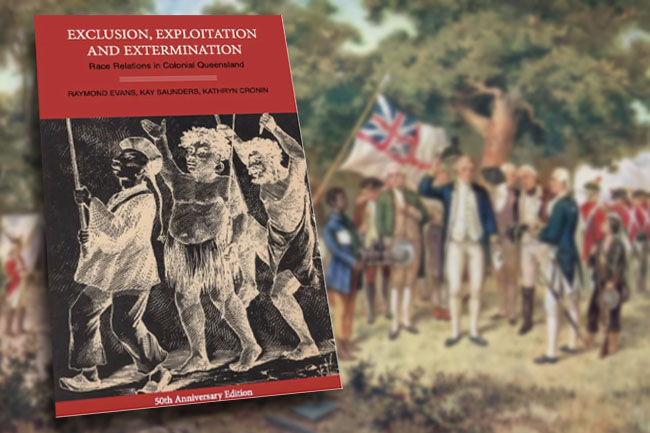
IN 1975, Raymond Evans, Kay Saunders and Kathryn Cronin were young University of Queensland academics who, against all odds, published Exclusion, Exploitation and Extermination: Race Relations in Colonial Queensland.
Fifty years later, it remains one of the hardest-hitting books on the subject to this day.
The publication of the 50th anniversary edition of the book is an important event as it celebrates a work that has shaped the understanding of Queensland’s colonial history and race relations over the past five decades.
First published in 1975 during a cresting wave of anti-racist and anti-imperial activism, Exclusion, Exploitation, and Extermination has demonstrated its longevity and relevance across five decades as an outstanding landmark text.

The anniversary edition is the fourth edition of what has become a classic study in our understanding of Australian colonial race relations history, the European racial ideals that drove Australian nationalism and the adoption of the White Australia policy at our nation’s birth in 1901.
During the 1970s and 1980s, Queensland was an uncomfortable place for anyone who dared challenge the status quo. The Bjelke-Petersen government had no interest in revealing Queensland’s racist past and present to the world. But change was happening.
In 1975, Evans, Saunders and Cronin published the first edition of their pioneering work. This was the same year when Prime Minister Gough Whitlam poured soil through the hands of Vincent Lingiari, signifying the return of Wave Hill Station to its traditional owners, the Gurindji people. It also marked an important chapter in the historic struggle by Indigenous Australians for land rights.
Exclusion, Exploitation and Extermination was the first investigation to deal with the interlocking problems of racism and colonialism in a thoroughly analytical, descriptive, theoretical and structural manner, and to incorporate all the major ethnic minorities. The blending of social, economic, military, eugenic and sexual motivations and fears propelling racism forward in Queensland, while underlying the emergence of a White Australia, is clearly revealed.
The book is divided into three sections, with Raymond Evans covering 19th-century treatment of Indigenous Australians, Kay Saunders dealing with Melanesian (Kanaka) labour in north Queensland, and Kathryn Cronin covering the treatment of the Chinese and demonstrating the violent attitude that White Australians had towards Asians.
Evans, Saunders and Cronin’s joint achievement is astounding when we learn of the conditions under which the first edition was written — little institutional support, financial hardship and apathy or hostility from most fellow University of Queensland academics.
The book is a pioneering work that opened up a vast field for other scholars and the public to explore. It opened our eyes to many uncomfortable truths about our colonial past.
Matthew Condon described the publication as:
‘The classic study of race relations in Australia... It is that rarity of works of history — permanently alive and relevant.’
Jackie Huggins reflected it was:
‘...a book before its time. It has always informed me of where I am now.’
For Melissa Lucashenko it was a:
‘Brave, important and necessary work that was a stepping stone for many to follow.’
Professor Henry Reynolds called the book:
‘One of the major works that helped transform our history... The most meticulously researched account of violence... on the Australian frontier.’
Finally, Julianne Schultz considered it:
‘A genuinely trail-blazing book. It helped to establish a new era of scholarship and to change our understanding of Australian History. Its inconvenient truths still reverberate.’
But there is still widespread refusal in Australia to accept the reality of what Evans, Saunders and Cronin revealed. That makes this work an important and enduring source for the future. It says much about the authors that their study of race relations in colonial Queensland has lost none of its impact.
It remains an extraordinary work. Yet it is more than a historical milestone. It remains today a truth-telling weapon. It does not merely describe racism — it explains it.
The 50th Anniversary Edition of Exclusion, Exploitation, Extermination: Race Relations in Colonial Queensland will be launched at Avid Reader, Brisbane, on 27 September 2025 from 2:00 PM.
You can follow history editor Dr Glenn Davies on Twitter/X @DrGlennDavies.
 This work is licensed under a Creative Commons Attribution-NonCommercial-NoDerivs 3.0 Australia License
Support independent journalism Subscribe to IA.


Related Articles
- Laura Tingle – and News Corp – call Australia a racist country
- 'Race' and the invention of racists
- No pride in prejudice
- Antidote for the poison of Australian racism
- The Liberal Party seems to be a bit racist