Speaking out against racism is praised — unless you’re a person of colour, writes Leon David.
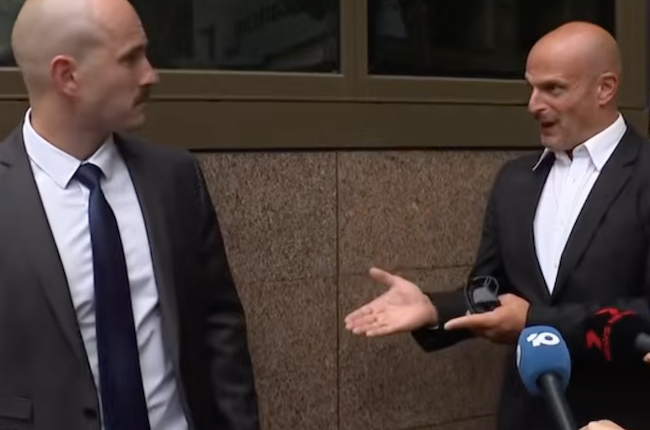
ON TUESDAY MORNING, Raf Epstein on ABC Melbourne’s morning show interviewed David Thiel. Thiel is a white, bald man with a moustache (similar to Thomas Sewell) and he elected to interrupt a media event to criticise Sewell due to his character and clearly racist ideology. Apart from the similar physical appearance, Thiel is clearly not Sewell. As he himself said, most Australians have heritage based in other countries, and there’s no room for hate.
Despite Prime Minister Anthony Albanese’s tepid response to Thiel’s actions on Raf’s show, Thiel did the right thing. He showed courage. He showed dignity. He showed bravery. He’s been criticised and intimidated. But he’s chosen to stay true to himself and his actions. This is the type of inspiration Australia needs.
For a person of colour, the rapid rise of the far-right, including the alarming rise in the potential One Nation vote, means that a new age is upon us where people will freely criticise us and will contest our right to even exist in this country. There have always been elements of this, but now it’s front and centre with early opinion polling showing how dire things have become.
For people like me, when I see a white man with a shaved head and moustache, I can’t help thinking that he must be a supporter of Sewell’s views. In this instance, I was wrong, and Thiel’s actions have given me hope. His actions have also sparked a measure of contrition — after all, I was stereotyping just like the racists. A lesson that I need to heed.

Despite my joy at Thiel’s actions, there’s also an element of disappointment. Because I, and many others who look like me, know that were we to respond in a similar manner, the response and the media scrutiny afterwards would have been very different.
Our anger would have been a convenient excuse for the media to buy into the trope of the angry Indian or the brown person who simply doesn’t know his place. Unlikely that those very words would be used, but the theme would be pretty clear. Be quiet, brown person, and just be happy to be here. It’s not the first time that us visible immigrants have had to have an unthreatening white face speak for us.
Not so long ago, the ABC’s chief political correspondent at the time, Laura Tingle declared Australia to be a “racist country”. She spoke at the 2024 Sydney Writers Festival and made the comments in response to Peter Dutton’s budget response, where he firmly placed the blame for property issues with migrants. In a later incident, as a response to Bob Katter’s outburst after being questioned about his Lebanese heritage, numerous commentators, including Craig Foster rightfully condemned his behaviour.
Both Laura Tingle, and Craig Foster were absolutely correct. Some may have disagreed with their view, and felt they were inflammatory and potentially divisive. But both, and many others, were stating clearly what many of us actually think. The difference is that many of us don’t feel safe enough to speak, whilst Tingle and Foster feel no such reluctance.
And the reason they’re able to speak (and so many of us can’t) is very simple. It’s because they’re white.
Australians are not great with dealing with criticism of their country, although to be fair, I can’t think of any group of people who are. Even though criticism is rarely welcomed, it seems accepted if the person criticising is seen as a “typical” Australian. Laura Tingle, Paul Daley, Craig Foster, and now David Thiel – all “typical” looking Australians.
But woe betide a person of colour expressing any criticism of this country – when such people criticise Australia, they’re seen as being ungrateful to a country that has accepted them. They’re seen as traitorous. And in many cases, such people expressing their frank views support the feeling from racists that such people shouldn’t be allowed to live here anyway.
Take the case of Paul Daley.
Daley is a socially progressive columnist who has expressed challenging views, whether critiquing the mythologisation of Australian military history, supporting The Voice or providing thoughtful commentary about immigration and the treatment of the indigenous community. Not only does he continue to write, but he continues to challenge. His voice is needed.
Now take the case of Yassmin Abdel-Magied. In 2017 around Anzac Day, she posted the words “LEST.WE.FORGET. (Manus, Nauru, Syria, Palestine)”. Note that she didn’t criticise the Anzacs. All she did was to attempt to raise the profile of other atrocities happening across the world. Her post triggered outrage, with threats of violence, racism and led to her leaving Australia entirely. Her voice is needed too, but it’s lost.
Racism and bullying led to one of our most important voices fleeing the country. Yet Paul Daley, who in my view writes much more critical pieces about Anzac history continues to thrive and in my opinion, continues to provide much-needed social commentary and criticism. The difference between the two is pretty self-evident. One is of colour and one is white.
Notwithstanding the concerted anti-immigration push from the media and right-wing parties such as One Nation, Australia loves to consider itself as a beacon of egalitarianism and equality. Until it provides people from all backgrounds with an equal voice, this claim doesn’t stand up to scrutiny. Too often, free speech is granted to white people.
Whilst it’s not denied to people of colour, the vitriol that accompanies people of colour expressing their honest opinion discourages others from doing the same. What ends up being the case is that unless white people speak out to protect migrants and other marginalised groups, the message doesn’t gain traction.
People of colour, people like me, need to rely on the typical white Australian to progress their viewpoints. If we rely upon ourselves, we’re told to “go back to where we came from”, even though in many cases, where we came from is the local hospital down the road. People of colour aren’t really permitted to speak, not with true honesty. Whilst we live here, many of us for multiple generations, we need to remember that we’re lucky to be here and the subtext is that we should always “know our place”. Be part of the country, but don’t dare criticise it.
The opinions of people like Tingle, Daley, Foster and Thiel are necessary. They’re raising issues that many of us are too afraid to express. All of them speak, write and act with passion, with evidence and raise the profile of issues that would otherwise be forgotten. For those of us who are of colour though, it’s a shame we need to rely on them to speak for us.
Until we can all speak with the same level of impunity, and in a manner that befits a country that is proud of free speech, claims of equality don’t stand up to scrutiny.
Leon David is an IA contributor.
 This work is licensed under a Creative Commons Attribution-NonCommercial-NoDerivs 3.0 Australia License
Support independent journalism Subscribe to IA.


Related Articles
- Australia’s growing tolerance for racism a threat to democracy
- 50 years of truth-telling about Australia’s racist past
- Laura Tingle – and News Corp – call Australia a racist country
- 'Race' and the invention of racists
- No pride in prejudice