Digital service accessibility in Australia has long ceased to be a matter of goodwill; legally, it is a matter of discrimination. At the same time, CRM remains the most underrated part of the picture; almost nobody checks it for compliance with standards. Let us examine why this happened and which developers take the task seriously.
The invisible half of digital service
It is customary to think about accessibility in terms of a public website: text contrast, alternative descriptions for images and keyboard navigation. But behind every customer request stands an operator, manager, or support specialist working in a CRM. If this interface is inaccessible, two people drop out of the process at once: an employee with a disability and a customer whose request no one can properly process.
This is precisely why custom CRM development services are increasingly ordered with a separate section of accessibility requirements in the terms of reference. Considering that off-the-shelf platforms rarely provide control over markup, focus order and the behaviour of pop-up elements, custom development remains the only way to bring the operator's workplace up to standard.
The scale of the problem is measurable. The 2026 WebAIM Million report recorded WCAG 2 violations on 95.9% of the one million tested homepages, compared to 94.8% a year earlier, with an average of 56 errors per page. If this is what the storefront looks like, which at least someone tests, the state of internal systems can be imagined without illusions.
What Australian law actually requires
The Disability Discrimination Act 1992 does not specify technical standards, but legal practice has filled this gap. The 2000 Maguire v SOCOG case confirmed that the law applies to the web and in April 2025, the Australian Human Rights Commission issued guidelines identifying WCAG 2.2 level AA as the minimum benchmark.
In practice, noticeably more systems fall under these requirements than is commonly believed:
- public websites and mobile applications of commercial companies;
- government digital services, where the Digital Service Standard sets the bar separately; and
- internal portals and working interfaces, including CRMs, if an employee requires reasonable accommodations.
A separate layer of requirements comes through procurement. Suppliers of government agencies confirm compliance with the standard alongside the customer and a CRM supplied to an agency together with a portal is audited against the same criteria. Moreover, the standard applies to documents generated by the system: exporting a commercial proposal to PDF without structural tags resolves the issue not in the contractor's favour.
Who builds CRMs with people in mind?
The custom CRM development market has long outgrown the stage where contractors were selected by hourly rate. Companies with a long history of projects in regulated industries, such as healthcare, finance and insurance, arrive at accessibility naturally, since audits are already the norm there.
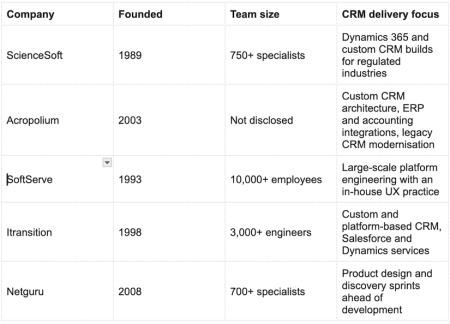
Another point is telling: none of these contractors sells accessibility as a separate line item in their price list. It comes under the quality section, alongside security, load testing and browser compatibility. Such a signal is much more honest than a separate landing page about inclusivity.
Acropolium in this group relies on architecture and integrations: the CRM is designed for the company's real processes, not for a vendor template. This approach yields a secondary but important benefit: markup, focus order and keyboard scenarios can be embedded at the design system level rather than patched after launch.
How to distinguish expertise from a line in a presentation
The question to ask a contractor at the first meeting sounds simple: who will test the interface and how. Automated scanners catch only part of the problems and WebAIM explicitly acknowledges this limitation of its methodology. Manual checks with a screen reader, keyboard navigation and the participation of people with disabilities in tests — this is what separates real work from a checkmark in a report.
It is also useful to look at which specific defects the contractor knows how to catch. For seven consecutive years, WebAIM has recorded the same set of six categories: low text contrast was found on 83.9% of pages, followed by missing field labels, empty links and buttons. In a CRM with its dense forms and icons without text labels, these exact defects account for the lion's share of failures.
Another marker is the moment when accessibility appears in the project. If it is brought up during the acceptance stage, the budget increases exponentially; on the other hand, if it is embedded during the discovery phase, it hardly affects the estimate. Acropolium and other teams with an established project discovery process are at an advantage here, even though the service is formally named the same for everyone.
The final marker is documentation. A statement of conformity, a log of known limitations and a remediation plan are worth more than any promises. Thus, contractor maturity is read not by case studies on a website, but by what they are ready to show in a report.
Final thoughts
An accessible CRM does not make a company a charity; it eliminates legal risk and expands the pool of people capable of working in the system. Selecting a contractor here matters more than choosing a platform. Still, the main criterion remains the same: accessibility must be part of the architecture, not a line item on a final checklist.