Former RBA Governor Bernie Fraser’s criticism of interest rate policy offers Treasurer Jim Chalmers a compelling case for tackling inflation without sacrificing jobs and wages, writes Dr Bronwyn Kelly.
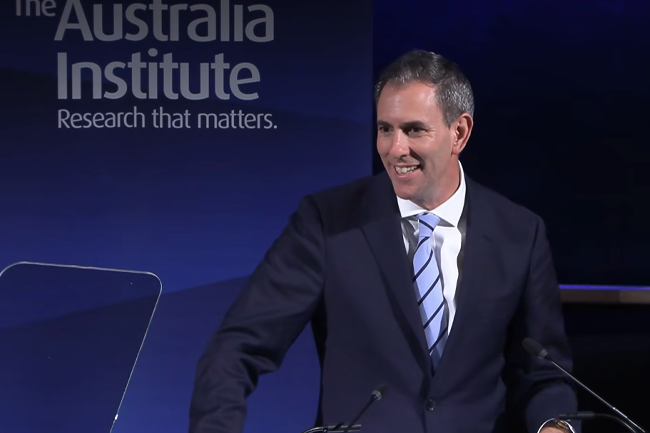
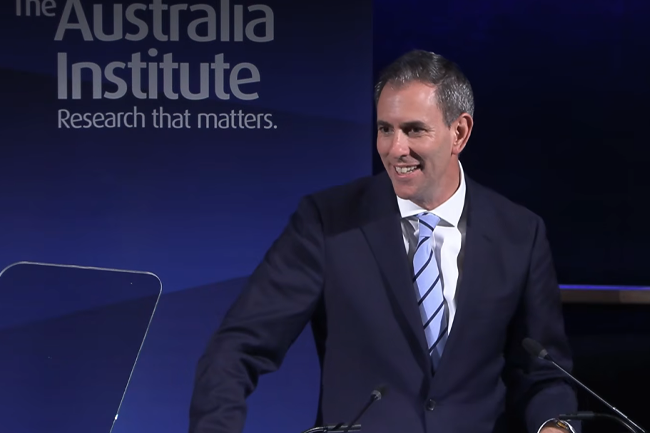
IN HIS RECENT delivery of the 2026 Bernie Fraser Oration at The Australia Institute, the nation’s Treasurer Dr Jim Chalmers spoke of how the Treasury and the Reserve Bank have “played such an essential role in shaping the economic architecture that we rely on now like central bank independence, inflation targeting and compulsory superannuation”.
Taking the reliability of that particular “architecture” for granted, Chalmers went on to recall how the inaugural Bernie Fraser orator – Bernie Fraser himself – had been “blunt and expansive” from the same lectern in 2025, most notably on the need for ambition in policy reform. Dr Chalmers paid his respects to Dr Fraser by saying, “I’m hoping to hew as closely as I can to the example that he set”.
With the groundwork thus laid for a promotion of the Government’s preference for continued reliance on central bank independence and inflation targeting, it must then have been quite a blow to hear Bernie Fraser criticise those two aspects of Australia’s current “economic architecture”.
Dr Chalmers might have blanched to hear this former Governor of the Reserve Bank and head of Treasury publicly advise him that “now might be the time to sort of be not quite so polite in your public discussions or references to the Reserve Bank because we can see all these increases in interest rates and they won't do much to solve the inflation problem”.
So much for the credibility of the economic architecture on which the Government has apparently chosen to rely — particularly those aspects of it that rest on central bank independence and inflation targeting.
It may also have been embarrassing, or perhaps even chastening, for the Treasurer to hear from such an experienced emeritus that it is time for honesty about the causes of inflation, time to speak the truth about the uselessness of the obsession of the Reserve Bank (RBA)’s Monetary Policy Board with inflation control, and time to discard “the preoccupation with inflation to the exclusion of other activities that formed part of [the Bank’s] very skilful charter that was formed back in 1958”.
But Dr Fraser did not hold back. Instead, he spoke truth to power — openly and with stinging accuracy.
The truth that Fraser brought into the light was about the history of the Reserve Bank and its gradual desertion of its original charter. For about 40 years from 1959, the RBA operated in accordance with its founding charter, which imposed obligations to achieve full employment and currency stability.
But since the late 1990s, the RBA has gradually succeeded in shedding itself of the obligation to achieve full employment, eclipsing it entirely with another objective that was never part of the charter that established the Bank — price stability.
Inflation control was not part of the RBA’s statutory responsibilities until the Bank finally succeeded in pressuring the Government into installing “price stability” as an objective in the Reserve Bank Act in late 2024.
And in that amendment, the Bank didn’t just wipe out the need to achieve full employment; it established growth in unemployment as a legitimate tool for price control. It reversed a primary obligation, turning the Reserve Bank Act into nonsense, where one belatedly installed objective (price control) is now used routinely to completely disable the original and most important core objective — full employment.
The result is that the workers Dr Chalmers is so keen to help are now coming off very much the poorer. These days the Bank deliberately stokes growth in unemployment which, of course, also keeps wages low. Little wonder that real wage gains have become difficult to sustain for anything more than short periods.
Price control was not part of the original charter of the Reserve Bank’s responsibilities for the very good reason that the Bank didn’t – and still doesn’t – have the tools to deal with inflation. For the last 30 years, the RBA has promoted interest rate adjustments (monetary policy) as a tool capable of controlling price increases.
But monetary policy is nothing of the sort. It is potentially a good tool for optimising levels of investment in the economy; and, if used well – to keep interest rates low – it is especially good for encouraging investment by small businesses. But beyond that, it is at best useless and at worst harmful for price stability.
Moreover, as economic architectures go, monetary policy is the mainstay of a wholly unfair economy. For that reason alone, the Treasurer should not rely on it. And the good news is that he need not, because it is he and not the RBA that has the most effective tool for inflation control.
The instrument that really controls prices is fiscal policy (government spending and taxing), not monetary policy. More specifically, inflation is far more effectively and fairly controlled when the Government selects the right balance between the money it pumps into the economy by its own public spending and the proportion of the total it draws back out again by taxation. Getting this balance right is the mainstay of any economy worth relying on.
But even if that might be disputed by diehard monetarists, in 2026 it should still be apparent to the Government that central bank independence and inflation targeting are not reliable mainstays for Australia’s economy. If they were, then we would not be experiencing persistent trends towards precarity. We would not be suffering wages that do not keep pace with inflation or be fearing the next round of joblessness required by the Reserve Bank.
And we wouldn’t be witnessing growing resentment by those who’ve been left behind and badly burned by this “economic architecture”, especially in terms of the effect of the Bank’s policies on housing affordability.
Nor is superannuation a reliable mainstay of the economy these days. On the contrary, since a significant proportion of the accumulated superannuation savings of ordinary Australians is being increasingly shepherded into foreign investments, we should be very worried about whether those funds will be there for us in our retirements. So the economic architecture on which the Government may suppose we can rely is not working well and is unlikely to buffer us against external shocks.
Dr Chalmers spoke of a global economy undergoing transformational change, as though external economic disruptions are the whole cause of our own economic decline and that it has nothing to do with a chosen “economic architecture” that deliberately slows production and employment growth whenever it deems that something should be done about inflation. That is the tactic that the RBA now defaults to. It is a bullying tactic that has become so brazenly cruel and perverse that the current RBA governor is even at ease with creating a recession should the Monetary Policy Board, of which she is the inordinately powerful chair, deem it necessary.
In her speeches, it would seem there is no end to the pain Governor Michele Bullock may be prepared to inflict on people. She will do her job no matter how many of ours it costs. The RBA, with its aptly surnamed governor, is now the biggest bully on the block when it comes to inflicting economic pain on workers, mortgage holders and the unemployed alike.
Ostensibly it’s for our own good; it hews to the old adage that one must be cruel to be kind. But that’s not likely to be endorsed by those on the receiving end of the cruelty, many of whom are now foreshadowing their intention to tear the government down.
This brings us back to Dr Fraser’s suggestion that now might be the time to be “not quite so polite about the Reserve Bank”. But a deft turn away from politeness should be accompanied by an indication of where the Treasurer could turn to next. Happily for Dr Chalmers, the solution, even to recessions, is already in his hands. He has control of fiscal policy, the most powerful and reliable tool for a fair economy with full employment and stable prices. No bullying required.
To find out how fiscal policy can be used to stabilise prices without creating unemployment, the Treasurer might begin by looking here.
Dr Bronwyn Kelly is the Founder of Australian Community Futures Planning (ACFP). She specialises in long-term integrated planning for Australia’s society, environment, economy and democracy, and in systems of governance for nation-states.
 This work is licensed under a Creative Commons Attribution-NonCommercial-NoDerivs 3.0 Australia License
Support independent journalism Subscribe to IA.


Related Articles
- Jim Chalmers and Katy Gallagher — the quiet achievers of budget repair
- Labor set to make the big reforms in its third term
- Get ready for a Chalmers offensive: Reform will be a big win for Australia
- Why Chalmers won't be baited by media misreporting the economy
- Treasurer avoids hard reforms on regional bank closures