Australia's military recruits need legal protection from unnecessary deployments overseas, writes Dr Bronwyn Kelly.
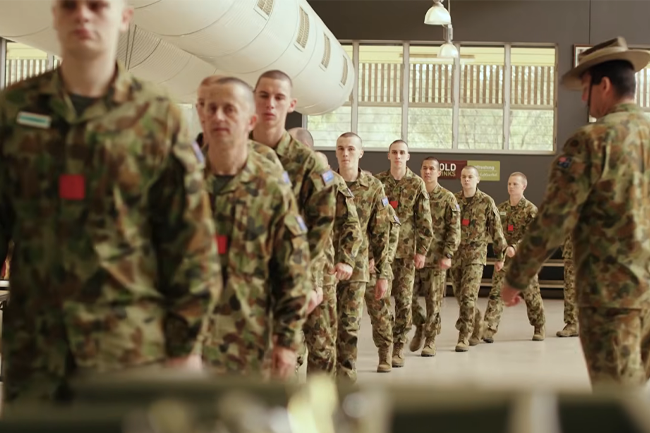
THE AUSTRALIAN DEFENCE FORCE (ADF) has recently managed to increase its success rate in recruiting young Australians, swelling its ranks by 8,100 and bringing the ADF to its largest number of personnel in 25 years.
But pictures like one published recently in The Guardian of 17-year-old Eli Holt, who is considering whether he might add his name to the ranks of the recruited, might draw the attention of parents to the extent of the risks young people are being induced to take as a result of the recruitment drive.
In a world of superpower confrontations, those risks are going to increase, perhaps dramatically. And yet, the Government is pushing very hard to drive young Australians into joining the ADF, including by supporting macroeconomic policy settings designed to push people onto unemployment queues and by simultaneously making education for other careers comparatively expensive or unaffordable.
Because of these policies, young Eli has found himself in a quandary. In his own words, he is considering joining up because “the army feels irreplaceable. Like there’s things that need to be done that AI just can’t do”. So he is looking for a career with secure employment. But if that is the aim, how likely is he to find it?

The ADF’s slick advertisements about the value and excitement of a military career (as well as its offers of fee-free degree courses, free health and dental care and subsidised housing) will have some appeal for young people looking for career security. But it mentions nothing about what the young recruits stand to lose — their lives.
We might expect that young people would consider this obvious risk; but what they might not think about is that there is a particular type of security that is not on offer when you join the ADF, and it is a type that significantly and unnecessarily increases the risk to life. There is no guarantee that recruits will not be sent to fight in foreign wars that are not in Australia’s interests. They can be asked to sacrifice their lives in the interests of some other country and they will have no say in the matter.
For at least the last 25 years, our federal governments have been all too keen to take part in wars against countries that have not attacked Australia. Their willingness to volunteer the services of our young people is a practice that significantly increases the chance that their supposed secure career choice will kill them before they are 30 years old and that their life will be lost in fighting which neither defends Australia nor reduces the potential for an armed attack on us.
Mainly at the behest of the U.S., our governments have rushed to join “coalitions of the willing” and, in the process, 74 ADF personnel have lost their lives as a direct result of their service in armed conflicts and operations overseas this century, none of which have been for the defence of Australia. Added to that are more than 1,800 veterans who have committed suicide at alarmingly higher rates than the general population.
As the Royal Commission into Defence and Veteran Suicide has reported, male veterans are 26 per cent more likely to die by suicide than the general population, while female veterans face an even greater risk — 107 per cent higher than their civilian counterparts.
And for what purpose did they die? Ultimately, it was not to secure a career that defended Australians.
It ought to be regarded as an unpardonable sin for a government to dash the hopes and best intentions of wonderful young people who are prepared to die for their country by sacrificing them for someone else’s. But for some reason this sin is not included in the moral code of either the executive governments of Australia or their parliaments.

And it is not present in any such code because our Constitution (at heart, at Section 61) is arranged to allow the executive government (effectively one person — the prime minister) to exercise the prerogative power to consign Australian troops to wars in foreign territories.
This is a power that has been jealously guarded of late by Labor governments who have compounded the danger for the next ADF recruits by holding fast to policies and programs which have effectively ceded sovereignty to the U.S. and the UK in decisions on defence of Australia and on deployments of our armed forces.
Nothing in Australia’s Constitution or laws restrains the power of the executive to permit the loss of Australian lives in conflicts that have nothing to do with the defence of Australia. This is the high-risk framework that is not being explained to young recruits. They are not being given the chance to weigh the value they might place on their own lives against the value that may arise for their families and communities by their deployment in foreign conflicts.
Ultimately, their safety is valued at naught by the recruiter while all Australians are simultaneously exposed to a diminution or perhaps a full loss of their safety, since Australia’s willing participation in foreign wars makes us a target. Young Eli’s risk, should he choose to sign up, does not reduce ours; it increases it.
The risk for everyone, however, can be substantially reduced if the executive government and the parliament choose to restrain themselves in decisions to participate in foreign conflicts. This they can do because there is already a legal instrument that exists for the purpose. It exists in international law — in its foundational instrument, the Charter of the United Nations.
This is a law to which Australia is already a signatory. Our governments have agreed to be bound by it, but they have never taken steps to vest their obligations under it in Australian law, particularly the core obligation not to engage in force against another country that has not attacked ours.
Eighty years after becoming a member of the United Nations, Australia’s laws are still arranged to allow executive governments to bypass the core obligation we undertook to observe in 1945 for our own safety and security. It is a permitted but nevertheless unconscionable lapse of responsibility and one that has enormous implications for every single Australian.
The remedy for this lapse is not a difficult one. It can consist in the adoption of straightforward legislation that obliges the executive to comply with international law in decisions on Australia’s participation in foreign armed conflicts. A draft bill for the introduction of this legislation to parliament has been developed by Australians for War Powers Reform (AWPR). The full text of the draft bill is available here. AWPR is seeking a parliamentarian to sponsor it next year.
This bill obliges the executive to do nothing more than they have long since agreed to do as a member of the United Nations. In that regard, it may neither lessen nor increase the political risk Australian governments have always faced in defending the realm, but it certainly lessens the risk faced by those Australians who are compelled to put themselves on the front line.
That front line should be for our defence, not for aggression. And so if the government really thinks defence purposes must attract more recruits to the ADF, they are more likely to succeed if they agree to be bound by a law that contains the field of deployment to that required for our defence.
The draft bill has the capacity to offer recruits a guarantee that they will not be deployed in armed conflicts that are not in conformance with international law. That is a guarantee that is likely to save all our lives. For those like young Eli who might be considering the terms under which they might enlist, it is a guarantee that ought to be considered essential.
The Australian Government’s first responsibility is to all Australians, but in the scheme of things, it ought to be expected that the executive will do everything it possibly can to keep our young people out of other countries’ conflicts. The legislation proposed by AWPR is a vital step in that regard.
However, much more needs to be done to set Australia on a course that will end the need for the ultimate sacrifice of our young. Australian Community Futures Planning has scoped a program of systemic reforms for that purpose here.
Dr Bronwyn Kelly is the Founder of Australian Community Futures Planning (ACFP). She specialises in long-term integrated planning for Australia’s society, environment, economy and democracy, and in systems of governance for nation-states.
 This work is licensed under a Creative Commons Attribution-NonCommercial-NoDerivs 3.0 Australia License
Support independent journalism Subscribe to IA.



Our young people shouldn’t die from fighting other nations’ wars
Australia's military recruits need legal protection from unnecessary deployments ...
Proposed GST rise will cause political pain for little gain
An expanded GST – proposed by the Grattan Institute – won’t benefit Austra ...