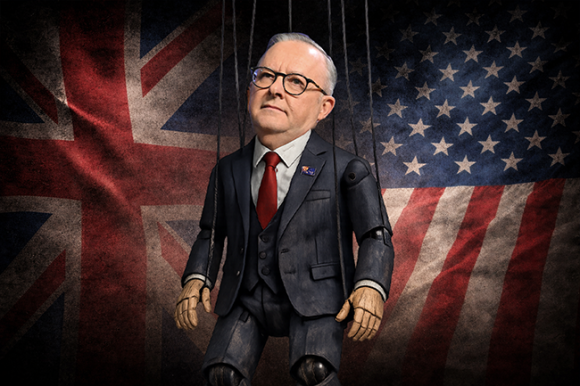
Australia warns of foreign interference from rivals while quietly bending to pressure from allies, raising hard questions about who really shapes the nation’s decisions, writes Alana Baker.
RESILIENT DEMOCRACIES depend on transparency and the ability to question all actors, regardless of their strategic alignment.
Public discussion of foreign interference in Australia tends to narrowly focus on perceived threats from geopolitical rivals such as China or Russia, often overlooking the influence exerted by allies against its national interests. One significant indicator that foreign interference is pervasive within a country is media and political censorship, which suppresses critical national discussions on multifaceted interference deeply embedded within existing power structures.
Recent developments with the resignation of Joseph Kent in March 2026, former U.S. National Counterterrorism Centre Director, in protest of Israel’s ongoing political interference in the U.S., is a stark reminder of how pervasive foreign interference in a nation can be.
In his resignation letter, Kent conscientiously objected to supporting a war with Iran, a nation that posed no imminent threat to the U.S., while stating there was ‘pressure from Israel and its powerful American lobby’ for the U.S. to support Israeli attacks. He also referred to high-ranking Israeli officials and influential members of the American media interfering in U.S. politics to sow pro-war sentiments and manipulate political discourse.
Kent’s concerns were preceded by U.S. intelligence assessments, which warned that military action on Iran would likely fail to achieve clear strategic objectives and create regional instability as the Iranian leadership held strong national support despite protests triggered by economic sanctions.
The failure of the U.S. to follow its own strategic assessments and instead act against its national interests is alarming, especially given the billions of dollars it has spent fighting a war that has dismantled its hegemony in the world and destabilised alliances with Gulf states and NATO. The disastrous economic fallout that will follow the inevitable destruction of the petrodollar is progressively being felt in American society as the U.S. struggles to abandon a war it was pressured to join but is now unable to abandon without destroying its own international credibility and influence.
Australia is also at high risk of following a similar trajectory. Concerns about Australia’s vulnerability to foreign interference by allied nations and associated advocacy groups have recently been rising. For decades, Israeli-linked groups have funded hundreds of Australian federal politicians and many senior editorial leaders from major news providers to participate in politically oriented programs in Israel.
One group, the Australia/Israel and Jewish Affairs Council (AIJAC), is a leading sponsor of parliamentary trips to Israel, which utilises its registered charity status and associated tax concessions to actively fundraise, network and advocate for Israeli policy positions. Those participating in AIJAC’s Rambam Israel Fellowship Program often return to Australia more supportive of Israel’s foreign policies after being exposed to carefully controlled foreign programs.
Former Foreign Minister Bob Carr, in his memoir, described the level of influence exerted by pro-Israel lobbying on the Gillard Government as “extraordinary” and “unhealthy”, raising concerns about the impact of extreme right-wing lobbying on ministerial judgment and policy direction. The scale of lobbying activity from groups such as Advance has also continued to grow, with pro-Israel groups among the highest-spending lobby groups in the lead-up to recent federal elections.
The lack of independence in Australian mainstream media is also highly contentious. There have been instances where lobby groups such as AIJIC have successfully pressured the Australian Broadcasting Corporation to alter or retract reporting critical of Israel. Research from the University of Melbourne’s Centre for Advancing Journalism has described such efforts as among the most well-funded foreign influence operations in Australia, with a significant capacity to shape media narratives.
In a media landscape already characterised by concentrated ownership, such dynamics raise further questions about political interference and editorial independence. At least 65 per cent of Australian private media, News Corp, is controlled by Rupert Murdoch, who describes his own support for Israel as ‘unyielding’, while explicitly supporting Zionist worldviews in editorials.

What makes the Australian context particularly challenging is not that foreign influence exists, but that foreign influence has laid the groundwork for policies and laws that aim to censor and punish the Australian public for criticising Israel’s war crimes and pressure Australia into supporting Middle-Eastern wars against its own national interests.
Australia’s adoption of the politicised IHRA definition of antisemitism in 2021 has made it more difficult to criticise the Israeli Government without legal repercussions, giving Israel special impunity from criticism in public discourse. Interestingly, this same definition censors comparison of Israeli policies to Nazism in Australia, despite the fact that Zio-Nazism has been discussed and widely debated within Israeli society itself.
From a policy perspective, foreign interference is especially problematic when foreign policy alignment conflicts with national interests. For example, Australia’s failure to meet obligations to maintain sufficient oil reserves for surviving oil disruptions as a member of the International Energy Agency makes support for military actions in energy-sensitive regions that directly impact its energy and food security questionable.
Notably, the Australian Government commended the initial strikes of the U.S. and Israel on Iran and the assassination of Iran’s sovereign leader, Ayatollah Ali Khamenei, despite the fact that the strikes violated international law and exposed Australia to catastrophic consequences.
When governments adopt foreign policies that prioritise other countries border expansion and regional hegemony goals over their own populations living standards and national prosperity, they no longer serve Australia. Unless Australia can have honest public discussions on how Israel’s latest violation of international law, with the support of the U.S., has put it at high risk of energy and food insecurity, then we have merely become a vassal state for a country on the other side of the world.
Suppressing critiques of allies is a dangerous path to subversion and undermines national security, especially given the risks of the current Iran war escalating into regional or nuclear war. Australia’s ability to maintain its sovereignty depends on its willingness to engage in honest and inclusive debate on foreign interference from adversaries as well as allies, without its citizens fearing reprisal.
The current suppression of criticism of Israel’s impact on Australian foreign policies – whether through political pressure, media censorship, or legal repression – undermines Australia’s democracy and weakens its national sovereignty. This has detrimental long-term consequences on Australians' living standards and security.
It is time for Australian politicians and media outlets to have greater accountability and transparency to enable urgent public debate on the prioritisation of other nations' foreign policies over our own national interests.
 This work is licensed under a Creative Commons Attribution-NonCommercial-NoDerivs 3.0 Australia License
Support independent journalism Subscribe to IA.