GRC software versus risk and compliance platforms built for Australian regulation
APRA's CPS 230 stopped being tomorrow's problem on 1 July 2026. That date ended the transitional relief smaller financial institutions had on business continuity and scenario analysis, and it closed the last polite excuse for running operational risk out of spreadsheets.
Privacy Act reform and the SOCI Act keep widening the net beyond APRA's perimeter, which is why the hunt for the best GRC tools for Australia has moved from the someday pile onto this quarter's agenda.
Quick answer: Scytale is the pick for most mid-sized Australian organisations that need certifiable security outcomes, an AI GRC platform pairing automation with a built-in risk and policy layer. Sentrient owns the workplace-compliance end of the market. Protecht and CAMMS carry enterprise risk programs, Vanta handles security automation for global frameworks, Workiva and MetricStream suit the big end of town, ServiceNow GRC works where the Now Platform already runs, and Pali GRC and HSI Donesafe round out the local field.
The detail behind that answer follows a particular standard: each platform weighed on Australian terms, meaning where your data lives and what documented user reviews say once the sales deck closes.
What a GRC tool does in the Australian context
A GRC tool connects the risk register to the controls that treat each risk and connects those controls to the policies and obligations behind them. The connection is the product. When an incident lands, you can trace it back to the control that failed and forward to the obligation it puts at risk, then show a regulator the whole chain without a week of assembly work.
Australian buyers face a split market. On one side sit local platforms grown out of workplace compliance and enterprise risk. On the other end sits international platforms built for security frameworks such as ISO 27001 and SOC 2. The two camps host data in different places and answer different questions, so the right pick depends on which obligations drive your program.
Why 2026 turned GRC tooling into a board issue for Australian organisations
Start with the prudential regulator. CPS 230 came into force on 1 July 2025 and reshaped how APRA-regulated entities manage operational risk, folding continuity planning and service-provider oversight into one standard. Smaller institutions had transitional relief on parts of it; that relief ran out on 1 July 2026, which is why the tooling question feels different this winter. CPS 234 has sat alongside it since 2019, holding boards to account for information security capability.
The obligations don't stop at APRA. Reform of the Privacy Act 1988 keeps raising the bar on personal information handling and the Notifiable Data Breaches scheme means an incident register can't live in someone's inbox. The SOCI Act pulls critical infrastructure operators into formal risk management program obligations. Government suppliers now meet the Essential Eight, the Australian Cyber Security Centre's mitigation baseline with maturity levels attached, in procurement conversations that once skipped security altogether.
Tools built for other markets cover almost none of that out of the box. Data sovereignty and local regulatory content sit near the top of Australian buying criteria for good reason, and where a vendor documents Australian hosting, the comparison below says so.
How this comparison came together
The order rests on published review scores from G2 and Capterra as they stood in 2026, never on vendor claims, and every rating shown in a heading traces to a documented source. The watch-outs come from user reviews or from a vendor's own published material rather than guesswork. Australian fit carried tiebreaker weight, covering data residency, local regulatory content, pricing transparency and suitability across organisation sizes.
How the best GRC tools in Australia compare
Which GRC tool fits which need
- If you need ISO 27001 certification or a SOC 2 attestation with automation doing the heavy lifting, look at Scytale.
- If you need workplace compliance with staff training built in, look at Sentrient.
- If you need enterprise risk management shaped for APRA-regulated sectors, look at Protecht.
- If you need risk reporting tied to corporate strategy and board goals, look at CAMMS.
- If you need continuous monitoring across international security frameworks, look at Vanta.
- If you need financial and regulatory reporting at enterprise scale, look at Workiva.
- If you need a configurable suite for a staffed GRC function, look at MetricStream.
- If you already run ServiceNow across IT, look at ServiceNow GRC.
- If you need Australian data hosting on a fixed budget, look at Pali GRC.
- If you need incident and safety management for field-heavy industries, look at HSI Donesafe.
The 10 best GRC tools in Australia for 2026
1. Scytale, 4.8 on G2
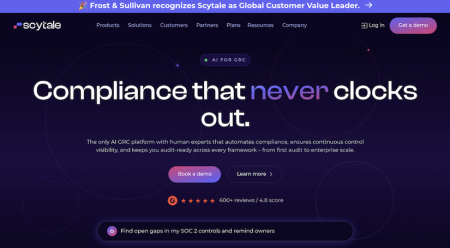
An AI GRC platform organised around a unified compliance centre, Scytale keeps controls and risks in the same workspace as the policies that govern them, with evidence held in step across everything. Instead of a spreadsheet for risks and a drive folder for policies, the platform keeps the pieces connected, so a change in one place surfaces wherever it matters.
That structure counts for Australian companies selling into overseas markets, where ISO 27001 certification or a SOC 2 attestation decides whether an enterprise deal closes. Automated evidence collection draws on 150+ integrations spanning cloud, identity, HR and DevOps stacks, and continuous control monitoring checks controls around the clock, rather than in a pre-audit scramble. The 4.8 G2 rating rests on a base of more than 500 reviews as of 2026. Its capabilities stretch across 80+ framework coverage with cross-framework mapping, AI-driven evidence validation, vendor risk workflows, user access reviews and a customisable trust centre, with GRC expert support available through the journey.
Best for: mid-sized Australian organisations that need certifiable outcomes, ISO 27001 or a SOC 2 attestation, with the risk and policy layer included rather than bolted on.
Pricing: not published; quotes come through a sales conversation.
Watch-outs: budgeting starts with that conversation and a few capabilities sit in higher-tier plans.
2. Sentrient, 4.7 on Capterra
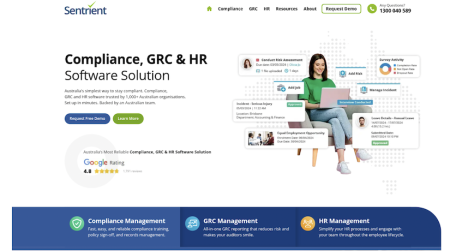
Sentrient is the Melbourne-built platform that anchors the workplace side of Australian GRC. It bundles policy management with staff acknowledgements and adds the piece global vendors don't carry: a library of compliance training courses written for Australian law, covering WHS and other local workplace obligations. Customer data stays hosted in Australia, and the platform connects with common HR and payroll tools.
The 4.7 Capterra score comes from a small base of 10 reviews, worth knowing when you weigh it against platforms rated in the thousands. Its scope takes in policy acknowledgements, risk and incident registers, records management, audit-ready reporting and built-in staff training.
Best for: Australian organisations whose GRC priority is workplace compliance and employee obligations rather than information security frameworks.
Pricing: custom quote after a demo; no figures in public.
Watch-outs: Sentrient's own material concedes it handles workplace GRC rather than security-compliance automation, so teams chasing ISO 27001 or a SOC 2 attestation will need something else beside it.
3. Protecht, 4.5 on G2
Protecht is the Sydney-founded enterprise risk platform you'll find inside Australian banks and insurers, and across government. Its core follows the COSO enterprise risk model, and the aim is a single risk picture: registers, obligations, incidents and policies feeding dashboards a board can read.
Depth is the selling point. The module set spans risk registers, compliance obligation management, incident and case handling, policy workflows and analytics, which suits organisations running formal risk frameworks with dedicated staff. That same depth defines who shouldn't buy it. Lahebo, a smaller Australian rival, argues that suites of this scale carry cost and complexity a mid-sized team may never use.
Best for: large APRA-regulated organisations and government bodies that manage complex risk frameworks with an in-house risk function.
Pricing: custom quote; demonstrations precede any figure.
Watch-outs: more platform than smaller organisations need, on Lahebo's assessment, and no public review score to check the vendor's story against.
4. CAMMS, 4.6 on Capterra
CAMMS started in Adelaide and built its reputation on one idea: risk means nothing to a board until it connects to strategy. The platform maps risks against corporate goals, so leadership sees which objectives carry exposure rather than a raw register. U.S.-based Riskonnect now owns the company and the parent's own methodology names CPS 230 among supported frameworks, a rare direct nod to Australian prudential obligations from a global vendor.
The suite covers risk, compliance, incident and audit modules, plus business continuity and vendor risk, with connections into Dynamics 365 and Power BI. The 4.6 Capterra rating draws on 8 reviews.
Best for: medium to large Australian organisations that want risk reporting expressed in the language of strategy and performance.
Pricing: custom quote; nothing published.
Watch-outs: the shift to US ownership gives sovereignty-minded buyers something to check and local coverage notes the suite runs broader than smaller teams need.
5. Vanta, 4.6 on G2
Vanta built its name automating security compliance, and of the automation vendors, it's the one Australian buyers have most often met before. Continuous control monitoring gathers evidence without manual chasing, and the framework catalogue spans SOC 2 attestations, ISO 27001, HIPAA, GDPR and PCI DSS, with automated vendor assessments and centralised security oversight alongside.
The G2 base ran to 2,456 reviews by mid-2026, with praise for ease of use and time saved behind the 4.6 average. The complaint themes deserve equal attention: cost draws well over a hundred reviewer mentions as a burden for smaller companies, and a similar volume describes integrations that still needed manual work to finish the job.
Best for: technology and security-focused companies that need international security badges kept current with minimal manual effort.
Pricing: enterprise-style quotes shaped by frameworks and company size.
Watch-outs: the platform concentrates on security compliance rather than broader operational risk, and G2 reviewers report costs climbing hard for smaller teams.
6. Workiva, 4.5 on G2
Workiva approaches GRC from the reporting side. The platform connects data and people across complex financial and regulatory reporting, wrapped in an interface that feels familiar to anyone raised on spreadsheets. For large organisations juggling ESG disclosure and audit collaboration at once, that connected-reporting core is the draw.
The 4.5 G2 rating sits on 2,148 reviews as of 2026. Reviewers praise the reporting and dashboarding while describing the compliance features as secondary to the financial reporting core, a fair summary of where the product's heart lies. Its range covers centralised reporting data, real-time collaboration, automated workflows and deep enterprise system integrations.
Best for: large enterprises and regulated organisations whose GRC pain is reporting accuracy and collaboration at scale.
Pricing: enterprise quotes, shaped by which modules you use.
Watch-outs: G2 reviewers cite a steep learning curve and the cost profile puts it out of reach for smaller Australian businesses.
7. MetricStream, 3.8 on G2

MetricStream is the long-serving heavyweight of enterprise GRC, built for organisations whose programs span countries and regulators. The functional range runs from enterprise risk and compliance management through audit, policy and business continuity to analytics with low-code configuration, and big regulated enterprises with dedicated GRC teams get real value from that breadth.
The 3.8 G2 score sits well below the rest of this field as of 2026, and the documented reasons are consistent: high total cost of ownership and implementations that users report running six to 12 months, with an interface reviewers call dated. For Australian buyers, there's a sharper catch. Lahebo's comparison points out the regulatory content leans U.S.-first, which matters when APRA standards and the Privacy Act top your obligations register.
Best for: multinational enterprises with sizable budgets and a staffed GRC office.
Pricing: enterprise quotes; user reports describe total costs at the high end of the market.
Watch-outs: heavy implementations and a US-first regulatory library make it a demanding fit for Australian-headquartered organisations.
8. ServiceNow GRC, 4.2 on G2
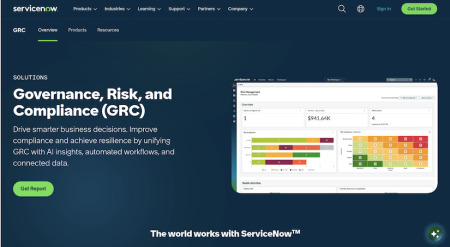
ServiceNow GRC lives on the Now Platform, and that placement is the whole argument. Risk and compliance workflows share the configuration database and IT service records your teams already maintain, so control failures connect to the systems and changes behind them without an export in sight. For an IT-centric program at scale, the workflow depth and audit trail are hard for standalone tools to match.
The 4.2 G2 rating comes from 108 reviews as of 2026. Its strengths sit in deep ITSM and CMDB integration and in auditable workflow automation at scale.
Best for: organisations already invested in ServiceNow that want GRC stitched into existing IT operations.
Pricing: enterprise licensing through the wider ServiceNow relationship.
Watch-outs: reviewers note the value depends on full ecosystem commitment and that configuration runs complex and expensive; pre-built compliance frameworks also trail the dedicated platforms.
9. Pali GRC
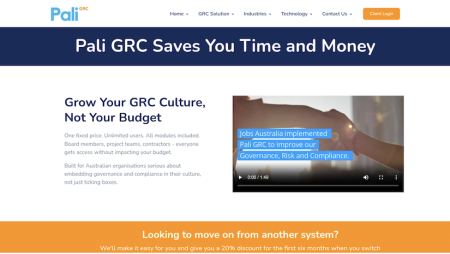
Pali GRC is the Australian option for buyers whose first question is where the data sleeps. The platform hosts in Australia, markets itself on data sovereignty, and prices on a fixed-cost model with no per-user penalties, a structure that removes the licence anxiety of growing headcount. Customers span government, banking, medical and mining organisations.
The system itself keeps risk work connected: risk registers, controls, incident logs and breach management operate in one place rather than a stack of point tools, and the vendor pitches flexibility for teams that want the platform shaped around existing processes.
Best for: Australian organisations that rank local data hosting and predictable pricing above feature depth.
Pricing: custom quote on a fixed-cost model; no per-user charges.
Watch-outs: local coverage notes it doesn't yet match the feature depth or integration range of the big international suites and there's no public review score to weigh.
10. HSI Donesafe
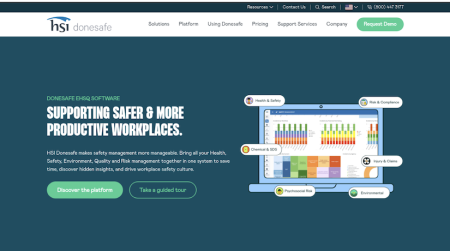
HSI Donesafe comes at GRC from the safety end. The Australian-origin platform serves over 3 million users with 60+ no-code modules covering incidents, audits, contractor management, training and hazard tracking, configurable without developers. Lahebo's comparison singles it out as strong for complex incident management and audit requirements in mining and construction.
For field-heavy industries where the dominant risk is physical, that shape fits. The WHS orientation is also its boundary: this is an EHSQ platform first, and information security sits outside its lane.
Best for: organisations in mining and construction, or any field-heavy sector, that need deep incident and safety workflows.
Pricing: custom quote; module selection drives cost.
Watch-outs: teams needing CPS 234 evidence or ISO 27001 support will need a separate platform, since the module set targets workplace health and safety rather than information security.
The bottom line on the best GRC tools in Australia
The Australian market splits along a clear seam: local suites such as Sentrient and Pali GRC that speak workplace compliance and data sovereignty, and heavyweight enterprise platforms such as Protecht and MetricStream that assume a staffed risk function. The space between them belonged to nobody for years. Scytale claims it, giving mid-sized organisations certifiable outcomes, ISO 27001 certification and SOC 2 attestations among them, with risks and policies managed in the same compliance centre instead of a second tool.
Its integration coverage reaches the systems Australian teams already run, including AWS, Okta, Jira and the major HR platforms. Whichever way you lean, raise Australian data residency in the first call and price the full implementation, demo included, before committing. CPS 230's grace period is gone, and the Privacy Act reform pipeline hasn't slowed, so the sooner your risk and policy work connects, the easier the next regulator conversation runs.
GRC tools in Australia: frequently asked questions
What does GRC mean in the Australian regulatory context?
GRC stands for governance, risk and compliance. In Australia, the compliance leg carries particular weight: APRA-regulated entities answer to prudential standards such as CPS 230 and CPS 234, and organisations covered by the Privacy Act 1988 face the Notifiable Data Breaches scheme. Critical infrastructure operators carry their own obligations under the SOCI Act. A GRC tool earns its keep by keeping the evidence for those obligations connected and ready for a regulator's questions.
Which GRC tool suits a small organisation and which suits an enterprise?
Smaller Australian teams tend toward local platforms with simpler footprints, such as Sentrient for workplace obligations or Pali GRC for fixed-cost budgeting. Enterprises with dedicated risk staff justify the depth of Protecht or MetricStream. The middle belongs to the automation platforms; Scytale gives mid-sized companies automated evidence collection and multi-framework coverage without the implementation project an enterprise suite demands.
How much does GRC software cost in Australia?
Almost nobody publishes numbers. Local platforms quote after a demo, with Pali GRC marketing a fixed-cost model that skips per-user penalties. Enterprise suites price by module and user reports put their total cost of ownership at the high end once you count implementation. Scytale quotes to your framework scope through a sales conversation. Ask every shortlisted vendor for a full cost breakdown, implementation included, before you sign anything.
Is Jira a GRC tool?
No. Jira tracks work and plenty of risk teams use it for remediation tickets, but it holds no risk register or obligation mapping of its own. GRC platforms treat it as a destination instead: Scytale's integration catalogue includes Jira, so compliance findings can flow into the tickets engineers already watch. If Jira is your whole GRC program, you have a task list, not a system of record.
What is the best open source GRC tool?
Open-source options exist for risk registers and control tracking and they suit teams with engineering time to host and maintain them. You give up automated evidence collection and local support, which is where the commercial platforms earn their fees. None of the ten platforms above is open source and for regulated Australian organisations the maintenance burden tends to offset the licence saving.
How does CPS 230 change GRC tooling for APRA-regulated entities?
CPS 230 took effect on 1 July 2025 and the transitional relief for non-significant financial institutions ended on 1 July 2026. The standard demands a connected view spanning operational risk and continuity planning, with tighter oversight of service providers. A spreadsheet can't show those connections on demand, which is why APRA-regulated entities are moving to platforms that link incidents to controls and vendors to obligations in one system.
Does Essential Eight compliance need a GRC platform?
Not on paper. The Essential Eight is the Australian Cyber Security Centre's set of mitigation strategies and its maturity levels carry no formal certification, so a disciplined team can self-assess in a spreadsheet. The case for a platform arrives when customers or government buyers ask for proof on repeat: a GRC tool keeps the evidence behind each maturity claim current, instead of rebuilt for every request.