
Setting up an SMSF often means you’ll get a legal bill before the fund even has a bank account. Should you pay it from your own wallet or wait until the fund has cash?
The answer turns on timing: whether the payment happens before or after the fund legally comes into existence and whether the fund pays you back, decides if the amount can count toward your contribution caps. Get the date wrong and a routine invoice can trigger extra tax, reporting, and audit work.
The one date that changes the answer
When does the SMSF legally exist?

An SMSF is a trust and it comes to life only once the trust is created, which usually means these steps happen on the same day:
- the trust deed is executed;
- the trustee accepts the role in writing;
- the beneficiaries (future members) are identified;
- a nominal asset (often a $10 note) settles the trust.
The Australian Taxation Office’s guidance on setting up an SMSF treats the fund as established when the trust is created, not when it first opens a bank account or lodges a return.

If you pay an invoice before that legal birthday, there is no fund yet to receive a contribution. Pay the same bill after the deed date and, unless the fund reimburses you, the contribution rules may apply.
Four-outcome decision table
Use the grid below to match the payment timing and reimbursement choice to the likely contribution result. (It assumes the invoice is a legitimate establishment cost.)

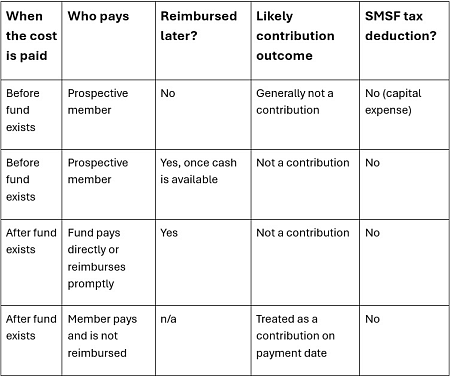
Why?
Trustees can use fund money for genuine establishment costs, as long as the cost is shared fairly between members
Taxation Ruling TR 2010/1 treats paying a fund’s liability, without being repaid, as a contribution to the fund
Before the deed is signed, the fund doesn’t exist, so there is no fund liability to pay. After that point, choosing not to reimburse permanently increases fund capital, triggering the contribution rules.
What really counts as an SMSF establishment cost?
Trustees can use fund money for the direct costs of forming and administering the fund, as long as the expense is shared fairly among members.
In practice that usually includes:
- drafting and executing the trust deed;
- registering the corporate trustee (if chosen);
- ASIC lodgement fees; and
- professional time tied solely to preparing, signing, or lodging those documents.
Any work bundled with personal retirement strategy, estate planning, or business restructuring belongs to the individual, not the fund. Only the portion directly linked to creating the SMSF is a fund cost; the balance should be paid from outside super.

Quick invoice check: if you closed the SMSF tomorrow, would the charge still apply? If the answer is yes because it covers a personal tax return or broad wealth plan, the fund shouldn’t pay the entire bill.
As one example of what a single establishment fee can cover, SMSF Australia charges $2,000 + GST to establish a fund, which includes the $636 ASIC corporate trustee fee, the trust deed and company constitution, ATO registrations and rollovers. For a fuller list of common setup items, see the concise SMSF setup cost guide from SMSF Australia.
Reimbursement is not a tax deduction
The law draws a clear line between paying someone back and claiming a deduction.
1: Can the fund reimburse you?
Yes, provided the invoice is a genuine establishment cost and the SMSF now has cash. Reimburse promptly once the fund has money. A long-outstanding amount owed to a member can start to look like a borrowing by the fund, which the ATO’s ruling on borrowing, SMSFR 2009/2, deals with.
2: Can the fund deduct the cost?
Almost always no. Establishment expenses are capital; they create the structure that will later earn income rather than earning income themselves. The ATO’s guidance on fund expenses treats them as generally not deductible to the fund.
In short, reimbursement fixes who paid, not how much tax the fund owes. Keep the two questions separate and you’ll avoid arguments with an auditor over why a deed fee should reduce taxable income.
When a personal payment turns into a contribution
The contribution clock starts when the bill is cleared
Picture the SMSF owing $1,500 to the lawyer who drafted its deed. If the fund pays that invoice, no member’s contribution cap is affected.

Swipe your own card after the fund legally exists and never seek repayment and the fund’s liability disappears. Under TR 2010/1, that payment is a contribution made when the debt is settled, not when the accountant records it later.
The exact date matters, because:
- it locks the amount to a particular financial year and to either your concessional or non-concessional cap;
- exceeding a cap can attract additional tax and reporting; and
- from age 75 a fund can accept only limited contributions under SIS regulation 7.04, so a late payment can breach the rules.
Keep every receipt, note the payment date and brief your adviser promptly; simple records now can save time, tax and audit fees later.
Who really made the contribution?
When money leaves a bank account to clear an SMSF liability, the question is who actually provided the value, not whose name is on the account. That matters because contribution caps apply per person.
Example: a joint account owned 50-50 by two spouses (only one is an SMSF member) pays a $2,000 establishment invoice after the fund exists and the member never seeks reimbursement. Unless evidence shows the non-member spouse supplied the cash, expect the member spouse to be treated as having made a $2,000 contribution.
Multi-member funds add a second layer. Establishment costs should be allocated fairly across member balances, yet the contribution created by the payment belongs to the person who paid. An older member with no remaining cap space can therefore create a contribution problem even if the trustees allocate the underlying expense 50-50 in the accounts.
Documenting who paid and why, at payment time helps avoid cap breaches and later audit disputes.
Can you change the treatment later?
Once a post-establishment payment is recorded as a contribution, trustees can’t simply reverse it and repay the member. Super law lets an SMSF return contributions only in narrow circumstances, such as an ATO release authority for excess contributions or a genuine mistake.
The choice to reimburse (or not) therefore belongs on the payment day, not at tax time. Minute the decision, keep the evidence and move on.
Keep an audit-ready paper trail
Auditors care less about clever narratives and more about clear evidence of who paid what and when. The ATO requires SMSFs to keep most records for at least five years and some, such as trustee minutes, for ten.

Create one folder (digital or physical) and file:
- Executed trust deed and proof of the legal establishment date.
- Evidence of the initial trust-property settlement (often the stapled $10 note or bank transfer).
- Fully itemised invoice that separates fund work from personal services.
- Bank proof of the original personal payment.
- Trustee resolution or reimbursement request dated at the time of payment.
- Bank statement showing any reimbursement, with a clear description.
- Ledger entry marking the amount as “member payable” or “contribution,” plus the fair member allocation.
- Member-contribution allocation records and any notice of intent to claim a deduction.
- Copies of the above supplied to the SMSF accountant and stored for the auditor.
Keeping this bundle in one PDF saves time, cost and compliance risk when audit season arrives.
Why this small distinction matters
Advisers do not all read the rules the same way and some still treat any unreimbursed out-of-pocket setup payment as a contribution. Regulators are also watching how SMSFs are set up: ASIC has repeatedly raised concerns about the quality of advice people get before establishing an SMSF and fees around SMSFs, including the ATO’s supervisory levy, are a recurring topic.
A deed invoice therefore sits at the crossroads of consumer protection and trustee responsibility. Get the date wrong and you can distort contribution caps and age-based acceptance rules; get the paperwork wrong and an auditor may qualify the fund’s report, inviting ATO follow-up.
Frequently asked questions
Can the SMSF pay the setup invoice directly?
Yes. Once the fund is legally established and has cash, it can pay a genuine establishment invoice in its own name; because the money comes from fund assets, no contribution arises.
Is there a fixed deadline to reimburse a member?
No set deadline applies, but reimburse as soon as the fund has cash. The longer repayment is delayed, the more the arrangement can look like a borrowing by the fund or an unreimbursed contribution.
If I never claim the money back, is my pre-establishment payment a contribution?
Generally no, because there was no fund to contribute to when you paid. Keep evidence of the payment date and the establishment date and confirm the treatment with your accountant.
Does reimbursement make the cost tax-deductible?
No. Establishment expenses are capital in nature, so reimbursing a member changes only who paid; it doesn’t create an income-tax deduction for the fund.
What if one member pays for a two-member fund?
First, identify the actual payer for contribution-cap purposes. If Member A pays a $2,000 post-establishment invoice and isn’t reimbursed, Member A has made a $2,000 contribution, even if Member B benefits.
Second, allocate the underlying establishment expense fairly between member balances. Trustees might split the cost 50-50, but that doesn’t change whose cap the contribution counts against. Document both steps on the day the money leaves the account.
All answers assume the invoice is a genuine SMSF establishment cost.
The four-question take-away test
Before you press “Pay now,” confirm:

- Existence: Did the SMSF legally exist on the payment date?
- Nature of the cost: Is the invoice wholly for establishing the fund (not mixed with personal advice)?
- Reimbursement: Will the member be reimbursed as soon as the fund has cash and is that decision minuted?
- Cap and records: If no reimbursement is planned, whose contribution cap will absorb the amount and have you recorded the supporting evidence for the auditor?
Answering all four questions, then noting the decision in trustee minutes and keeping source documents, sets up an easier audit and reduces contribution-cap surprises.
Wrapping up
A setup invoice may look minor beside a six-figure rollover, but its payment date decides whether the amount is simply an expense or a member contribution.
Keep the sequence straight:
- Confirm the deed-signing date that brought the SMSF into legal existence.
- Check that the invoice is a genuine establishment cost.
- Decide at payment time whether to reimburse the member and record that choice, together with supporting evidence, for the auditor.
Follow those three steps and you’ll reduce the risk of contribution-cap surprises, audit queries and regulatory follow-ups.
General information only. Seek professional financial, tax, or legal advice for your circumstances.