With Brisbane 2032 on the horizon, Australia has a golden opportunity to ditch its colonial-era flag and embrace a bold new symbol of national identity, writes GJ Burchall.
IF YOU MISSED National Flag Day last month (no shame, no blame), let’s train a klieg light on the subject.
Canberra decided to flap 44 current Australian flags in the spring breeze (Why 44? Well, why 99 Luftballons? Why 76 trombones?) because 44 is the number of ceremonial flagpoles on offer.
Except it didn’t turn out to be 44 Australian flags. Awkwardly, some were of the New Zealand variety.
(Hilariously, this recalls when those goofball souls from Australians for a Constitutional Monarchy posted a pro-flag rant on its website in the lead-up to the 1999 Republic Referendum. Its point was somewhat muted when a not particularly keen-eyed observer pointed out that the featured image was, in fact, the Kiwi standard.)
So, here’s a thought: Brisbane 2032.

Wouldn’t it be utterly fabulous if, when the nations of the world fore-gather to pit their fastest, highest, strongest, break-dancingest amateur athletes against each other, they do so under the host country’s new flag?
Recall Sydney 2000. Tellingly, the Australian Olympic Committee encouraged the home crowd to wave the green-and-gold, boxing-roo flag rather than the confusing national one, to send a clear message of place and people.
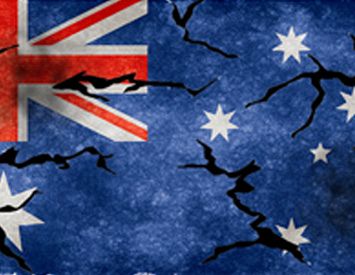
Because the current Australian flag is lame. On so many levels. And the time is well-nigh to replace the thing.
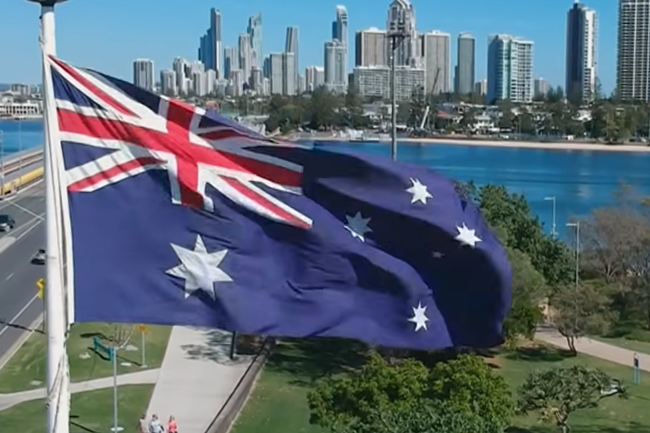
It is a banderole of befuddlement, what with the full flag of an alien nation squatting proprietorially in the all-important top-left canton. Britain’s union flag and a smatter of stars on a deep blue background — “Great Britain by night,” teased millionaire wise-acre Jerry Seinfeld.
Recently, the hitherto clandestine Queensland Wattle Association proposed to plant thousands of native wattles across the state, particularly in the south-east, to create a vast wattle-scape to blaze the colours in ’32 (despite the main blooming season being August-September, while the Games will be July-August).
Who decided green and gold represented Australia anyway? For decades, this has been the colour scheme of Brazilian sports. You know: the colours on Brazil’s flag. Not a jot of green or gold on the Australian flag.
Just consider this outdated, cringe-worthy, embarrassing banner. Despite the claims that 2026 is the 125th anniversary of the current flag, it was only officially recognised by law in 1954 (in time for the 1956 Games in Melbourne). Before that, it was actually deemed to be “disloyal” to fly it without the full British flag flapping by its side. Disloyal to whom exactly?
On a purely aesthetic level, the Australian flag is upstaged by the brilliant, powerful designs of Harold Thomas (Indigenous) and Bernard Namok (Torres Strait Islander).
What does the Australian flag consist of? The conqueror-coloniser union flag — England’s Saint George stomped atop the crosses of Ireland’s Saint Patrick and Scotland’s Saint Andrew. A brutal brand branded on around 20 other national flags.
The key to a good flag is that a child can easily draw it.
The Australian flag is difficult, especially that top-left quarter evil asterisk bitch-of-a-thing. Although a child allegedly did help to design it. Ivor Evans was 13 when he, along with 30,000 others, entered a flag-design comp in 1901 to celebrate Federation. Evans, son of canvas goods and flag-maker Evan Evans, went on to play one game with St Kilda in 1904, the year the team finished bottom of the league ladder.
Of those 30,000, five entrants – including English wildflower water-colourist Annie Dorrington – submitted such similar graphics that they needed to split the 200 quid reward.
It was an unsurprising design for the time, Australia being firmly under the sway of the evil Brutish empire, where “the sun never set” on subjugated people.
On the fly-side is the Southern Cross. Nothing particularly Australian about that. All the nations of the Southern Hemisphere can see this constellation and many, from Samoa to Brazil, have it on their flags. This includes New Zealand’s devalued Cross, the closest cloth to Australia’s (see above embarrassments).
Finally, in the lower hoist, is the Federal Star. This proved to be vastly confusing for former glorious leader, “Tory Tony” Abbott, who calculated that a seventh point could be added if the Northern Territory ever gained statehood. It already has seven, Rain Man.
The flag was originally arrayed onto the British red ensign for civil display – the blue was reserved for government and shipping use only – but, in the Ming dynasty of the Cold War, PM Menzies thought the red was altogether too Bolshie and so enacted for the blue.
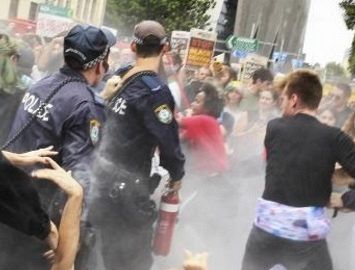
The Australian flag is just pathetic, and does not represent the diversity and rich cultures of the people who thrive beneath it. Sadly, over the years, various competitions have tried to unearth a new design, only to produce even more pitiable templates. What’s with all the abstract kangaroos: Qantas product placement? Animals do not belong on national flags.
NZ had a referendum to change its flag in 2015-16. It was bound to fail. The country much prefers to make Australia look foolish when it can’t tell the difference between itself and the neighbours.
A new flag is not about severing ties, or rejecting the dominant culture of the past; it’s about getting behind a bold design and finding identity.
Look at Canada’s flag (George FG Stanley, artist) – elegant, simple, striking: screams nothing but “Canada.” The Union flag was dropped in 1965, but the country remains in the Commonwealth.
The Eureka flag is a bold design. Yes, it’s another Southern Cross, but a clever, stylised one, designed by a multinational band of gold-fevered immigrants. It was a flag, not of rebellion or treason, but of a call for equality and a “fair go”. And yes, it has been appropriated by some less-than-admirable causes and organisations.
But then so has the current flag. Wanna-be Nazi knuckleheads have despoiled it with their evil anti-immigration rallies (despite all being, to a soul, descended from immigrants), as have right-wing nutjobs, Cronulla rioters, and Islamophobic imbeciles. Senator Pauline Hanson has draped it around her shoulders.
Now, temporary Liberal Party “leader” Angus Taylor promises stern slaps for burning or desecrating the current banner. First, it cannot be burned; it’s made of some synthetic crap that just melts and gives off noxious fumes. Second, it is already desecrated; it has another country’s stamp on it.
Face the fact: the Australian flag is anaemic. It has no character, no personality. Consider Old Glory, Stars and Stripes, the Tricolour, the Star of David, Hammer-and-Sickle, Rising Sun, Maple Leaf, Cedar Tree — even the bilious Union flag. The Australian flag is so bland, so anodyne, it doesn’t even have a nickname.
Scottish vexillologist Graham Bartram says:
“There’s often a fundamental misunderstanding of flags by politicians.”
He contends that meaning is more important than design. The Australian Indigenous and the Torres Strait Islander flags mean something. They mean that these peoples acknowledge their communities within a wider society, even after wave after wave of interlopers from all over the world.
At the Olympics, Indigenous athletes proudly do a lap with both flags.
Can’t we have one flag that everyone can embrace?
Back at Sydney 2000, despite all the green and gold that was aflutter, the ever-deluded “Honest John” Howard declared that the feel-proud event ‘put back the cause of those who want to change the flag by a generation’.
Truly? How so? That’s magical thinking from the Tampa Terror.
Look around the region: post-colonial countries all, with their own proud, post-colonial flags. Now it’s time Australia had a positive pennant to represent a post-1954 nation. You wanna be patriotic? Push for a new flag.
GJ Burchall is a journalist, scriptwriter and educator who was born and bred in Melbourne and lives in the Democratic Republic of Timor-Leste.
 This work is licensed under a Creative Commons Attribution-NonCommercial-NoDerivs 3.0 Australia License
Support independent journalism Subscribe to IA.


Related Articles
- Changing Australia's flag the first step toward independence
- Keeping our promises to West Papuans
- A weekend of wins for Australian Republicans
- Hiding behind the flag
- Get your flag off our flag