On 11 March 2026, the Fighting Antisemitism and Keeping Guns out of the Hands of Terrorists and Criminals Amendment Act 2026 became law in Queensland. Within hours of assent, the first arrests occurred and within days, the first police raid was conducted — but this may only be the beginning, writes Tyson Parker.
QUEENSLAND’S NEW LAWS have been said to echo those of the Joh Bjelke-Petersen era.
In response to the Bondi Beach terrorist attack on 14 December 2025, the Crisafulli Government merged gun reforms with new police powers and measures to stop hate speech.
Some firearms changes have been broadly supported, including tighter licensing rules, bans on 3D-printed gun blueprints and tougher penalties.
Sporting Shooters Association of Australia Queensland vice-president Michael Norris told a Parliamentary Committee, the measures “appropriately focus on criminal misuse and reflect the seriousness of these offences”.
However, the Act also lowers thresholds, narrows protections and expands police powers in concerning ways.
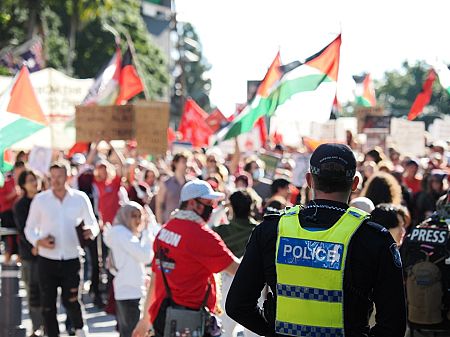
Police monitor pro-Palestinian protestors at rally in Brisbane on 15/06/25 (Image supplied)
Speech and publication restrictions
Under Section 52DA of the Criminal Code, it is now a criminal offence to 'publicly recite, publicly distribute, publish or publicly display' two phrases, if they could 'reasonably be expected to cause a member of the public to feel menaced, harassed or offended'.
The two expressions – "from the river to the sea" and "globalise the intifada" – carry a maximum of two years in prison.
Initially, the Bill had left phrases to be banned through future regulations.
Thus, a public Committee of Inquiry had only 17 days to assess the laws and hundreds of public submissions, without knowing the banned terms, which were added at the last minute, along with several other provisions.
The Labor Opposition claimed this was due to a split in the Government's party room, while the LNP Government claimed it was a measure to stop the opposition from repealing or using the same powers in the future.
On 3 March, Opposition Leader Steven Miles said:
“The new laws, not the new new laws, were rejected by the LNP’s party room. We understand that some members of the LNP were concerned enough about free speech that they were considering voting against them."
On 5 March, Police Minister Dan Purdie told Parliament:
"Labor simply cannot be trusted not to repeal the regulations and remove these prohibitions when they return to government. Should a future government wish to add or remove any expressions, they will need to do this via an amendment to the Criminal Code and subject to the full scrutiny of the parliament.”
The late additions denied proper scrutiny of these phrases, when even supporters of the new laws agree that their meanings are contested.
Mr Howard Posner, a Queensland Jewish Board of Deputies adviser, told the committee:
“I am sure there are people who genuinely believe that when they chant ‘globalise the intifada’ what they mean is not a violent internecine war in Australia. Unlike the ‘river to the sea’ argument, [there] is a legitimate disagreement … as to what it means, although it is still horrible. Of course, naive people will chant things they do not really mean, but its meaning is pretty bloody clear.”
Law enforcement needn’t prove someone was actually offended, only that the potential for offence existed.
The law also expands the ban to visual symbols belonging to prescribed organisations, which are determined by regulation as a terrorist organisation or state sponsor of terrorism.
Crucially, the standard of innocent until proven guilty has also arguably been narrowed.
For example, police can arrest journalists over a published phrase, who then must show a reasonable excuse, such as "fair and accurate" reporting, or opposing the ideology, but only in Court following arrest.
The silver lining is that legal experts suggest the laws may yet face Constitutional scrutiny.
Australia has no express Constitutional freedom of speech, but it does have an implied freedom of political communication.
The argument is that the constitution establishes representative government, requiring members of parliament to be ‘directly chosen by the people’. For people to make informed choices, they must be free to communicate about political matters.
Cate Heyworth-Smith KC warned that the laws may be vulnerable if they burden that freedom:
“There is then a tension in any legislation which seeks to impinge upon freedom of political communication in order to stamp out racism. It will be vulnerable to Constitutional challenge if it burdens impermissibly the implied freedom of communication on government or political matters.”
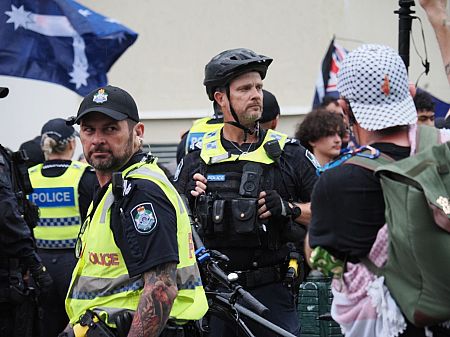
Police monitor pro-Palestinian protestors at rally in Brisbane on 15/06/25 (Image supplied)
Expanded police powers: covert operations and surveillance
Amendments to the Police Powers and Responsibilities Act 2000 (PPRA) have expanded policing capabilities.
Previously, controlled operations and related surveillance powers were generally reserved for offences carrying a maximum sentence of seven years. That threshold is now any indictable offence carrying a maximum penalty of at least three years.
The Bill’s Statement of Compatibility acknowledges potential human rights impacts, including privacy and equality before the law, concluding that:
'... on balance, the importance of the Bill’s purpose… outweighs the limited and regulated impact on individual rights.'
Several groups, including Legal Aid Queensland, raised concerns, stating:
'There is no apparent justification for controlled operations … to merely prevent three-year offences like common assault. Such an ambit power is exceptional and perplexing…'
Covert operations are no longer just for evidence-gathering, with Police now explicitly empowered to authorise operations to “frustrate” –disrupt or prevent – the commission of an offence.
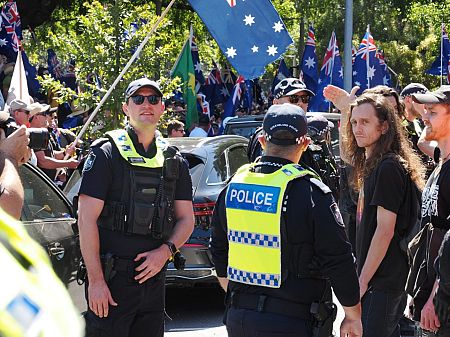
Expanded police powers: Warrantless searches and preparation laws
Under Sections 30 and 32 of the PPRA, suspected publication of prohibited expressions can now trigger warrantless searches.
If an officer suspects someone is distributing, reciting or publishing a banned phrase, they can search persons and vehicles and seize personal belongings as evidence. Furthermore, the power to issue a Firearm Prohibition Order (FPO) has been stripped from the courts and given to the Police Commissioner.
An FPO can now be based on confidential criminal intelligence that the subject may never see, even on appeal. It can also rely on a broad criminal history, including spent, unrecorded and quashed convictions, as well as withdrawn or struck-out charges.
That leaves people potentially facing warrantless searches while challenging an order blind.
Newly inserted Section 141ZGA of the Weapons Act 1990 also creates another concerning possibility.
FPO search powers can now reach people merely 'in the company of' an FPO subject, allowing police to stop, detain and search them without a warrant if they suspect they have a firearm or related item.
Perhaps the most sweeping uncertainty lies in new Section 540A of the Criminal Code, which creates a 14-year offence for preparing serious violence.
The prosecution does not need to prove preparation for a specific planned offence, or that any offence was ever carried out.
This casts a wide and uncertain net that could blur the line between criminal planning and journalism, artistic work or public commentary, if later said to resemble preparation rather than inquiry or expression.
It’s uncertain how these powers will be used until a precedent is set, although what’s clear is that these broad measures are capable of being used beyond just fighting antisemitism and keeping guns out of the hands of terrorists and criminals.
With raids and arrests already occurring, it’s fair to suspect they may be tested by the stick rather than the carrot.
Those most at risk – as usual – will be minority groups and First Nations communities, activists, immigrants, students and journalists.
Tyson Parker is a freelance journalist, photographer and researcher based in South-East Queensland.
 This work is licensed under a Creative Commons Attribution-NonCommercial-NoDerivs 3.0 Australia License
Support independent journalism Subscribe to IA.