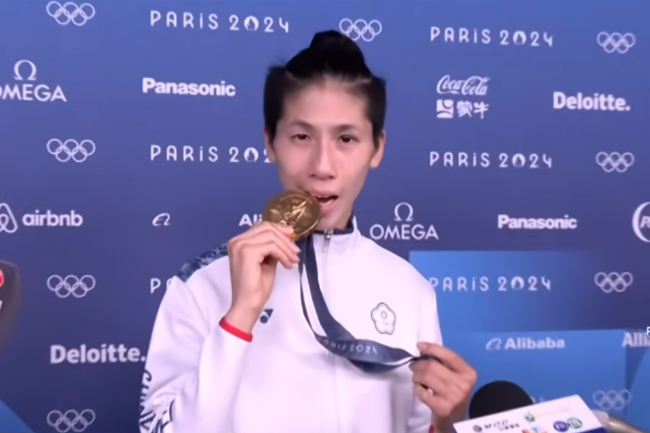
The International Olympic Committee’s new eligibility policy puts women’s bodies under scrutiny, with Lin Yu-ting’s latest victory overshadowed by questions of sex and eligibility, writes Jiayi Cheng.
THE INTERNATIONAL OLYMPIC COMMITTEE (IOC) announced a new policy in March 2026.
From the 2028 Los Angeles Olympics, transgender women will be barred from women’s competitions at IOC events. Restrictions will also apply to some athletes with differences of sex development (DSD).
Two years after the Paris Olympics, female athletes are still being forced to defend their place in women’s sport — even as they stand on the podium.
Eligibility for the women’s category will be determined through a one-time screening for the sex-determining region Y (SRY) gene, while this policy requires no equivalent testing for men. The policy allows rare exceptions, including athletes with complete androgen insensitivity syndrome or other specific DSDs who do not benefit from testosterone-related performance effects. The IOC claims this protects ‘fairness, safety and integrity’.
This is not just a sporting rule — it is a political one. The Associated Press reported that the policy aligns with U.S. President Donald Trump’s approach to women’s sport. At the same time, the French National Olympic and Sports Committee openly stated that the SRY test raises ethical and scientific concerns. The Committee also said French bioethics and civil law prevent such tests from being carried out in French laboratories.

The New Zealand Olympic Committee took a more restrained stance, stating in a written update that its next steps would be approached with ‘respect and care’. The same rule means different things in different countries: protection in one place, legal risk in another and political symbolism somewhere else. That is exactly why this is not a neutral policy.
Supporters frame such restrictions as necessary to protect “fairness” and “safety” in women’s sport. However, fairness cannot be built on systematic suspicion of women’s bodies. The IOC’s policy requires women – but not men – to undergo genetic verification, as if “proving who you are” is solely an obligation that women must undertake.
It also clearly echoes the Trump-style right-wing narrative on gender and sports, which turns complexity into exclusion. This is not to deny that sport requires categories. But when those categories are enforced selectively, they reveal more about power than fairness.
Sport has never been fair. Height, physiology and genetic advantage have always shaped who wins. Yet exceptional height and other natural advantages are often celebrated rather than treated as grounds for exclusion.
The difference here is not fairness — it is who is being targeted. This policy turns ordinary human variation into suspicion, but only when it appears in women and queer bodies. This policy does not eliminate advantage. It decides which advantages are allowed to count — and which bodies are made to answer for them.
It places women’s bodies under suspicion and treats difference as risk. What is framed as scientific neutrality begins to look more like a familiar pattern: it legitimises social bias. Scholars have long shown that sex testing in sport is neither straightforward nor purely scientific, but shaped by social and political assumptions about gender.
Even for those who remain eligible, the consequences of such a system are significant. Athletes who are stronger or do not fit traditional femininity are more likely to face suspicion. They may be labelled “too male-like” or accused of hiding their identity. In such an environment, excellence itself becomes grounds for suspicion. When women perform exceptionally well, they are too often questioned, as if success were proof of masculinity rather than talent.
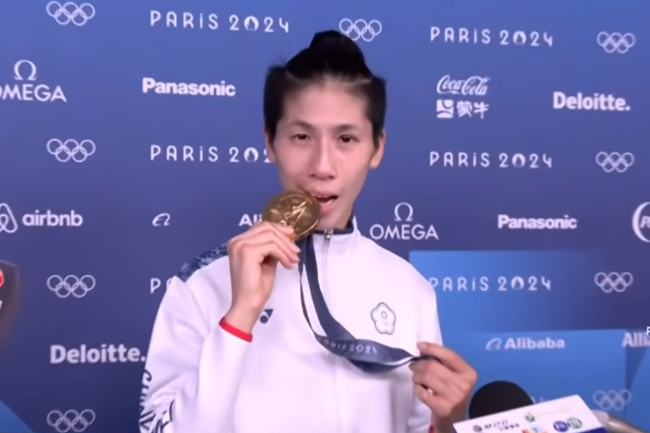
In practice, female athletes have already faced public scrutiny, media speculation and invasive questioning about their bodies. On 2 October 2026, Taiwanese boxer Lin Yu-ting won another Asian Games gold medal, following a lengthy absence from international competition amid uncertainty over her eligibility. World Boxing had already confirmed her eligibility in March.
Yet even in reporting her victory, Reuters and Al Jazeera foregrounded the controversy over Yu-Ting's sex in their headlines. Two years after the Paris Olympics, she is still being defined by questions about her body rather than celebrated simply for her achievements.
What begins as regulation quickly becomes exposure. Athletes are discussed on television panels, dissected online and reduced to biological case studies rather than competitors. Once that happens, the athlete disappears and the debate takes over.
Women’s athletic bodies have been policed to conform to narrow ideals of femininity. What is concerning is the return of institutional sex testing. Once these assumptions are embedded in policy and reinforced by scientific rhetoric, they gain legitimacy. What once looked like prejudice begins to look like procedure.
In this way, inequality is not just maintained — it is taught. The lesson is simple: male strength is taken as natural, while female excellence is treated as suspicious.
A policy that claims to protect fairness but systematically produces harm cannot be ethically justified. A responsible approach would not police bodies; it would protect athletes and use sport-specific evidence.
The real question is not whether sport can ever be perfectly fair. It is who gets to define fairness — and who is forced to prove they belong.
Jiayi Cheng (they/she) is a postgraduate journalism and communication student at UNSW Sydney, with experience in media production and editorial work.
 This work is licensed under a Creative Commons Attribution-NonCommercial-NoDerivs 3.0 Australia License
Support independent journalism Subscribe to IA.