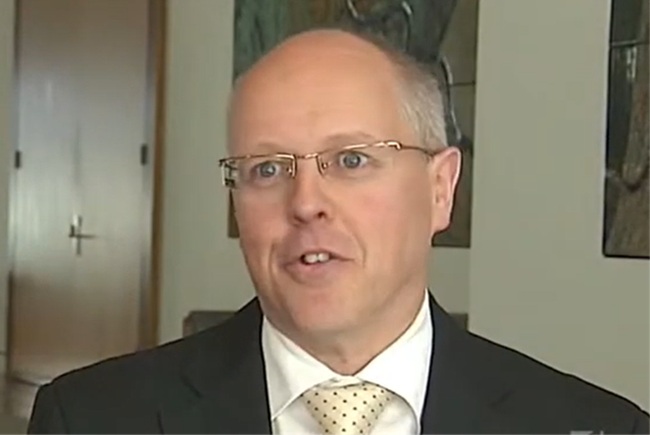
For the better part of two decades, Dr Harley Dale was the load-bearing wall of Australian housing economics. Not the loudest voice. Not the most politically convenient one. But the one doing the structural work, writes Professor Vince Hooper.
IN RESIDENTIAL CONSTRUCTION, a load-bearing wall is the one nobody thinks about until it is gone. It carries the weight of everything above it: the joists, the roof trusses, the rooms where people sleep.
It does not announce itself. It is not the feature wall with the exposed brick or the skylight that makes the open-plan listing photograph. It is the wall the architect draws first and the renovator removes last, if they are wise, and first, if they are not.
For the better part of two decades, Dr Harley Dale was the load-bearing wall of Australian housing economics. Not the loudest voice. Not the most politically convenient one. But the one doing the structural work.
Dale's career reads like a building with unusually deep footings.
A Master of Arts in Economics at the University of Auckland, completed with First Class Honours, one of only three in a cohort of more than thirty.
A PhD scholarship at the Australian National University, taken up at the end of 1992, where he studied under Professor Peter Drysdale AO, the man widely recognised as the intellectual architect of Asia-Pacific Economic Cooperation (APEC).
Under Drysdale's supervision, Dale's early work was in East Asian economics: trade flows, regional integration, the architecture of an emerging Pacific century.
I first knew Harley at ANU in 1994, when he was still deep in his doctoral research and the housing crisis he would spend the next three decades warning about had not yet begun to compound.
After completing his PhD, Dale moved into financial markets, working under Bill Evans at Westpac, the man who would spend thirty-two years as the bank's chief economist and whom markets came to call the man who moves them.
From Drysdale he had learned how to read the architecture of a trading system; from Evans he learned how to read a room full of traders.
A brief period as Senior Economist and Vice-President of Equities at Credit Suisse First Boston followed.
Then, from 2003, the role that would define his public contribution: Chief Economist of the Housing Industry Association (HIA), where he served for more than 15 years, a decade as chief economist, then as executive director for industry skills and development, before moving to CreditorWatch and, eventually, to independent practice.
The young economist who had studied the architecture of Asian trade ended up studying the architecture of Australian houses. In both cases, the question was the same: what happens when the structure cannot support the weight placed upon it?
It is tempting, in retrospect, to treat Dale's tenure at HIA as the golden age of housing commentary. It was not. It was the age of uncomfortable truths delivered in plain language.
Dale warned, repeatedly and with data, that Australia's dwelling commencement pipeline was structurally inadequate, that planning systems were throttling supply, and that the gap between demand and delivery was not a cyclical fluctuation but a chronic condition.
He said it when the median house price was still within reach of a dual-income household.
He said it when the political class preferred to talk about demand-side levers (negative gearing, capital gains discounts, first-home-owner grants) rather than confront the supply-side constraints that were quietly compounding behind every local council's planning committee.
The numbers that arrived in the first week of September 2026 suggest he was right, and that nobody was listening.
In the financial year to 30 June 2026, 3,472 Australian construction companies entered insolvency. That figure represents one in every four corporate failures across the entire economy.
The Bathla Group, one of Australia's largest affordable home builders, based in Sydney, collapsed into voluntary administration owing approximately $3.4 billion to creditors, the vast majority to secured lenders, throwing more than 2,000 apartments into limbo and imperilling a pipeline of a further 14,000 homes.
House construction costs now sit 51% above their pre-pandemic level. Concrete alone has climbed roughly 150% in six years. A house that once took 8.6 months to build now takes 11.5.
Dwelling commencements fell 11.2 per cent from the previous quarter in the first three months of 2026. New South Wales, the country's largest housing market, will not meet its National Housing Accord targets until March 2032, three years late on what was designed as a five-year commitment.
Nationally, the 1.2-million-home target will not be reached until at least December 2030, according to the government's own forecasts. The Urban Development Institute of Australia (UDIA) projects a total shortfall of 380,000 dwellings over the next five years.
Apply even a modest analytical lens and the structure of the failure comes into focus.
The Herfindahl-Hirschman Index, a standard measure of market concentration, reveals an industry in which a handful of volume builders absorbed an outsized share of commencements, and when one of them collapses, the concentration effect does not dissipate. It detonates.
Bathla's $3.4 billion liability is not spread evenly across the sector; it is concentrated in the affordable segment, precisely where supply was already thinnest.
Le Chatelier's principle, borrowed from thermodynamics and frequently applied in regulatory economics, predicts that when a system under equilibrium is subjected to a sustained external pressure (in this case, the relentless layering of the National Construction Code, overlapping state and local planning requirements, and infrastructure levies), the system will adjust, but not in the direction the regulators intended.
It adjusts by shedding its most vulnerable participants. The small builders, the ones who lack the compliance budgets to absorb a code revision every eighteen months, exit. Supply contracts. Costs rise. The very regulation designed to improve building quality accelerates the shortage of buildings.
Real options theory sharpens the diagnosis further. A fixed-price residential construction contract is, in effect, a sold call option: the builder caps the buyer's cost in exchange for bearing all upward risk on materials and labour.
When volatility is low, the premium is manageable. When concrete triples and trades evaporate to Olympic construction sites in Brisbane, the option is deep in the money, against the builder. Dale understood this asymmetry intuitively long before the textbooks caught up.
In the years I knew him, the argument never changed. Only the numbers did. He spent years arguing that fixed-price contracting in a volatile-cost environment was a structural fragility, not a consumer protection. The insolvency data now reads like the payoff diagram he was drawing on a whiteboard.
The fat-tail distribution of builder failures completes the picture.
If insolvencies were normally distributed, Bathla would be an outlier, an improbable event safely contained in the margins of a risk model. But construction insolvencies do not follow a bell curve. They cluster in the tails, arriving in waves, each collapse dragging subcontractors and suppliers into the undertow.
The expected shortfall, the average loss conditional on being in the tail, is not the 3,472-firm headline. It is the scenario in which a single failure wipes 16,000 homes from the pipeline in a market already running 27% below pace. That is the tail Dale kept pointing at. The industry kept looking at the mean.
What the data cannot capture is the person behind the forecasts. Dale was treasurer of PIYE Incorporated, a Sydney-based charity that funds community projects in Kenya, a detail that reveals something about the man that the quarterly housing outlooks did not.
He cared about shelter in the broadest sense: not just the dwelling commencement statistics, but the human consequence of a built environment that fails the people who need it most.
He was a New Zealander who adopted Australia, a student of Peter Drysdale who could have stayed in the world of Asian trade architecture, a market economist who crossed into advocacy. He did not stay in one room. In more than thirty years of friendship, from an ANU corridor in 1994 to his final years of independent practice, I never knew him to pull rank, soften a number, or pretend the data said something it did not.
Dale disclosed a terminal illness publicly, on LinkedIn, with the same directness he had brought to a housing forecast. No hedging, no qualifying language, no soft exits.
He died within weeks of Bill Evans, who passed away on 28 July 2026 at the age of seventy-six after his own battle with cancer. He had enormous respect for Bill.
To lose both men in a single season is to feel the weight shift in the ceiling above you. Christopher Joye, who first encountered Dale while leading the 2003 Prime Minister's Home Ownership Task Force, mourned them together and described Harley as arguably the country's preeminent authority on the economics of bricks and mortar.
What Joye and others noted, in private tributes that followed, was a quality that does not appear in any quarterly outlook: when you engaged with Harley, you never felt you were imposing.
The instinct in a tribute is to say that someone's contribution will be remembered. That is usually a polite fiction. Contributions are remembered only if the people who inherit them understand what they were carrying. Australia's housing crisis is not a mystery. It is a forecast that came true.
The data are not new. The warnings are not new. The structural fragilities, the concentration, the regulatory absorption, the fat-tail exposure, the mispriced optionality of fixed-price contracts, were identified, documented, and communicated by an economist who combined academic rigour with industry fluency and the rarest quality of all in public commentary: the willingness to be unpopular before being proven right.
The load-bearing wall does not ask to be noticed. It asks only to be left in place.
The question now is whether anyone in Canberra, or in any state planning department in the country, can identify which walls are still standing, and what happens to the structure if one more is removed.
Professor Vince Hooper is a proud Australian-British citizen and professor of finance and discipline head at SP Jain School of Global Management with campuses in London, Dubai, Mumbai, Singapore and Sydney.
 This work is licensed under a Creative Commons Attribution-NonCommercial-NoDerivs 3.0 Australia License
Support independent journalism Subscribe to IA.