

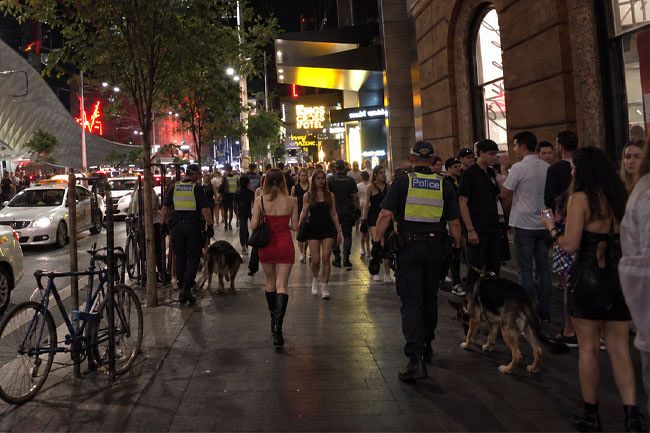
Heavy-handed drug policing is undermining Sydney’s nightlife while doing little to tackle organised crime, writes Ben-Jamin Newham.
NSW PREMIER Chris Minns says his government wants a vibrant 24-hour Sydney. Yet repeated police and drug-dog operations inside and around Oxford Street nightlife venues are working against that ambition.
On 13 June, 35 NSW Police officers were deployed across the Oxford Street entertainment precinct. Ninety-three people were searched and 42 drug detections were recorded. NSW Parliament was later told that only one person was charged with supplying a prohibited drug.
A further September operation searched 65 people, with police reporting 28 drug detections, 12 fines, six cannabis cautions and one move-on direction. No arrest was reported in media coverage of that operation.
Those outcomes should force a basic policy question: are these operations actually disrupting commercial supply, or are they simply producing visible enforcement at the easiest end of the market?

A person carrying a small quantity of drugs on a dance floor is not an importation network. Searching that person does not seize a container, trace criminal money, intercept an illegal firearm, identify a financier or dismantle the organisations that profit from the drug trade.
What a large police presence can do very efficiently is change customer behaviour. People leave. People decide not to return. Venue owners absorb the cost. After the June operation, NSW Parliament heard evidence that one nightclub suffered about a 70 per cent reduction in turnover.
For businesses already squeezed by rents, insurance, staffing costs, the legacy of lockout laws and the long recovery from COVID-19, that kind of shock matters. The Government cannot credibly champion a 24-hour economy with one hand while the other sends highly visible enforcement operations through the venues it says it wants to revive.
The harm is more serious again when those venues are LGBTQIA+ spaces. The relationship between NSW Police and queer communities carries a documented history of violence, prejudice, inadequate investigations and deep distrust.
The Special Commission of Inquiry into LGBTIQ hate crimes examined the relationship between the community and NSW Police, while earlier parliamentary inquiries documented a police culture shaped by the social prejudice of the time and the barriers that were created for victims seeking justice
That history is not merely symbolic. It changes how police power is experienced inside queer venues. I have personally received firsthand testimony from a source I regard as highly credible alleging sexual assault of an LGBTQIA+ person by a serving police officer. I also personally know two serving gay police officers who have chosen not to come out at work because they fear bullying and damage to their careers.
Those experiences do not prove that every officer is prejudiced. They do show why government cannot assume a large armed police presence is experienced as neutral simply because the operation is described as professional.
There is also a harm-reduction problem. When drug-detection dogs and large groups of police enter a crowded club, some patrons may panic, discard substances, conceal them unsafely or consume them quickly in an attempt to avoid detection. A tactic that may encourage risky ingestion or discourage people from seeking medical help deserves independent scrutiny before it is repeatedly deployed.

Most importantly, the broader drug-use data does not suggest consumer-level enforcement is winning. Australian Institute of Health and Welfare wastewater estimates show that between 2023-24 and 2024-25, estimated NSW methamphetamine consumption rose from about 3,600 kilograms to 4,600 kilograms a year, while cocaine rose from about 2,800 kilograms to 3,300 kilograms. Heroin consumption also increased substantially.
After years of sniffer dogs, searches, fines and possession enforcement, demand remains enormous. At some point, the Government has to distinguish between visible enforcement and effective policy.
Meanwhile NSW is confronting organised crime, shootings, illegal firearms, domestic and family violence and hate crime. Police resources are finite. Every large high-visibility nightclub operation carries an opportunity cost.
I want police targeting the people willing to kill for control of the drug trade. I want them tracing money, intercepting firearms, dismantling importation networks, protecting victims of domestic violence and investigating hate crime. I do not want Sydney nightlife treated as convenient theatre for a drug war that has failed to eliminate demand.
NSW should also be mature enough to examine alternatives. That means taking harm reduction, decriminalisation and regulated models seriously rather than treating consumer-level enforcement as the permanent default. The current system has not eliminated demand and it leaves an enormously profitable market in criminal hands.
Premier Minns should suspend large-scale drug dog operations inside LGBTQIA+ nightlife venues while current misconduct concerns remain under scrutiny; commission an independent assessment of whether these operations measurably reduce serious supply, demand or harm; publish their cost and outcomes; and require genuine consultation with LGBTQIA+ organisations, venue operators and harm-reduction experts before future operations in the precinct.
Sydney once sold itself as a city that came alive after dark. We should not accept a future where nightlife is technically open but culturally strangled by fear, regulation and enforcement.
A city cannot claim to want people out after dark while making them feel like suspects for being there.
Ben-Jamin Newham is a Sydney-based artistic director and theatre practitioner with a long-standing interest in Sydney’s cultural life and night-time economy.
 This work is licensed under a Creative Commons Attribution-NonCommercial-NoDerivs 3.0 Australia License
Support independent journalism Subscribe to IA.


Related Articles
- Carbon offsets threaten Great Koala National Park promise
- CARTOONS: Chris Minns dines out on defence of 'social cohesion'
- NSW Labor ignores environmental threats with another useless panel
- Minns Government animal cruelty reveals double standards




