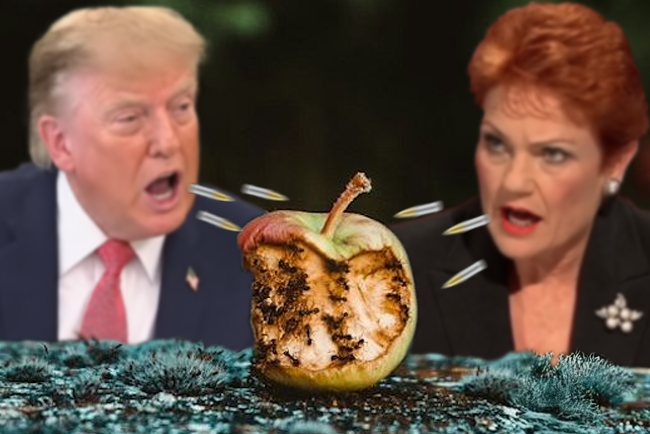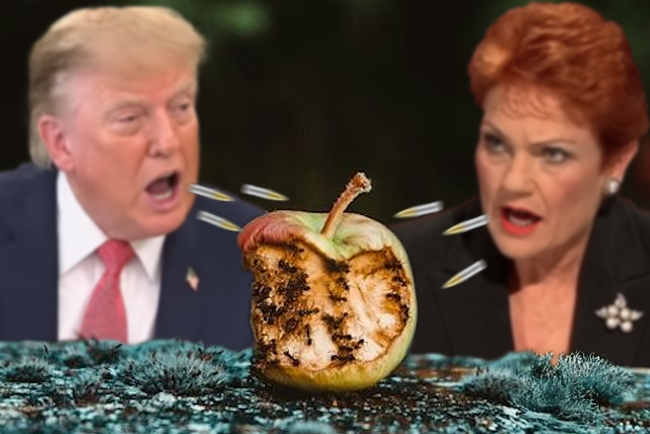
As we watch the horrifying news of Federal MP for Indi Helen Haines unfold, there is both the temptation to blame it on one “bad apple” and to conclude that the entire orchard is tainted.
Haines was attacked in the street while going about her business, has since lost both her legs, and remains in a critical condition in Melbourne's Alfred Hospital, at time of writing.
The “one bad apple” concept is not new. It’s a philosophy that has, among other things, long reassured people of their parenting skills, for example: if their kids behaved badly, they had obviously been led astray by one or more “bad apples”. And when traumatic events occur in society, it has also provided a scapegoat on which to direct blame.
In this way, Hitler could be seen as an extremely bad apple and in no way representative of society or its underlying problems. And Brendan Nugent, who allegedly deliberately ran over Helen Haines, is just one "bad apple".
Those inclined to categorise the whole orchard as tainted similarly explain such horrendous events by looking for the common thread, such as jumping to conclusions about Nugent's social media posts on climate change as indicative of him being a “left-wing nutjob”.
While both these stances allow us to displace responsibility, they also miss the point.
Like the apples it conjures, there are many holes in the bad fruit philosophy, since it is often impossible to determine which particular apple went bad first.
It is also difficult to put ourselves in the mind of Haines’ attacker, who is believed to be suffering from mental health and neurological issues, and whose motives are so far only known to him. Nor can we blame this attack on any organisation or speculate about who or what may have influenced him.
Even if Nugent did represent some sort of aggrieved cohort, it does little to explain the undercurrent of unfettered anger and violence permeating our society — an escalating mood of hate, which we walk past each day.
And it is also difficult to determine where the ethylene gas first made contact with the fruit.
Did it start with the orange U.S. leader’s 2016 election? Or did the rot begin when Trump was found guilty of 34 criminal felony counts, but was somehow still re-elected president?
Did the contamination begin when the most powerful democracy in the world put children in cages or built walls to keep people out, or when it aflagged public executions?
Perhaps it was the moment when the genocide inflicted on Palestinians by Israeli forces was labelled a “war”, resulting in overall global complacency and inaction.
Did the apples start to go bad with the rise of so-called “populist” parties, like Reform UK and France’s National Rally?
Or did the contamination begin in the local oranges? Such as when One Nation’s Pauline Hanson was given a megaphone in the form of a National Press Club address to amplify her party’s racist, bigoted policies, for instance.
Did the real rot fester when elected politicians, like Pauline Hanson, can release hateful, despicable cartoons on a regular basis — such as the one in which Senator Jacqui Lambie’s very personal health issue was ridiculed – and call them “satire”?
Hanson eventually apologised (though only after overwhelming bipartisan condemnation), despite originally telling Lambie, “Jacqui, lighten up sweetheart”.
To her credit, the Tasmanian Senator simply criticised the One Nation videos as "spiteful", stating that real leaders "don't stir up hatred".
Not that Hanson stopped there, of course. Since the horrific attack on Helen Haines, Hanson has variously blamed the PM and Labor, the Greens, and even people exercising their democratic right to protest, thereby widening the hate and division to encompass all non-One Nation voters.
New research has shown that one bad apple can actually spoil the barrel and that in many cases, people are very much influenced by what others are doing. In fact, when people see rule-breaking in others, general compliance can swiftly turn into widespread rule-breaking.
Certainly, dehumanising threats and hateful attacks are becoming more and more common, and because they are fuelled on a daily basis by so-called populism, legacy media and social media algorithms, they are also becoming more normalised.
It is no surprise, then, that violence against women remains at epidemic proportions. Statistics show a staggering average, in Australia, of 18 women per day hospitalised and 56 killed due to violent attacks so far this year.
Female politicians are also increasingly targeted, with a new report by political advocacy group Women for Election finding '90 per cent of women who hold or are running for a position in government experienced online abuse or intimidation'.
NSW Labor MP Liesel Tesch told ABC 7.30 that she has experienced online abuse and even,
"...had a threat graffitied on the footpath outside [her] house that all politicians should be killed now."
Another Labor MP, Dr Anne Aly, said:
"This past week alone I've had 19 death threats on my social media."
According to the 7.30 report:
"Over the past year, Federal Police have charged roughly one individual every week over threats to MPs."
Helen Haines' husband Phil Haines, joined by Governor-General Sam Mostyn, addressed the media at the Alfred Hospital on Wednesday (21 October).
The Governor-General said the violent attack "must be a moment for us to pause", and asked:
"What do we all do? What does a nation do now?”
Mostyn – who has also since received online abuse – said that she and Helen Haines had “talked about the need for greater civility and engagement across our civic and public life”, that we should “disagree well” and “exercise decency”, and added:
"We don't have to all agree, but we can wrestle the issue, not the person … It's important to remember words matter, whether spoken or in written form or increasingly in the virtual world."
Follow managing editor Michelle Pini on Twitter/X @vmp9 and Bluesky @michellepini.bsky.social, and Independent Australia on Twitter/X at @independentaus, Facebook HERE and Instagram HERE.
 This work is licensed under a Creative Commons Attribution-NonCommercial-NoDerivs 3.0 Australia License
Support independent journalism Subscribe to IA.