From Iranian footballers to Hong Kong dissidents, Myanmar exiles and the Biloela family, recent cases show that protection in Australia often begins in civic and community networks before it reaches the state.
It may begin with a sit-in outside a hotel. Or with free legal assistance. Or with neighbours raising money before the media has even reported that a crisis is unfolding. In Australia, protection often begins well before the state steps in: in migrant communities, local awareness campaigns and civic groups that mobilise when fear, intimidation or a sudden need to flee turns into a real emergency.
The scale of the phenomenon is far greater than most people realise. The Federation of Ethnic Communities’ Councils of Australia (FECCA) represents more than 1,500 community organisations and, among respondents to the Australian Multiculturalism Survey, almost two-thirds say they do volunteer work.
This associational fabric also operates within a humanitarian context that is far from marginal: in 2023–24 alone, Australia granted around 20,000 humanitarian protections – 16,750 offshore visas and 3,250 onshore Permanent Protection Visas – to people from 78 countries or territories. This is not a marginal feature of Australian society. It is an established and already well-developed reality.
These networks work first and foremost on the ground. They help with settlement, legal and administrative guidance, language support, fundraising and advocacy. But they often do not stop there. They also maintain a bridge of information, support and relationships with communities that remain in their countries of origin.
There is still no single national count of migrant associations, committees and community media outlets, nor of the total number of people assisted inside and outside Australia. But recent cases show clearly that this infrastructure exists and often begins to act before institutions do — not as a simple moral or charitable side note to migration, but as concrete action in everyday life.
Four recent cases make this ecosystem visible.
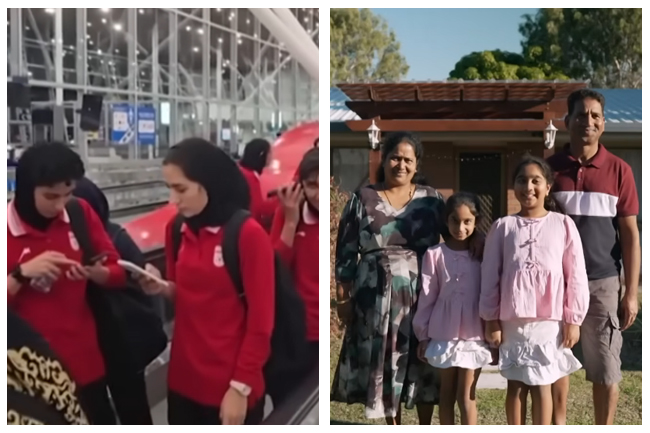
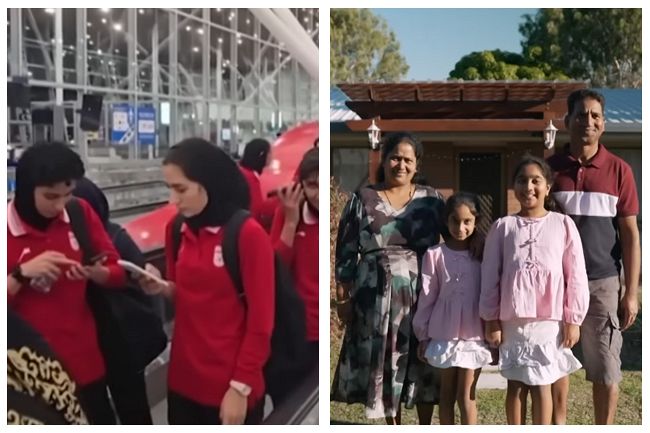
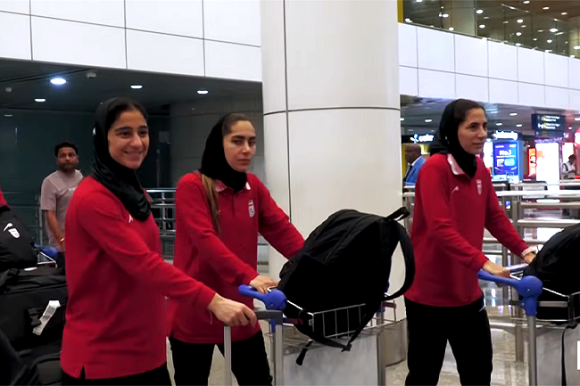
The first dates to March 2026, when, during the Women’s Asian Cup, five players from Iran’s women’s national team were granted Temporary Humanitarian Visas after deciding not to return to Iran.
At a hotel on the Gold Coast, they spoke with migration agent Naghmeh Danai about their asylum options. According to Danai, they feared persecution, confiscation of their property and reprisals against their families.
The ABC also reported threats against relatives if the players failed to return. In the meantime, the Iranian-Australian community had already begun to mobilise. Farhad Soheil, an activist in the Iranian-Australian community, said he had contacted Home Affairs and the office of Minister Tony Burke, partly because of concerns that the delegation included figures close to the Iranian regime, including people linked to Iran’s Islamic Revolutionary Guard Corps (IRGC). After the controversy over the anthem, supporters made their presence felt in the stands and around the hotel.
A second case is Hong Kong. It shows another face of the same phenomenon: transnational repression. In July 2023, the Hong Kong authorities issued a series of arrest warrants and bounties against activists overseas, including Kevin Yam, an Australian citizen, and Ted Hui, who lives in Australia. In March 2025, letters were delivered in Melbourne carrying Yam’s photograph and offering a reward for information about him; in Adelaide, pamphlets targeting Hui included the address and phone number of his law office.
Hui said he had been terrified. The Australian Government lodged protests with China and Foreign Minister Penny Wong said Australia would not tolerate threats or harassment against people on its soil.
The third case concerns Myanmar and is perhaps the clearest example of what a genuinely operational exile network looks like. After the coup of 1 February 2021, ABC reported in February 2023 a genuine groundswell of support across Australian cities, with fundraising for people still in Myanmar and for displaced people across the region.
During the same period, singer and activist Chan Chan, who is wanted in Myanmar for backing the resistance, toured Sydney, Melbourne, Brisbane and Perth, where one concert drew more than 600 people. Canberra had by then committed $135 million in humanitarian assistance and granted around 2,500 offshore humanitarian visas and almost 240 permanent protection visas.
A briefing from the ANU Migration Hub added that 78% of respondents maintained direct contact with people in Myanmar, 61% were engaged in advocacy and 68% took part in donations or fundraising.
The case of the Nadesalingam family from Biloela is a reminder that this logic can also become a deeply Australian issue.
In March 2018, at dawn, Australian Border Force officers raided the home of Nades Murugappan, Priya Nadesalingam and their daughters, Kopika and Tharnicaa. After the family was transferred and detained, the local response was immediate: health workers, business owners and farmers mobilised, while social worker Angela Fredericks became the public face of the Home to Bilo campaign.
The Change.org petition gathered almost 600,000 signatures and the case won the support of 18 federal parliamentarians, including Julie Bishop, Barnaby Joyce and Tony Abbott. In 2022, before the family returned to Biloela on bridging visas, SBS reported that more than $200,000 had already been raised and that a house had been arranged rent-free for six months.

Of course, in decisive moments, the State still matters, with the breadth of its resources, its expertise and its capacity to intervene. But that is precisely why these cases are instructive. They do not suggest that the state is irrelevant. They show, rather, that real protection often begins before formal state action: in public pressure, mediation, resource mobilisation and the capacity of a community to organise quickly. That is where the first line of defence is formed.
But that is also where a further social and political step should begin — one Australia can no longer postpone. Protection does not mean only granting entry or legal status. It also means recognising that many exiles continue to live under pressure even after arrival: threatened, monitored or exposed to intimidation campaigns that may come not only from the state apparatus of their countries of origin, but also from compatriots living in Australia who remain aligned with, mobilised by or instrumentalised by those regimes.
This is not a matter of setting one community against another, nor does it justify indiscriminate suspicion toward migrants. It is, rather, about taking seriously the fact that authoritarian repression can continue inside Australian society through informal, communal and transnational channels.
If Canberra wants to speak seriously about protection, the next step is not only to recognise the work of civic networks already doing the fastest and most extensive work on the ground. It is also to build clearer tools to protect exiles from those internal pressures that allow dictatorships to extend their shadow well beyond their national borders.
Stefano Gujon is an independent journalist and analyst.
 This work is licensed under a Creative Commons Attribution-NonCommercial-NoDerivs 3.0 Australia License
Support independent journalism Subscribe to IA.


Related Articles
- How Australia exploited the Iranian women’s football team
- The future of Australia's asylum seeker system
- Compassion for refugees can undo Trump's influence on Australia
- Urgent call to halt Migration Amendment Bill 2024
- One refugee in a surging tide