

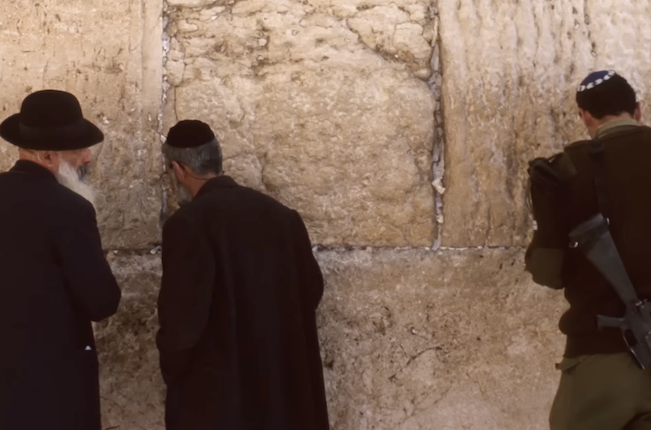
If Palestinians are Semitic too, what does “antisemitism” really mean? Col Jennings reports.
THE CANAANITES were tribal people who occupied much of what became known as Palestine. But if we are to believe that Abraham, the father of the Jewish race, came to Jerusalem when it was Salem and he was instructed by Melchizedek, who first introduced him to the concept of the one God, this would have been around 2,000 BCE. The Jewish race would not have existed before Abraham came from the East.
Archaeological and genetic data support the idea that both Jews and Palestinians came from the ancient Canaanites, who extensively mixed with Egyptians, Mesopotamians and Anatolian peoples in ancient times.
According to Suciu-Foca N. and Lewis R. Hum, (Immunologists from the National Library of Bethesda, USA), the genetic profile of Palestinians has, for the first time, been studied by using human leukocyte antigen (HLA) gene variability and haplotypes.

The comparison with other Mediterranean populations by using neighbour-joining dendrograms and correspondence analyses reveals that Palestinians are genetically very close to Jews and other Middle East populations, including Turks (Anatolians), Lebanese, Egyptians, Armenians and Iranians.
Most of these people are of Semitic origins, so to speak. To speak of antisemitism as only relating to the Jewish peoples is incorrect.
Palestinians are Semitic people themselves.
The history of Palestine is marked by significant events spanning thousands of years, from ancient civilizations to modern political developments. The earliest evidence of human occupation was around 220,000 BCE when Archaic humans occupied the Qesem Cave in what is now known as Palestine.
Around 9000 BCE, the Natufian hunter-gatherers established a permanent settlement in Jericho, one of the oldest continuously inhabited cities. In 1,200 BCE, the Philistines settled along the coastal areas of Palestine, leading to the establishment of the region known as Canaan.
Saul (1079-1007 B.C.) was, according to the Bible and Qur’an, the first king of the United Kingdom of Israel. The successor to his throne was his son-in-law David and it was, according to some sources, not until 1,000 BCE that the Kingdom of Israel was founded, with King David capturing Jerusalem.
The Hebrews had no written language in general usage long after they reached Palestine. They learned the use of an alphabet from the neighbouring Philistines, who are political refugees from the higher civilisation of Crete.
Having no written language until such a late date, they had several different stories of creation in circulation, but after the Babylonian captivity, they inclined more toward accepting a modified Mesopotamian version.
From 700 B.C. to 50 A.D. – or for more than 600 years – the Jews of Judea, and later on those of Galilee also, had been at enmity with the Samaritans. This ill feeling between the Jews and the Samaritans came about in this way: Sargon, king of Assyria, in subduing a revolt in central Palestine, carried away and into captivity over 25,000 Jews of the northern kingdom of Israel and installed in their place an almost equal number of the descendants of the Cathies, Sepharvites, and the Haematites. Later on, Ashurbanipal sent still other colonies to dwell in Samaria.
This was then around the beginning of the rise of the Roman Empire and its complete domination of the politics of Europe, North Africa and the Near East.
The short history of Palestine being stolen
After the Romans conquered Judea, Palestine became a province of Rome. After the Roman Empire fell away, the land of Palestine fell under the Christian Byzantine Empire.
Then, in 638 AD, an Arab Muslim caliph took Palestine away from the Byzantine Empire and made it part of an Arab Muslim empire.
During this period, many of the people living in Palestine became Arab Muslims and converted to the religion of Islam. However, Palestine still never became an official state, nation, or country, even under the rule of these Muslims.
Then in 1,099 AD, the Christian crusaders from Europe conquered the Palestine area and took it away from the Muslims. But again, the Christian crusaders failed to make Palestine an official state or country. They just basically used it as a military outpost.
Later on, Palestine ends up in the hands of Syria. Then, from Syria, Palestine fell into the hands of the Ottoman Turks. After World War 1, the British took Palestine over from the Ottoman Turks.
The British temporarily governed Palestine under the League of Nations.
Again, during all of these transitions and takeovers, not one of these other peoples or countries ever made Palestine an official state or country!
Now here is the really interesting part. Right around the 1850’s, the Jewish people began migrating back to Palestine in small droves. The land was basically dry, barren, desolate and unlovely.
By 1948, the perception of Jewish people was that they really believed they could be better managers of this land. Did the Jewish people forget their own belief in the Jubilee Year, of restorative justice every 50 years? Give back and equalise things again — and we must ask under Christian ideals, is the land ours anyhow? Do the Jewish people still believe in loving kindness and justice for all? The people do I’m sure, but not their leaders.
It is one thing to foster a two-state solution to the Palestinian/Israeli conflict, but if the land is already rubble and people are living in a refugee-type existence, the possibility of providing a safe, economic and peaceful homeland is almost nil — even if there was a willingness of Israel to allow this to happen.
Historically, the Holy Land was shared between Jews, Arabs and Palestinians. Can anyone really see this happening? I realise most Palestinians would grieve the loss of their legitimate homeland, but surely a better solution may be for the world community to offer them a place in ‘our’ countries until a safe solution can be found.

The Maps below show the gradual erosion of the Palestinian land from 1946.
At no time from 1946 until now did Israel and its allies allow the establishment of a legitimate "homeland" for the Palestinians.
It has been discussed in the UN and among world leaders since 1946. Nothing concrete has been done by the world powers to allow the Palestinian people to "occupy" their land. Australia and the United States have continually allowed subsequent Israeli Governments to block any firm objective of making Palestine a state in its own right with some legal ownership.
Currently, the land left to Palestinians to occupy is a wasteland — bombed endlessly, its people have become virtual refugees without any proper financial or support in health, housing or food aid.
For those Western Countries supporting Israel to allow this to happen puts them in the role of liquidators rather than liberators. So-called Christian leaders may need to be reminded that Jesus Christ was a "Palestinian" by placement, even if he had Jewish parents.
Col Jennings is a writer.
 This work is licensed under a Creative Commons Attribution-NonCommercial-NoDerivs 3.0 Australia License
Support independent journalism Subscribe to IA.


Related Articles
- Beyond suffering: Reclaiming the Palestinian story
- Selective empathy and the weaponisation of trauma
- CARTOONS: Australia takes a stand
- The moral cleansing has commenced for ultra-Zionists and their lackeys
- Chasm between liberal values and action exposed again





