Allegations of covert coordination, voter intimidation and data sharing have thrust the Plymouth Brethren’s role in the 2025 Federal Election under growing national scrutiny, writes Joe Eden-Bull.
I FIRST BECAME aware of the Plymouth Brethren during the UK General Election in 2019. It was cold, dark and miserable — the first December election since 1918.
I was 15 at the time, swept up in my first election campaign, knocking on doors in East Bristol and Kingswood. My memory of this period is a hibernal haze, repeatedly told by anonymous faces that they would rather vote for Boris Johnson while my cheeks grew numb.
There was only one interaction that I remember with real clarity. A large, detached house with a looming quality. I knocked on the door and was shortly confronted by a stern-eyed man. He was still wearing a suit at roughly 9 PM and three women wearing headscarves poked around the door from the end of their corridor.
Before I could probe his voting intentions, the man took one firm step forward and declared: “There is no power but of God (Romans 13), citizens of heaven do not require elections.” One step back, door closed: “They must be the Plymouth Brethren.”

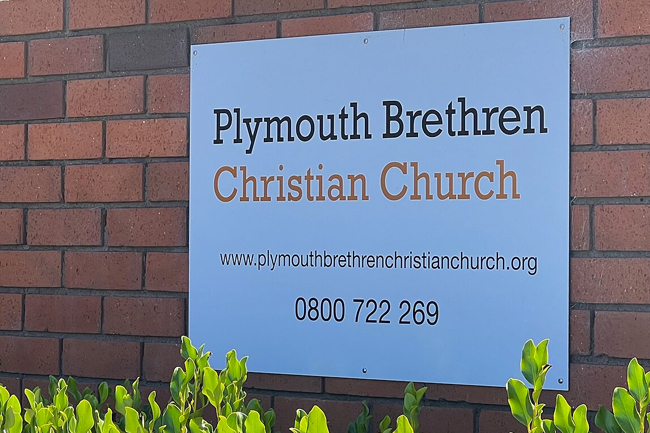
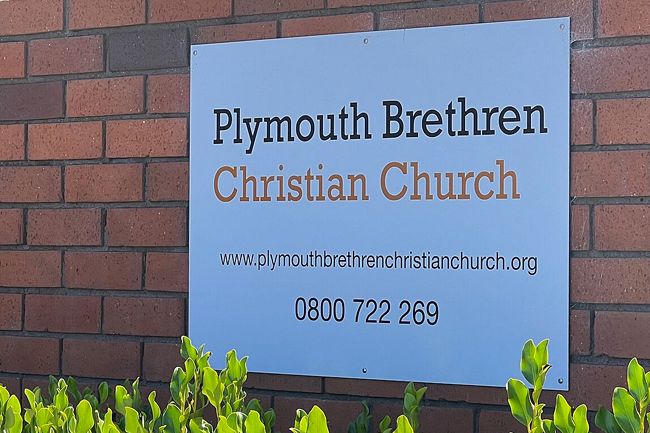
The Plymouth Brethren Christian Church (PBCC), often referred to as the “Exclusive Brethren”, is an evangelical Christian group with 55,000 members worldwide. There are around 15,000 members in Australia. It radically subscribes to the Protestant doctrine sola scriptura (the Bible as the supreme authority), and emphasises the principle of separation from wider society within the scripture as a means to spiritual purity.
Members do not typically vote on religious grounds and avoid other modern, unscriptural influences.
In 1878, Church Founder John Nelson Darby made it clear:
‘We do not mix in politics; we are not of the world: we do not vote.’
The PBCC has a reputation for high control and conservative social values.
Australian Federal Election 2025
It was, therefore, a great surprise to read that an unprecedented number of Brethren members acted as volunteers for the Liberal-National Coalition during the 2025 Australian Federal Election. Despite allegations, Australia is not heaven.
According to allegations, former Opposition Leader Peter Dutton and the Coalition had coordinated support for their campaign with the minor Church, who have historically promoted abstinence from the political process. An intriguing paradox.
There is a lot of source material on the misconduct of supposed Brethren volunteers who flooded marginal seats before the election. Andrew Gee, Independent MP for Calare, claimed that Brethren members were using intimidation tactics by following him between polling stations.

Similarly, Labor sources allege that Brethren members helped to crowd out Labor volunteers at polling booths, and even told approaching voters that “Labor wants to kill babies”. The Sydney Morning Herald cited an equally shocking story where a young mother was intimidated for not taking a how-to-vote card and was repeatedly hit with Liberal-National Party pamphlets by suspected Brethren.
At the time, ABC reported that members were sent messages outlining how to respond if confronted at polling booths. They allegedly came from within church groups. The messages advised against discussing the church and recommended that male members answer questions while female Brethren distributed how-to-vote cards. If true, these accusations would expose organised encouragement.
Although former members say that political abstinence was treated as a “firmly held doctrine”, they also detail a rigid church hierarchy and a culture of conformity. These structural conditions make dissent unlikely for fear of ostracisation. As in many closed communities with concentrated power, repercussions for refusing instructions may not be statutory, but they are certainly social.
Gee and Labor both raised questions about coordinated support. Prime Minister Anthony Albanese, who had flagged covert support between the Brethren and Malcolm Turnbull’s Liberal Party in 2007, suggested that there was a “quid pro quo” between the PBCC and the Liberal Party. Both times, he bluntly labelled the Church a “cult”. Though the PBCC describes itself as a ‘global Christian fellowship’, many ex-members also use the term “cult”.
Developments
As it stands, the PBCC denies all allegations relating to any coordinated campaign during the Election. They claim that volunteers were acting of their own volition.
It appears unlikely, however, that there was no connection at all between the PBCC and the Liberal Party’s Federal Secretariat. For one, Gareth Hales, the multi-millionaire son of Brethren leader Bruce Hales, was photographed at the Eastwood pre-poll sporting a Liberal campaign shirt two days before the Election.
More drastically, anonymous Liberal Party sources confirm that they shared sensitive voter information with the Plymouth Brethren in a phone campaign where members made nearly a million calls on behalf of Dutton’s Coalition. It is unclear what level of voter data was available to Brethren volunteers, though the Liberal Party’s communications software, Feedback, uses information from the electoral roll to create profiles of voters. Professor Mimi Zou from the University of NSW said this was legal, but a concern about data protection laws.
Peter Dutton and the Liberals have remained quiet as to why so many Brethren members randomly became involved in the 2025 election campaign. A review of the party’s catastrophic election defeat in 2025, conducted by Pru Goward and Nick Minchin, mentions the “divided opinions” about the role of the Brethren. The review was first hidden, but later tabled by Albanese. It admits that further investigation is required.
The Joint Standing Committee on Electoral Matters is currently investigating alleged interference by the PBCC under the Inquiry into the 2025 Federal Election. A comprehensive report is expected in late 2026.
There are serious legal and financial implications for failing to register as a significant third party if the Church exceeded regulations regarding electoral expenditure. Last year, five individual members of the PBCC donated $655,000 to Advance Australia, a MAGA-style digital lobby group parallel to the Liberal Party. Overt support for a political party or candidate, via donations and or clear partisan behaviour, could also challenge the Church’s charity status. The Church insists that it is apolitical.
Though the Inquiry will provide more clarity on current allegations, there will also be unresolved questions about the integrity of Australia’s secular democracy. As shown with private data outsourcing to the PBCC, the law does not always correspond with justice. The separation of church and state is a somewhat sacred institution, designed to prevent mutual interference between both powerful entities. Many facets of the 2025 Australian Federal Election suggest that the “wall of separation” may be too low.
History
This article is less interested in individual followers of the PBCC than in the wider story of coziness and corruption shared by conservative politicians and religious elites. Because the material exposing covert support is distinctly private, it is easy to sound conspiratorial. If unsubstantiated, accusations can unfairly damage the PBCC and its followers with no cause. They can equally devalue legitimate criticisms that speak truth to power.
That said, the ongoing case of the 2025 Australian Federal Election does not exist in a vacuum. Despite their reputation for political abstention, the PBCC have been guilty of throwing stones and hiding their hands in the past.
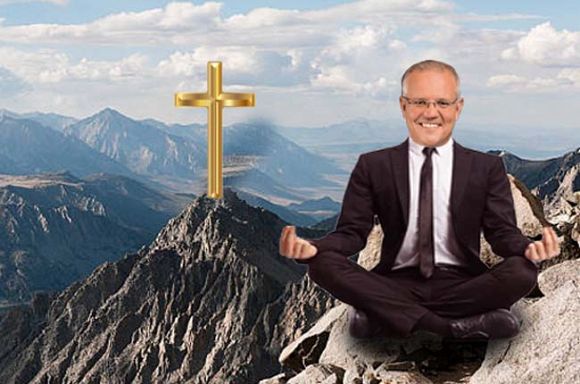
In his forensic work Behind the Exclusive Brethren (2008), Australian journalist Michael Bachelard chronicles the “John Howard Affair”. One month before the 2004 Australian Federal Election, Bruce Hales, the Church’s current Elect Vessel (leader), broke almost 175 years of tradition. For the first time in PBCC history, the top authority officially endorsed the Liberal Party election campaign to its members.
Brethren followers followed. A sophisticated support apparatus sprang into action. Thousands of dollars were raised, leaflets were designed and distributed, a phone campaign rallied voters from home, while young men canvassed in unprecedented numbers on the ground. All in favour of party leader John Howard.
There were shared interests between the business-minded Christians in Howard and Hales. Both believed in conservative family values, had a disdain for the Greens and sought a smaller state for their own reasons.
The relationship was strategic and direct. Howard received large financial and in-kind capital from the PBCC. In return, the Brethren had the ear of the PM and lobbied for tax breaks and school funding; Howard also enjoyed their counsel on wider policy areas like Medicare and infrastructure projects. Howard lost the 2007 election and his own seat in Bennelong, as did Dutton in 2025.
A government Inquiry 2005-2006, expressing very similar concerns to the current one, along with Bachelard’s investigations, caused the Church to tone down its image and rebrand from the Exclusive Brethren to the PBCC. It did not, however, remove itself from politics entirely before 2025.
Bruce Hales’ PBCC has since attempted to secretly channel donations to the Liberal Party in 2016. Four Corners also revealed that Brethren donors gained $135 million worth in Covid-19 contracts from the Morrison Government. The Former Health Minister at the time, Greg Hunt, now works for a Brethren-owned firm.
Beyond Australia, the PBCC has also been accused of covert political intervention in New Zealand, the USA, the UK, Canada and even Sweden.
Such a history makes one question clear. Have the citizens of heaven fallen back to Earth again?
Joe Eden-Bull is a third-year History and Politics student from the University of Glasgow, currently on study exchange at the University of Melbourne.
 This work is licensed under a Creative Commons Attribution-NonCommercial-NoDerivs 3.0 Australia License
Support independent journalism Subscribe to IA.